






Imagine running a marathon, and after every 2 km, you’re made to stop, change your shoes, and pay fresh registration fees.
Business owners in India used to experience a similar taxing nightmare before 2017.
They had to deal with excise duty, service tax, value added tax (VAT), octroi and luxury tax.
Thankfully, the Government of India has made things easier by implementing the Goods and Services Tax (GST).
This historic move has transformed a complicated, broken system into One Tax. The main idea behind this movement was ‘One Nation, One Tax’.
In this blog, we will be learning about types of gst in india in a detailed and easy way! Read on…
| Quick Summary: There’s no need to make your business taxes complicated. Here’s what you need to know about the current taxation system in India: • India has 3 types of GST: CGST and SGST for local sales, and IGST for sales outside the state. • You will need a unique 15-digit GSTIN number for all your bills. • All invoices must clearly show the updated rates as set by the council. • To protect your Input Tax Credit, use checklists and monthly reconciliations. |
The Concept Of A Dual GST Model
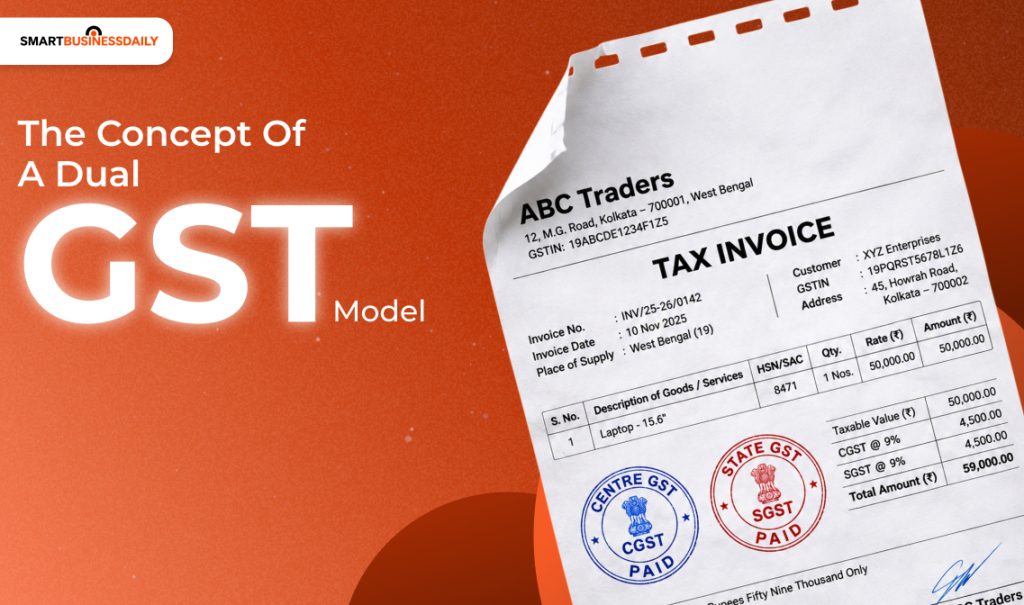
Understanding how GST works requires an understanding of how power is distributed between the Indian government.
India follows a federal structure, so both the Central Government and individual State Governments can control the economy.
To reflect this, the country adopted a Dual GST Model.
Both levels of government can charge taxes on the sale of goods and services.
Consequently, the transaction’s origin and destination determine the specific tax types you must apply.
Furthermore, the system splits the tax into distinct parts to ensure both local state and national infrastructure projects receive fair funding.
The Myth Of Triple Taxation
When new startups look at their invoice, they may become concerned when they see multiple acronyms such as CGST, SGST, and IGST.
This can make it seem like the government is charging 3 separate taxes on the same product. However, this is a complete misunderstanding.
You will never actually pay all 3 taxes on one transaction. The system is designed to work as an ‘either-or’ system.
Moreover, you will pay either both CGST and SGST or IGST. Regardless of the acronym, you will always pay the same tax rate, and your business will never be unfairly taxed.
Types Of GST In India: Breaking Down CGST, SGST, And IGST
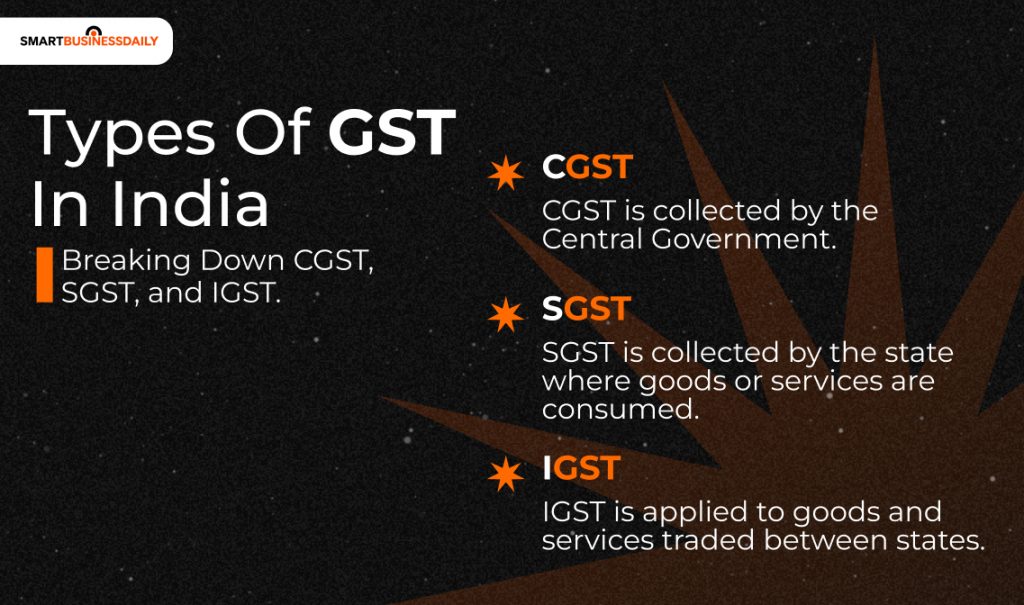
To manage your accounting efficiently, you must master the three primary types of GST in India.
Each type serves a distinct purpose, routes money to a specific government pocket, and applies to distinct business scenarios.
GST Transaction Mapping Rule
| Transaction Type | Location of Supplier & Buyer | Applicable Taxes | Revenue Distribution |
| Intra-State Transaction | Within the exact same state or union territory | CGST + SGST (or UTGST) | Split evenly between the Central Government and that State Government. |
| Inter-State Transaction | Across two completely different states or union territories | IGST | The Central Government collects it, then routes the consumer state’s share. |
| Import / Export | International trade outside Indian borders | IGST | Treated entirely as an inter-state movement under central jurisdiction. |
1) CGST – (Central Goods & Services Tax)
The Central Goods and Services Tax is commonly referred to as CGST. The Central Government collects it.
For local sales, the government collects this tax from your revenue and sends it directly to the Union treasury in New Delhi.
When is CGST used?
This applies only to intra-state transactions. This means that both the supplier of goods/services and the buyer of goods/services are both based in the same state or Union Territory.
Example:
If you run a small clothing production company registered in Mumbai (Maharashtra) and a shop owner in Pune (Maharashtra) orders bespoke cotton shirts from your company.
As the business and the customer are both based in Maharashtra, this is an intra-state transaction. This means you would charge your customer CGST.
2) SGST/UTGST (State Goods & Services Tax)
The State Goods and Services Tax is the counterpart to CGST. This tax goes directly to the Government of the state where the goods/services are consumed.
If the transaction is in a Union Territory that doesn’t have a local government (such as the Andaman and Nicobar Islands and Lakshadweep), it is referred to as UTGST (Union Territory Goods & Services Tax).
You cannot separate CGST and SGST!
An important thing to remember about taxes in India is that CGST and SGST are inseparable.
Moreover, they always go hand in hand and are always shared equally between the two.
If the product has a total GST rate of 18%, you would never charge the full 18%. Instead, you would divide it into 9% CGST and 9% STGST.
Example:
Continuing with our clothing example from Mumbai. Let’s say the total tax rate on the bespoke cotton shirts was 12%.
You would split it equally. 6% of the total would be CGST (going to the Central Government) and 6% would be SGST (going to the Maharashtra State Government).
3) IGST (Integrated Goods & Services Tax)
The Integrated Goods and Services Tax is a single tax that is applied to goods/services crossing state lines.
The Central Government collects it. However, they do not keep the whole amount.
Moreover, the Center acts as a middleman, takes its cut of the tax, and sends the rest to the consumer’s state.
When is IGST used?
IGST should be applied if you are completing an inter-state transaction. This applies when you supply goods/services from one state/Union Territory and deliver them to another.
Import and Export transactions are also classed as inter-state by the Government so you would apply IGST to any international trade.
Example:
Let’s say you receive a bulk order from a corporate client in Bengaluru (Karnataka).
Then, as the goods are moving from one state to another (Maharashtra to Karnataka), this becomes an interstate transaction.
So, you will no longer charge CGST and SGST. Instead, you will charge 12% full-rate IGST.
Deciphering Your Tax Identity: The GSTIN Number
Before you can legally collect these taxes from customers, your business must register on the official portal to receive its unique tax identity.
This identity takes the form of a fifteen-digit alphanumeric identifier known as the GSTIN (Goods and Services Tax Identification Number).
15-Digit GSTIN Component Structure
| Character Position | Identifier Component | Functional Purpose |
| Digits 1 & 2 | State Code | Identifies the specific state where your business is officially registered (e.g., 27 for Maharashtra, 29 for Karnataka). |
| Digits 3 to 12 | PAN Card Number | Links the indirect sales tax registration directly to the business entity’s permanent income tax account. |
| Digit 13 | Entity Code | Represents the total number of business registrations that your specific legal entity holds within that particular state. |
| Digit 14 | Default Alphabet | Reserved for future scalability by the tax department (currently drops the default alphabet “Z”). |
| Digit 15 | Check Digit | An automated validation code used by the system software to check for manual typing mistakes. |
Breaking Down The 15-Digit Code
The government does not generate your GSTIN as a random set of numbers and letters; it acts as a detailed barcode for your business.
This contains detailed information about your business. Below is a breakdown of the 15-digit code:
- First two digits:
This refers to your State Code. Companies registered in Maharashtra always have registration numbers starting with 27.
Similarly, companies registered in Karnataka always have numbers starting with 29.
- Next 10 Characters:
This is the 10-digit PAN card of your business. For sole proprietorships, it shows your PAN. Moreover, this shows a clear link between your direct and indirect taxes.
- Thirteenth digit:
This is the code for your entity. This will be a number or letter which shows how many times your entity has been registered in that state. If this is your first registration, it will show 1.
- Fourteenth character:
The government leaves this blank to allow for future expansion. At the moment, they just leave a default letter of Z in this position for almost all businesses.
- Fifteenth digit:
This is an alphanumeric validation code. The tax department’s software uses this to ensure there are no typos in the code.
The Current Landscape: Understanding The New GST Rates
The Indian tax system does not apply a uniform rate to every single item in the market.
Thus, to ensure social fairness, necessities carry zero tax, while luxury items carry high rates.
As a small business owner, you must regularly monitor new GST rates announced during periodic GST Council meetings to keep your billing software accurate.
Total GST Slabs & Component Breakdown
| Total Tax Slab | CGST Split (Local Sales) | SGST Split (Local Sales) | IGST Share (Inter-State) | Representative Examples |
| 0% (Exempt) | 0% | 0% | 0% | Fresh milk, raw vegetables, unbranded grains, books, and sanitary napkins. |
| 5% (Mass Consumption) | 2.5% | 2.5% | 5% | Packaged food items, domestic tea, coffee, life-saving medicines, and economy air travel. |
| 12% (Standard Rate 1) | 6% | 6% | 12% | Business apparel, processed foods, computers, smartphones, and business-class air tickets. |
| 18% (Standard Rate 2) | 9% | 9% | 18% | IT services, professional consulting, restaurants, steel, marble, and electronic goods. |
| 28% (Luxury & Demerit) | 14% | 14% | 28% | Automobiles, high-end motorcycles, soft drinks, betting, and luxury hotel stays. |
Compensation Cess
For specific luxury goods or socially harmful items (such as tobacco or aerated beverages), the government levies an additional fee on top of the 28% slab.
This additional fee is known as the Compensation Cess. The central government uses this pool of funds to compensate states for revenue losses when transitioning from the old tax system to the modern GST framework.
Input Tax Credit (ITC): The Ultimate Cash Flow Saver
If you remember only one concept from this GST guide, make it the mechanism of Input Tax Credit (ITC).
Think of ITC as a legitimate tax discount voucher that prevents double taxation on businesses.
When you manufacture or sell a product, you pay tax on the raw materials you buy from your suppliers. Later, when you sell the final product, you collect tax from your customers.
Input Tax Credit lets you subtract the tax you already paid to suppliers from the tax you owe the government on sales. As a result, you pay tax only on the value you added to the product.
Input Tax Credit (ITC) Cross-Utilisation Sequence
| Available Credit Type | First Priority | Second Priority | Final Priority | Strict Restriction |
| IGST Credit | Clear IGST Liability | Clear CGST Liability | Clear SGST Liability | No restrictions; can clear all liabilities. |
| CGST Credit | Clear CGST Liability | Clear IGST Liability | Not Allowed | NEVER use to pay off an SGST liability. |
| SGST Credit | Clear SGST Liability | Clear IGST Liability | Not Allowed | NEVER use to pay off a CGST liability. |
1. Utilizing IGST Credit
- You must use your accumulated IGST credit to clear your IGST liability first.
- If you still have IGST credit left over, you can use it to pay off your CGST liability.
- If a balance still remains, you can apply it to clear your SGST liability.
2. Utilizing CGST Credit
- You must use your CGST credit to pay off your CGST liability first.
- If you have excess CGST credit, you can use it to pay your IGST liability.
CRITICAL WARNING: You can NEVER use CGST credit to pay off an SGST liability. They are structural opposites and cannot interact.
3. Utilizing SGST Credit
- You must use your SGST credit to pay off your SGST liability first.
- If you have excess SGST credit, you can use it to pay your IGST liability.
CRITICAL WARNING: You can NEVER use SGST credit to pay off a CGST liability.
Actionable Compliance Checklist For Small Businesses
Maintaining perfect tax compliance doesn’t have to be expensive; these easy steps can be added to your weekly routine. Follow the steps below to avoid penalties.
First, you need to check your vendor’s GSTIN. Before entering into any contracts with new raw material vendors, we recommend you always check whether their GSTIN is valid on the public GST search page. If a vendor is blocked or has an invalid GSTIN, your business will lose all input tax credits.
Secondly, you have to check the place of Supply. Ensure your billing team is trained to check the customer’s delivery address.
If they are in the same state as you, then charge them using the split CGST and SGST rates. If they are in a different state, then ensure you charge them using the IGST rate.
Then comes monthly Reconciliation. At the end of each calendar month, ensure you match up your own purchase register with the auto-populated GSTR-2 B on the portal.
This also ensures that the suppliers you paid have paid the taxes they collected.
Also, use invoicing software. Don’t create invoices manually in a simple word processor. Invest in reliable accounting software to ensure that your invoices calculate the correct type of GST in India.
Finally, file Zero Returns on Time. Even if your startup has no sales or activity in a given month, you still need to log in and file a Zero Return. If you fail to do so, you will incur a daily late-filing penalty.
Common Mistakes That Trigger Penalties
While mistakes may be unintentional, they can cause your business to get into some major trouble with the tax department. Learning how to avoid these will save you a lot of stress.
Incorrect Tax Component Charged
One of the most common mistakes is not charging IGST where it should be.
Your business may accidentally ship goods out of state from your warehouse. However, you may have recorded it as an intra-state sale.
Furthermore, this will cause the tax department to invalidate your filing. As you may think, you cannot just ask the government to send the money to the correct account. You’ll have to pay the correct amount of IGST from your company’s cash flow.
Once you’ve paid, you can then claim a refund on the incorrect CGST/SGST. However, this will tie up your working capital for months.
Late Inward Supplies
If your suppliers don’t submit their monthly supplies on time, you will not be able to claim your credits. Their late submissions will not show up in your portal.
Therefore, you will not be able to claim the particular Input Tax Credit. You’ll have to pay the full amount out of pocket and wait for them to correct their mistakes.