






Imagine having to stop at every km, change your shoes, and pay a toll fee to a different gatekeeper whilst running a marathon.
Before 2017, Indian small business owners faced a similar situation. This was because multiple taxes were added on top of each other, increasing overall prices and creating endless, complex paperwork for entrepreneurs.
However, the implementation of the Goods and Services Tax has completely changed this.
This tax reform simplifies the previously complex indirect tax system into one unified system across the nation.
Understanding how it works will help you protect your profit margins and grow Your Business, with less risk of non-compliance.
What Is GST And Why Does It Matter For Your Business?
GST stands for Goods and Services Tax. This tax is a comprehensive, multi-stage, destination-based tax on all value additions throughout the supply chain.
Simply put, GST is a single indirect tax on the manufacture, sale, and consumption of goods and services.
Unlike previously, where taxes would be paid at the point of origin, GST is now paid at the point of final consumption.
Moreover, this removes the cascading effect of taxes, which means you don’t pay tax on top of tax.
Moreover, the final consumer pays the tax, with businesses in between acting as tax collectors.
The Old Nightmare vs. The Modern Solution
To truly appreciate the value of this modern tax structure, we must examine the chaotic landscape that existed before its implementation.
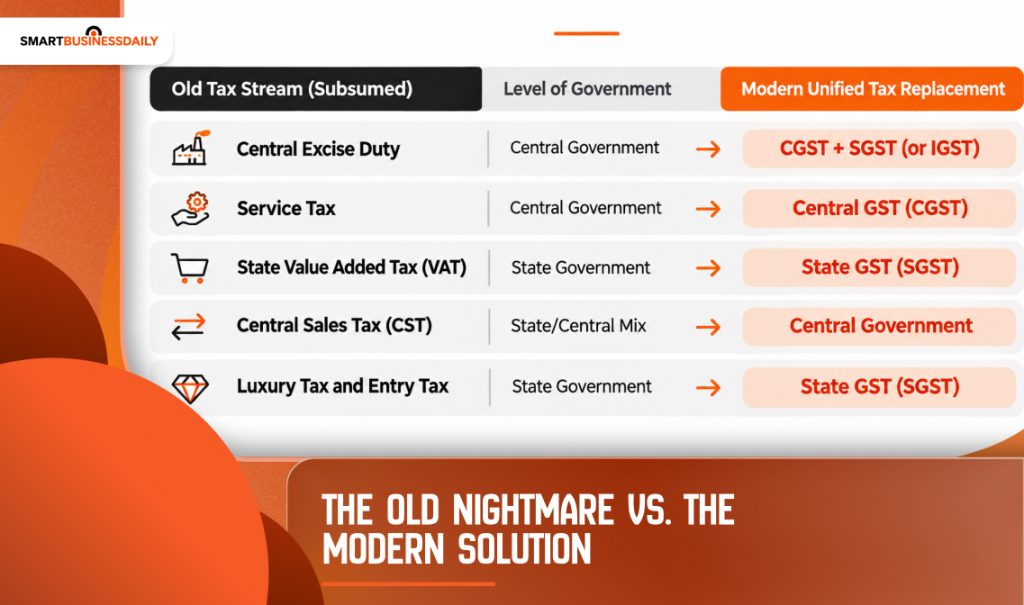
In the past, the central government levied taxes like Central Excise Duty and Service Tax, while state governments simultaneously collected taxes like Value Added Tax and Luxury Tax.
Consequently, goods moving across state borders faced immediate double taxation, making logistics slow, expensive, and incredibly inefficient.
The table below shows how the modern unified framework consolidated those individual, confusing tax streams into one streamlined channel.
| Old Tax Stream (Subsumed) | Level of Government | Modern Unified Tax Replacement |
| Central Excise Duty | Central Government | CGST + SGST (or IGST) |
| Service Tax | Central Government | Central GST (CGST) |
| State Value Added Tax (VAT) | State Government | State GST (SGST) |
| Central Sales Tax (CST) | State/Central Mix | Central Government |
| Luxury Tax and Entry Tax | State Government | State GST (SGST) |
Anatomy Of The System: Core Pillars Every Founder Must Know
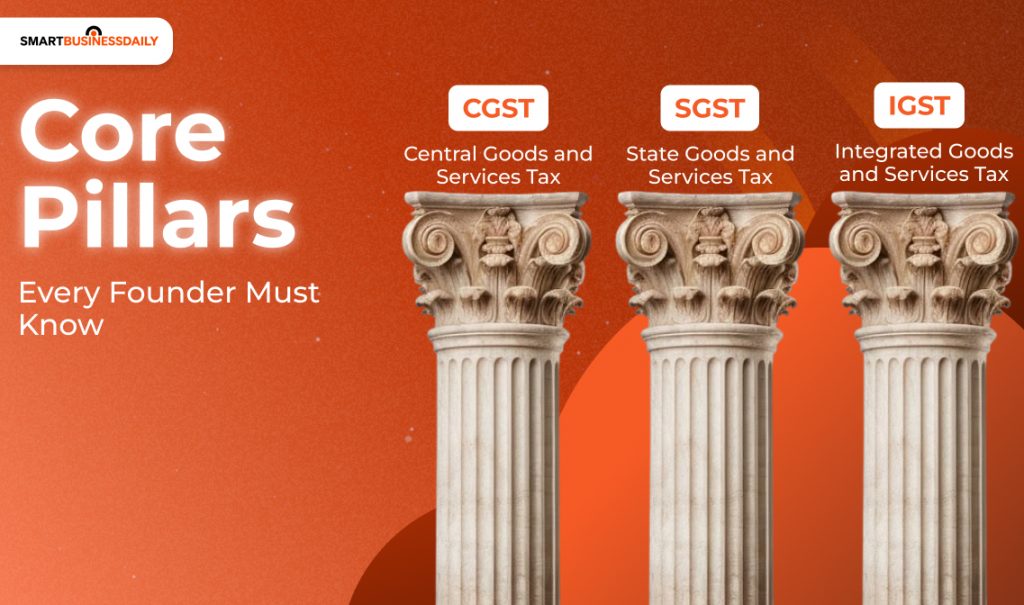
Navigating India’s tax structure is straightforward when you understand its core pillars. This knowledge helps you optimize cash flow and make smart purchasing decisions.
Decoding The Three Types Of GST In India
Because India features a federal structure, tax collection is shared. As a result, transactions require specific tax labels based on location.
- Central Goods And Services Tax (CGST)
Firstly, the central government collects CGST on interstate (within the same state) sales. For local transactions, you split the tax rate evenly between CGST and SGST.
- State Goods And Services Tax (SGST)
Secondly, the state government collects SGST on local intrastate transactions. Union Territories levy an identical equivalent called UTGST.
- Integrated Goods And Services Tax (IGST)
Thirdly, the Center levies IGST on interstate (between different states) transactions. You apply one single, full IGST rate to the invoice.
The Magic Of Input Tax Credit (ITC)
Input Tax Credit (ITC) serves as a digital tax offset, completely eliminating double taxation across your supply chain.
| Transaction Stage | Transaction Details | Tax Amount | Financial Impact |
| 1. Purchase | Buy raw materials locally | ₹100 | You pay tax; this creates your ITC pool. |
| 2. Sale | Sell final product to consumer | ₹150 | You collect this tax from the buyer. |
| 3. Settlement | Calculate net monthly liability | ₹50 | You subtract credit from tax collected. |
Also Check: The Ultimate Small Business Guide to CGST, SGST, And IGST: Understanding The Types Of GST In India
The Digital Identity: Understanding Your GSTIN Number
Just as you have a Permanent Account Number to identify individuals for income tax purposes, you will have a unique number to identify your business in the national indirect tax system.
Moreover, this number lets you claim input tax credit and issue valid tax invoices. You also need an e-way bill for goods worth more than ₹ 50,000 when you move them.
What Is A GSTIN Number?
GST stands for Goods and Services Tax. It is a comprehensive, multi-stage, destination-based tax on the value added at every stage of the supply chain.
Simply put, GST is one indirect tax on the supply of most goods and services. Petrol, diesel, natural gas, aviation fuel, and alcohol for drinking are still outside GST.
| Character Position | Specific Component | Functional Purpose | Architectural Example |
| Digits 1 & 2 | State Code | Identifies the registration state | 27 (Represents Maharashtra) |
| Digits 3 to 12 | PAN Block | Connects the tax file to the entity | AAAAA1111A (Owner/Company PAN) |
| Digit 13 | Entity Count | Tracks registration volume per state | 1 (First registration in that state) |
| Digit 14 | System Placeholder | Reserved for future data expansion | Z (Default administrative character) |
| Digit 15 | Check Code | Validates structural entry errors | 5 (Random checksum digit) |
Knowing how to read this formula allows you to quickly verify the legitimacy of new suppliers before signing vendor agreements.
Furthermore, if the state code doesn’t match the shipping warehouse location, or if the embedded PAN looks structurally invalid, you can pause transactions before running into compliance issues.
The Pricing Matrix: Navigating New GST Rates
The government does not use one rate for everything. Everyday items are taxed lightly, while luxury and harmful items are taxed more.
The Four Main Tax Slabs
Since 22 September 2025 (GST 2.0), the 12% and 28% slabs have been removed. The main rates are now 5% and 18%, plus a special 40% rate and a 0% rate for essentials.
- 0% (Nil): This includes resh milk, unbranded grains, fresh vegetables, notebooks, and some life-saving medicines.
- 5% (Essentials): This applies to tea, edible oils, butter, ghee, packaged namkeen, soap, and basic restaurant meals.
- 18% (Standard): This includes most goods and services. This includes software development, marketing consultancy, smartphones, steel products, air conditioners, and small cars.
- 40% (Luxury and harmful items): This applies to tobacco, pan masala, fizzy drinks, luxury cars, and yachts.
Staying Updated With Recent Adjustments
The council will meet regularly throughout the year to update certain categories.
Because GST rates change frequently, check the official online tax site before introducing a new product line.
Small changes to food packaging and rules around corporate services can instantly move you into a different tax rate.
Moreover, if you don’t keep up to date with the changes, you may accidentally undercharge and leave yourself liable for the deficit.
Step-by-Step Blueprint: Getting Registered And Staying Compliant
Don’t let compliance be stressful. By breaking your tax processes into a step-by-step guide, you can keep your records clean and focus on increasing sales.
Step 1: Determine Your Registration Thresholds
You won’t automatically need to register for this tax. The government have set high thresholds to help micro-enterprises.
- Goods Suppliers
If you mainly sell goods, then you will need to register once you reach a total turnover of ₹40 Lakh in one financial year.
In states under the special category, such as Arunachal Pradesh, Uttarakhand, Manipur, Telangana, Nagaland, Puducherry, Mizoram, Tripura, Sikkim, and Meghalaya, the limit is ₹20 lakh.
Whereas Assam, Himachal Pradesh, and Jammu & Kashmir follow the ₹40 lakh limit.
- Service Providers
If you provide a service (Graphic Design Studio, Consultant, or Salon), then the general threshold is ₹20 Lakh. If you provide a service in the North-Eastern states, then the threshold drops to ₹10 Lakh.
- Interstate E-commerce
If you sell goods between states, you must register even if your turnover is below the limit.
Most e-commerce sellers (Amazon/Flipkart) must also register from the first sale, though small sellers of goods inside their own state get some relief.
Also, interstate services below the limit don’t require registration. You can also register voluntarily below the limit to claim ITC and build trust with big clients.
Step 2: Gather Your Core Business Documentation
Before registering online, gather together all your personal and business documents. This will help to avoid your session expiring.
- ID Proof: You need to have clear scans of your PAN card, Aadhaar card, and passport-size photos.
- Business Constitution: Partnership Deed (if registered) or Incorporation Certificate (Private Limited Company).
- Main Place of Business Proof: You need to have recent Electricity Bill, Property Tax Receipt, or Rent Agreement with a signed NOC from the property owner.
- Banking Details: Canceled Cheque or Recent Bank Statement.
Step 3: Apply On The GST Portal
Apply at gst.gov.in. Registration is free, so do not pay agents for the government fee. You first get an ARN (application number), and after approval, you get your GSTIN.
Step 4: Master The Filing Schedule
After that, you need to understand how the filing works. Filing is a regular process where you declare how much you sold, purchased, and how much tax you collected. To stay compliant, you will need to file 3 forms:
GSTR-1 (Sales Return)
First, you declare all details of your outgoing supplies and invoices. This must be filed by the 11 th of the following month.
GSTR-2B (Auto Purchase View)
Second, this is an auto-generated, read-only tax document. This will show how much ITC you can claim for the month based on your supplier’s filings.
GSTR-3B (Monthly Summary & Payment)
Third, this is a self-declaration where you will calculate your final tax liability. After applying your valid ITC, you will pay the remaining amount.
Moreover, entrepreneurs and business owners must file this by the 20 th of the following month.
Navigating Common Pitfalls And Strategic Solutions
Even the most well-meaning entrepreneurs can make mistakes when handling their monthly taxes. Knowing where others commonly go wrong will help you put strong processes in place.
Composition Scheme
To help small shops with less paperwork, the government offers a simplified option called the Composition Scheme.
It is available to goods suppliers with turnover up to ₹1.5 crore (₹75 lakh in special category states) and to service providers up to ₹50 lakh.
You pay a small fixed percentage of turnover (1%, 5% or 6% depending on the business type). You pay tax every quarter and file one annual return.
Whilst this seems simple, it can cause two major drawbacks for ambitious startups.
First, you can’t charge any tax to your customers. Secondly, you are unable to claim any ITC on Your Business purchases.
This can cost you large corporate clients who rely heavily on ITC to offset costs.
Supplier No Credit
A common issue for small business owners is not being able to claim ITC because your supplier doesn’t file on time.
If your vendor hasn’t uploaded their sales invoices, then you will not receive any credit for that particular item.
To avoid this issue, implement a strict vendor policy. Check your matching documents every month and halt payments to any unreliable vendors who consistently don’t file on time.
Action Plan: Transforming Compliance Into A Competitive Advantage
Rather than seeing tax as a pain, smart startup founders will use it to build credibility in the market.
Full compliance helps you earn the trust of enterprise clients, secure bank loans, and avoid unexpected financial charges.
To help make your processes easier, the table below shows you what to do at the end of each month.
| Timeline Focus | Target Action Step | Core Objective | Key Benefit |
| Days 1 to 10 | Reconcile Inward Credits | Open your GSTR-2B form and cross-check it against your physical purchase receipts. | Ensures all vendor tax credits match up perfectly before final filing. |
| Day 11 | File GSTR-1 Form | Upload all sales invoices issued to clients during the previous month. | Transfers tax credits cleanly to your B2B customers. |
| Days 12 to 19 | Balance Cash Reserves | Set aside the collected net tax amount into a separate business bank account. | Prevents sudden cash flow crunches right before the government payout. |
| Day 20 | Submit GSTR-3B Form | Declare your monthly summary, apply your approved credits, and clear the net balance. | Maintains a flawless compliance record and helps you avoid late fees and interest. |
To put what you have learned into action, build this reliable month-end financial routine alongside cloud-based accounting tools.
In addition, enforce immediate invoicing discipline by recording every transaction with the correct state code and tax slab the moment the sale occurs.
By staying proactive, keeping clean digital records, and understanding the core mechanics of this unified tax system, you protect your business capital and position your company for long-term operational success.