








Office Lease Ending? Here’s How To Turn A Lease Expiration Into A Business Opportunity
6 Mins Read
Published on: 15 April 2025
Last Updated on: 15 June 2026

- Why An Office Lease Ending Is More Than A Real Estate Event?
- 1. Paying For Unused Space:
- 2. Missing Better Market Opportunities:
- 3. Employee Experience Challenges:
- Key Questions To Ask Before Your Office Lease Ends:
- 1. How Much Space Do We Actually Use?
- 2. What Will Our Workforce Look Like in Three Years?
- 3. Is The Current Location Helping Or Hurting The Business?
- 4. Have Occupancy Costs Increased Beyond Expectations?
- When Exactly Does Your Lease End (And What's In The Fine Print)?
- Review The Lease Agreement:
- Timeline Planning:
- Should You Stay Or Should You Go?
- Factors To Consider:
- Cost vs. Value:
- Negotiating A Lease Renewal:
- Smart Renewal Strategies:
- Legal & Compliance Considerations:
- Data, Security, And Confidentiality:
- Communication Plan: Tell Your People
- The Best Time To Plan Is Earlier Than Most Businesses Think:
Your office lease ends in 6 months. Plenty of time, right? Think again. What seems like a simple calendar date is actually a critical strategic decision point for your business.
This isn’t just about signing paperwork – it’s about positioning your company for the next phase of growth while avoiding costly mistakes.
Most businesses treat an office lease ending as an administrative task. They review the paperwork, contact the landlord, decide whether to renew, and move on.
That approach can be expensive.
An expiring lease is one of the few moments when a company can reassess its workplace strategy, operating costs, growth plans, and employee needs all at once.
Moreover, decisions made during this period can affect everything from employee retention to long-term financial commitments.
Instead of viewing a lease expiration as a deadline, businesses should view it as a decision point.
This guide will walk you through everything you need to consider: whether to renew or relocate, hidden costs, logistical challenges, and legal obligations that demand your attention now – not later.
Why An Office Lease Ending Is More Than A Real Estate Event?
When companies first sign a lease, they make assumptions about future growth, hiring plans, workplace culture, and operational requirements.
Several years later, those assumptions may no longer be accurate. The organization may have:
- Expanded significantly
- Reduced headcount
- Adopted hybrid work
- Entered new markets
- Changed operational priorities
Also, an expiring lease creates an opportunity to determine whether the current office still supports the business’s goals.
The question is no longer, “Should we renew?” Instead, the better question is, “Does this workspace still make sense?”
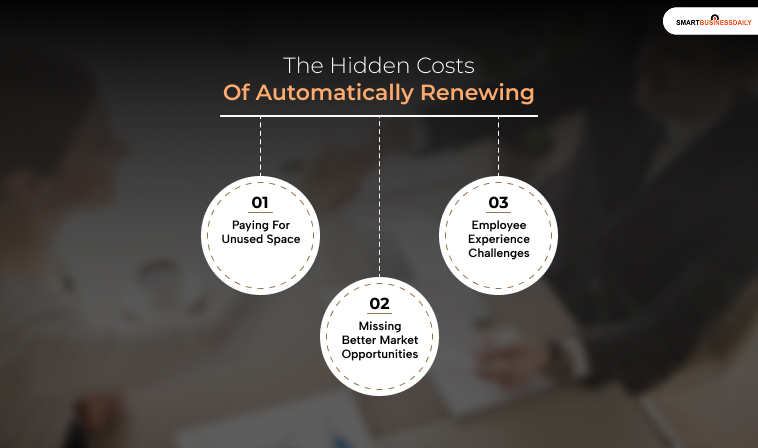
The Hidden Costs Of Automatically Renewing:
Many businesses renew simply because moving seems disruptive. However, staying in the same office can create long-term inefficiencies that are easy to overlook.
This includes:
1. Paying For Unused Space:
A company that adopted hybrid work may only use a fraction of its office capacity.
Yet it continues paying rent, utilities, maintenance fees, and operating expenses for the entire footprint.
2. Missing Better Market Opportunities:
Commercial real estate markets change constantly.
New buildings, flexible workspace options, and changing vacancy rates may create opportunities that were unavailable when the original lease was signed.
3. Employee Experience Challenges:
Workplace expectations have evolved significantly.
Moreover, employees increasingly value accessibility, modern amenities, collaboration areas, and flexible work environments.
Also, an outdated office can affect recruitment and retention efforts.
Key Questions To Ask Before Your Office Lease Ends:
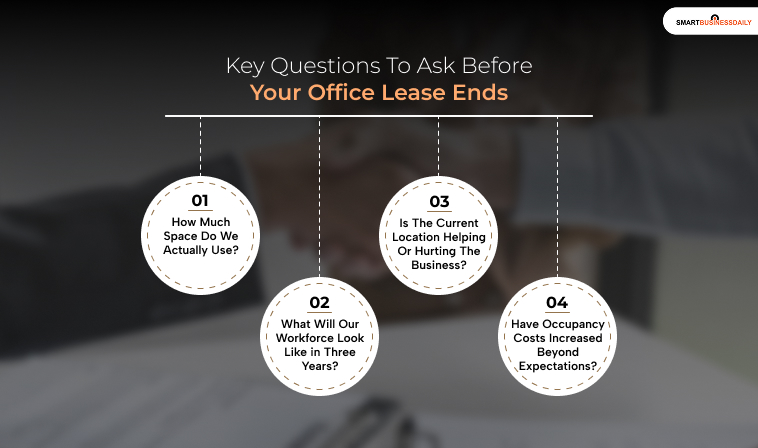
Before making any decision, leadership teams should conduct a structured review.
1. How Much Space Do We Actually Use?
Analyze office utilization rather than relying on assumptions.
Track:
- Daily attendance
- Meeting room usage
- Desk occupancy
- Collaboration space demand
Also, many organizations discover they need substantially less space than they currently lease.
2. What Will Our Workforce Look Like in Three Years?
Lease decisions should reflect future plans, not current conditions.
Consider:
- Hiring projections
- Remote work policies
- Department expansion plans
- Geographic growth strategies
Also, a workspace should support future operations rather than simply accommodate today’s needs.
3. Is The Current Location Helping Or Hurting The Business?
Location affects:
- Employee commute times
- Client accessibility
- Talent acquisition
- Brand perception
An office that was ideal five years ago may no longer be strategically advantageous.
4. Have Occupancy Costs Increased Beyond Expectations?
Look beyond monthly rent.
Evaluate:
- Operating expenses
- Maintenance charges
- Parking costs
- Utility expenses
- Technology infrastructure costs
A comprehensive cost analysis often reveals expenses hidden within the overall occupancy budget.
When Exactly Does Your Lease End (And What’s In The Fine Print)?

Review The Lease Agreement:
Dust off that lease agreement and read it carefully. Pay special attention to:
- Notice periods: Many leases require 90-180 days’ written notice of your intentions
- Renewal clauses: Does your lease include automatic renewal terms?
- Penalties: What happens if you miss deadlines or stay beyond the lease term?
- Move-out conditions: Are you responsible for restoring the space to its original condition?
That last point can be particularly expensive. Your lease might require removing all improvements, repainting, or extensive repairs – costs that can quickly reach tens of thousands of dollars.
Timeline Planning:
The biggest mistake businesses make is starting too late. Ideally, begin your lease planning 6-12 months before expiration. This gives you time to:
- Research market conditions
- Tour potential new spaces
- Negotiate favorable terms
- Plan for physical relocation if needed
When companies wait until the last minute to plan and book office relocation movers, they lose leverage in negotiations and often face rushed decisions that lead to higher costs and compromised locations.
Should You Stay Or Should You Go?
In this section, I’ll discuss two important angles:
A) The factors to consider before you can make up your mind.
B) The cost vs value debate.
Factors To Consider:
The most fundamental question is whether your current space still serves your business needs:
- Has your team grown or shrunk since signing the lease?
- Does the location still make sense for your workforce and clients?
- Have neighborhood dynamics changed (parking availability, nearby amenities, safety)?
A space that worked perfectly three years ago might be constraining your growth today – or you might be paying for square footage you no longer need.
Cost vs. Value:
This decision isn’t just about the monthly rent check:
- Compare your current rate against market prices (you might be paying below market already)
- Calculate the true cost of moving (beyond just moving services)
- Consider your negotiating position with the current landlord
Sometimes staying put and negotiating improvements makes more financial sense than relocating, especially when you factor in productivity losses during a move.
Negotiating A Lease Renewal:
Know the market. Remember, knowledge is power. As a result, before approaching your landlord:
- Research comparable spaces and their asking rates
- Understand vacancy rates in your building and neighborhood
- Know what concessions other tenants are receiving
This research positions you to negotiate from strength rather than uncertainty.
Smart Renewal Strategies:
If staying makes sense, consider these negotiation tactics:
- Request tenant improvements like fresh paint, new carpet, or updated fixtures
- Propose longer lease terms in exchange for lower rates or free months
- Add flexibility clauses that allow for expansion, contraction, or early termination
Remember that landlords typically prefer keeping good tenants over finding new ones – use this to your advantage.
Legal & Compliance Considerations:
Don’t underestimate the importance of properly closing out your existing lease:
- Schedule a preliminary walk-through with your landlord months before move-out
- Document pre-existing damage to avoid disputes
- Understand what “broom clean” or other condition requirements mean specifically
- Schedule repairs strategically to minimize disruption
Many security deposits are lost to disagreements that could have been prevented with proper planning.
Data, Security, And Confidentiality:
A move presents both security risks and compliance requirements:
- Ensure proper decommissioning of network equipment and data storage
- Securely dispose of physical documents
- Update business registrations, licenses, and mailing addresses
Data breaches during transitions are surprisingly common and entirely preventable.
Communication Plan: Tell Your People
Whether staying or going, communication timing matters:
- Inform employees with enough notice to plan their commutes and personal arrangements
- Notify clients and vendors professionally, emphasizing continuity of service
- Update your digital footprint (Google Business Profile, website, email signatures)
Poor communication can transform a smooth transition into a chaotic one.
The Best Time To Plan Is Earlier Than Most Businesses Think:
One of the most valuable lessons in commercial leasing is that decisions become more expensive as deadlines approach.
So, the earlier a company evaluates its options, the more negotiating leverage it gains. An office lease ending should not trigger panic. Instead, it should trigger planning.
Moreover, organizations that use lease expiration as an opportunity to reassess their workplace strategy often uncover cost savings, operational improvements, and growth opportunities that would otherwise remain hidden.
In that sense, a lease expiration is not the end of a contract. It is the beginning of a business decision that may shape the company’s next several years.




Related Articles



Comments Are Closed For This Article