







Walmart Vs Target: An Exhaustive 2026 Corporate Strategy And Retail Market Comparison
5 Mins Read
Published on: 30 July 2026
Last Updated on: 31 July 2026
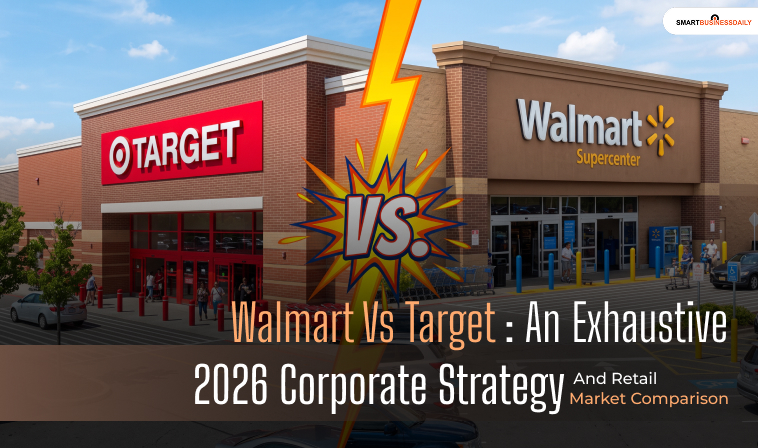
- Walmart vs Target: High-Density Operational Comparison
- Supply Chain Dynamics And Pricing Architecture
- Walmart's Bulk Cost-Leadership
- Target's High-Margin Curation
- Omni-Channel E-Commerce And Fulfillment Infrastructure
- · Walmart+ Digital Strategy
- · Target Circle 360 Engine
- · Fulfillment Speeds
- Walmart vs Target: Financial Metrics And Investment Profile
- Private-Label Brands And Aesthetic Differentiation
- 1. Essential Staples (Walmart's Strength)
- 2. Lifestyle Curations (Target's Strength)
- Final Verdict: Which Retailer Fits Your Business?
The modern retail ecosystem is shaped by the ongoing rivalry between two massive US corporations: Walmart Inc. (WMT) and Target Corporation (TGT).
Now, we have to acknowledge that both brands serve as major everyday shopping centers for millions of households.
However, they use completely different operational frameworks and supply chain strategies.
In fact, they also have quite distinctive consumer targeting models.
For retail analysts, corporate strategists, and everyday consumers, evaluating Walmart vs Target requires looking past basic storefront setups.
This review breaks down their financial scales and e-commerce delivery networks.
Also, we will take a look at their private-label designs.
Moreover, we will evaluate their customer demographics to reveal how each giant manages its market footprint.
Walmart vs Target: High-Density Operational Comparison
To understand how these two retail leaders compete, it helps to examine their baseline corporate metrics, infrastructure distributions, and core marketplace models:
| Performance Metric | Walmart Inc. (WMT) | Target Corporation (TGT) |
| Primary Value Proposition | Everyday Low Prices (EDLP) driven by massive, high-volume supply chains. | “Expect More. Pay Less.” focused on premium curation and stylish design partnerships. |
| Global Store Infrastructure | Over 10,500 retail units and clubs worldwide. | Approximately 2,000 retail storefronts concentrated across the US. |
| Core Customer Demographics | Broad, middle-to-lower income households prioritizing everyday budget savings. | Suburban, middle-to-upper income buyers willing to spend more for style and curation. |
| E-Commerce Ecosystem | Walmart+ membership offering fast grocery delivery and parameter search tools. | Target Circle 360 leveraging the Shipt delivery network for rapid fulfillment. |
| Private-Label Strategy | High-volume essentials focused on lowering cost-per-unit metrics. | Style-led internal brands mimicking high-end fashion and lifestyle aesthetics. |
Supply Chain Dynamics And Pricing Architecture

The pricing differences between Walmart and Target stem directly from how they manage their backend logistics and vendor agreements.
Also, we will get to take a look at their inventory distribution networks.
Walmart’s Bulk Cost-Leadership
Walmart relies on a strict Everyday Low Price (EDLP) framework.
By leveraging its unmatched bulk-purchasing power and highly efficient cross-docking logistics networks, Walmart can reduce its wholesale acquisition costs.
The company passes these savings directly to shoppers.
So, this ensures it consistently maintains the lowest price per unit on:
- National Brands
- Pantry Staples
- Household Paper Goods
Target’s High-Margin Curation
Target skips the low-margin price wars on basic goods, focusing instead on a high-curation model.
While its national brand items are priced competitively with Walmart, Target designs its store layouts to guide shoppers toward its high-margin private-label home goods and trendy lifestyle items.
This strategy increases its average order value and delivers stronger profit margins per transaction.
Omni-Channel E-Commerce And Fulfillment Infrastructure
E-commerce growth relies heavily on fast, flexible delivery options.
Both retailers have turned their physical brick-and-mortar storefronts into local fulfillment centers to speed up online order delivery.
· Walmart+ Digital Strategy
The Walmart+ subscription network focuses on digital grocery delivery.
By connecting its app search tools directly to its massive network of supercenters, Walmart can fulfill millions of local food and household orders in hours.
· Target Circle 360 Engine
Target offers fast home delivery through its Shipt acquisition.
Its loyalty framework focuses heavily on hyper-convenient. Additionally, it can make good usage of the contact-free Drive Up curbside pickup lanes.
Furthermore, these consistently earn top industry marks for user satisfaction.
· Fulfillment Speeds
Walmart wins in long-distance, multi-item shipping thanks to its nationwide distribution hubs.
On the other hand, Target leads in urban regions for efficient same-day curbside pickup.
Also Check: USPS Ground Advantage VS Priority Mail: What to Choose for Your Business?
Walmart vs Target: Financial Metrics And Investment Profile
Analyzing the financial engines driving both corporations highlights their varying approaches to generating shareholder dividends and maximizing asset turnover:
| Fiscal Performance Parameter | Walmart Financial Trajectory | Target Financial Trajectory |
| Revenue Stream Stability | Exceptionally high; heavily insulated against inflation due to grocery sector dominance. | Moderate; more sensitive to economic downturns due to a higher mix of discretionary items. |
| Gross Profit Margin Profile | Characteristically lower (typically 24–25%) but balanced by rapid inventory turns. | Typically higher (around 28–30%) driven by high-margin fashion and decor lines. |
| Capital Allocation Strategy | Heavy ongoing investments in automated logistics centers and global e-commerce tech. | Focused on store-within-a-store concepts (e.g., Ulta, Apple) and local fulfillment. |
| Dividend Yield Track Record | A certified Dividend King with over 50 consecutive years of payout increases. | Consistent dividend growth history with an emphasis on tactical stock buyback cycles. |
Private-Label Brands And Aesthetic Differentiation
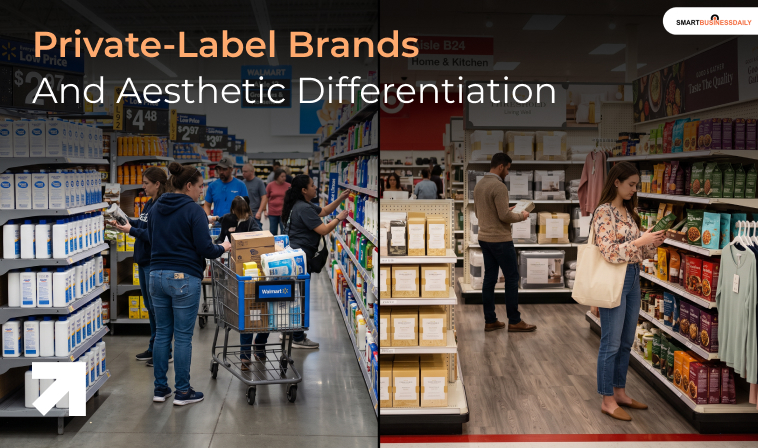
The most significant distinction between Walmart and Target lies in their strategies for developing internal private-label brands, which are essential for cultivating consumer loyalty.
1. Essential Staples (Walmart’s Strength)
Walmart emphasizes creating private-label brands such as Great Value and Equate.
This way, it successfully offers consumers straightforward, dependable alternatives to established national brands.
Furthermore, these products are strategically priced much lower than their competitors.
Also, they have a focus on delivering functional value and practicality rather than appealing aesthetics.
Walmart’s approach centers on meeting shoppers’ basic needs.
So, it ensures they can find quality essentials without breaking the bank.
Moreover, this strategy effectively attracts price-sensitive customers who prioritize cost savings over brand recognition.
2. Lifestyle Curations (Target’s Strength)
In sharp contrast, Target takes a different route with its private-label offerings, including brands like
- Threshold
- Good & Gathr
- A New Day
These brands are meticulously crafted to evoke the essence of high-end boutique items.
Moreover, these boasts modern designs and thoughtful packaging that enhance the shopping experience.
Therefore, collaborating with renowned designers and leveraging trend insights is very important here.
By this, Target successfully positions its products to convey a sense of premium quality at affordable price points.
Furthermore, this strategy appeals to consumers seeking stylish, trendy goods without the hefty price tag.
So, this fosters a sense of value that resonates with those seeking a curated lifestyle.
Final Verdict: Which Retailer Fits Your Business?
Deciding between Walmart and Target largely hinges on your household budget or business purchasing objectives.
If cost efficiency is your main concern, Walmart is the superior choice.
This retail giant excels in minimizing monthly grocery expenses and offers the option to buy household cleaning products in bulk.
Furthermore, Walmart typically offers the lowest cost per unit for standard consumer goods, making it ideal for those who prioritize price over style or shopping experience.
On the other hand, Target shines in areas beyond just pricing.
If you value a curated shopping environment that is both organized and aesthetically pleasing, Target should be your go-to.
Their stores often feature well-designed layouts that enhance the shopping experience, making it enjoyable to browse various departments.
Additionally, Target offers high-quality home decor and trendy fashion collections, allowing shoppers to find unique, stylish products without the premium prices of boutique stores.
Ultimately, your choice between Walmart and Target will depend on what you prioritize most: cost efficiency or a pleasant, enjoyable shopping experience that provides more than just basic necessities. Evaluate your needs, and you’ll find the right match for your shopping preferences.
Additional Resource: A Guide to Shipping with Lasership: Everything You Need to Know.




Related Articles



Comments Are Closed For This Article