














Choosing the right legal structure is one of the highest-leverage decisions you will make when starting a business.
Pick a traditional partnership, and one mistake by a co-founder could put your personal savings at risk.
Incorporate a Private Limited Company too early, and you might find yourself buried under heavy compliance costs and rigid board formalities before you even make your first rupee in profit.
This is where the Limited Liability Partnership (LLP) steps in as the ideal middle ground. Read on to learn what an LLP is and who should choose it!
Quick Overview: LLP At A Glance
Governing Legislation: Limited Liability Partnership Act, 2008 under the Ministry of Corporate Affairs.
Minimum Partners: Minimum of 2 partners. Must have at least 2 Designated Partners. One Designated Partner must be a resident of India.
Protection: Protection is limited to the partners’ capital contribution to the partnership. Except in cases of fraud, personal assets are not at risk.
Audit Requirements: No statutory audit requirement unless turnover exceeds INR 40 Lakhs or capital contributions exceed INR 25 Lakhs
Tax Advantages: Taxed at 30% at the LLP level. Profit distributions to partners are 100% tax-free under section 10(2A). Suitable for:
Bootstrapped agencies, consultancies, licensed professionals (CAs, Lawyers, Architects), and profitable SMEs that do not seek VC investment.
If you run a bootstrapped consultancy, agency, professional business, or profitable SME, setting up as an LLP can offer a good balance.
Read on to understand how LLPs operate, common pitfalls, and how tax works for profitable founder(s).
What Is An LLP?
An LLP is a hybrid structure available in India under the Limited Liability Partnership Act 2008.
It offers the flexibility and low compliance of a partnership, while providing legal protection and separation from the business, like a corporation. In an LLP, the business itself is treated as a Separate Legal Entity.
Business debts or other partners’ negligence do not create personal liabilities for partners in an LLP.
How Does An LLP Work?
Once the Ministry of Corporate Affairs (MCA) incorporates an LLP, the law recognizes it as a Separate Legal Entity. It can own property, open bank accounts, and enter into contracts. It can also sue others or be sued in its own name.
Requirements for an LLP in India:
- Minimum Number of Partners: Minimum of 2 partners. (Maximum number of partners not specified.)
- Minimum Number of Designated Partners: Minimum of 2 Designated Partners. At least 1 must be a resident of India (must have been in India for at least 120 days in the financial year)
- Designated Partner Identification Numbers (DPIN): All Designated Partners must have a valid DPIN provided by the MCA.
- Capital Requirements: There is No Minimum Capital Requirement. An LLP can be formed with as little as INR 10,000 in cash, physical, or intangible assets.
Understanding “No Mutual Agency” In The Real World
Most sources state that an LLP provides “no mutual agency.” However, it often doesn’t explain what this means for you as a business owner.
Mutual agency means that in a general partnership under the Indian Partnership Act 1932, each partner is an agent for the partnership and for other partners in the business.
If Partner A makes a bad decision with a vendor, or displays professional negligence without Partner B’s knowledge, Partner B’s personal property
This includes houses, cars, and savings, which may be seized to pay off debts.
However, in an LLP, partners are agents only of the LLP, not of each other.
If Partner A makes a mistake or breaches a contract, Partner B’s personal assets remain safe. In these situations, only the LLP’s assets cover the liabilities.
However, if a partner commits fraud, that specific partner must use their personal assets to pay off the debts. Even then, Partner B’s personal assets stay completely protected.
Key Features Of A Limited Liability Partnership

Understanding the key characteristics of an LLP helps explain why it is a strong compromise between partnerships and corporations.
Legal entity: This has a unique PAN, bank account(s), and is a Separate Legal Entity from its founders.
Limited Liability: Each partner is liable only up to their capital contribution in the LLP Agreement.
Continuity of Existence: If any partners pass away, retire, or become insolvent, the partnership firm is legally dissolved when it comes to general partnership.
In contrast, an LLP will continue to exist regardless of changes in partners.
Flexibility in Agreement: A private agreement called the LLP Agreement can define profit distribution, voting rights, decision-making powers, and exit clauses for partners.
This means that internal LLP governance does not have to follow strict company legislation.
Low Compliance: LLPs do not need to hold mandatory quarterly board meetings or maintain minute books.
Furthermore, an LLP must undergo a statutory audit only when its yearly revenue crosses INR 40 Lakhs or its total partner contribution goes above INR 25 Lakhs.
LLP vs. Traditional Partnership vs. Private Limited Company
When you decide how to register your business or explore what an LLP is, a side-by-side comparison of these three structures reveals their exact trade-offs. You can clearly see the differences in risk, cost, and scalability.
| Feature | Traditional Partnership | Limited Liability Partnership (LLP) | Private Limited Company (Pvt Ltd) |
| Governing Law | Indian Partnership Act, 1932 | LLP Act, 2008 | Companies Act, 2013 |
| Separate Legal Entity | No | Yes | Yes |
| Partner / Owner Liability | Unlimited (Personal assets at risk) | Limited to agreed contribution | Limited to unpaid share capital |
| Registration Requirement | Optional | Mandatory (with MCA) | Mandatory (with MCA) |
| Statutory Audit | Only if tax audit limits apply | Mandatory only if turnover > ₹40L or contribution > ₹25L | Mandatory every year regardless of turnover |
| Profit Distribution Tax | Exempt in partners’ hands | 100% Tax-Free in partners’ hands (Sec 10(2A)) | Taxed as dividends at investor’s slab rate |
| Raising Venture Capital | Not viable | Very difficult (No equity shares/ESOPs) | Ideal (Supports equity, preference shares & ESOPs) |
| Annual Compliance Cost | Very Low | Low to Moderate | High |
What Most Guides Miss: 4 Critical Realities Of Running An LLP
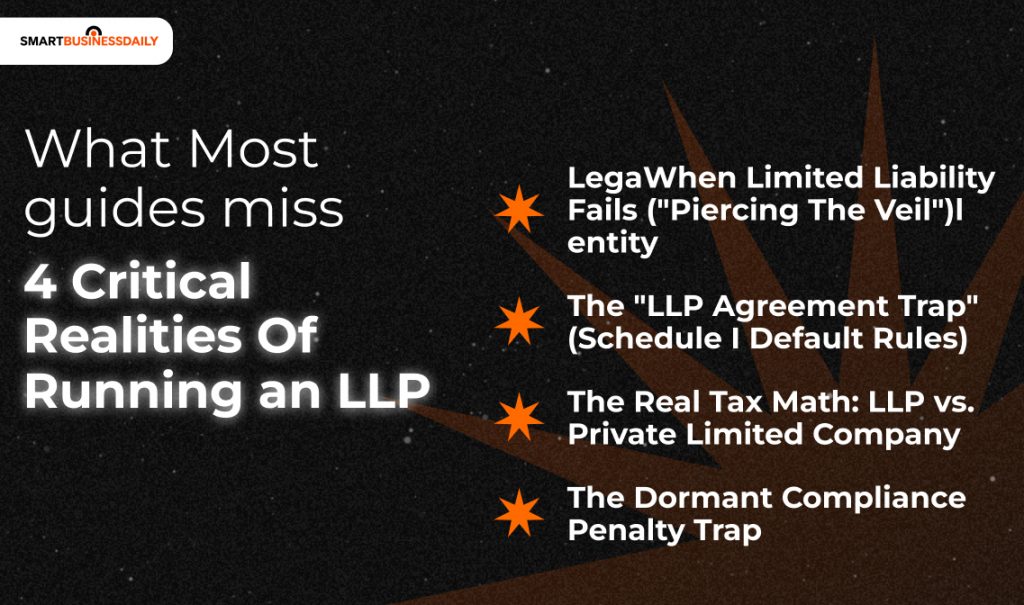
While many business resources describe LLPs, they often overlook key points. Be sure to consider the following points if you are setting up an LLP.
1. When Limited Liability Fails (“Piercing The Veil”)
Although LLPs do provide Limited Liability Protection for partners, it is not absolute.
In certain situations, partners lose their protection from liability and face personal liability under the following circumstances:
- Fraudulent Activity (Section 30)
An LLP or its partners might cheat creditors or commit fraud. In that case, the guilty partners lose their legal protection.
Moreover, they must then pay off the resulting business debts. To do this, they have to use their own personal money and assets.
- Single Partner For Under 6 Months (Section 6)
If there are fewer than 2 partners in the business (due to a partner leaving the business), the remaining partner may legally operate the business alone for up to 6 months in order to find a replacement partner.
However, if the LLP operates along with only one partner for more than six months, that partner becomes personally liable for all its obligations from that point onward.
2. The “LLP Agreement Trap” (Schedule I Default Rules)
Many entrepreneurs choose to quickly incorporate their LLP with a generic LLP Agreement (submitted in Form 3 within 30 days of incorporation) to reduce legal costs. However, this can be very costly.
If certain provisions are missing or unclear in your bespoke LLP Agreement, the default provisions in Schedule I of the LLP Act will automatically apply (Section 23(4)).
All profit and loss must be divided equally (50:50) between partners.
Even if Partner A has contributed 80% of the capital and worked full-time in the business, and Partner B has contributed 20% of the capital as a silent partner, profits and losses must be divided equally between partners (unless specified in the agreement).
No New Partners can be added to the business without Unanimous Consent from all existing partners.
This means that a minority partner can completely block business expansion.
No default salary for partners. No partners are entitled to receive a salary for managing the LLP, unless this is specifically included in the agreement.
3. The Real Tax Math: LLP vs. Private Limited Company
At first glance, it appears more tax-efficient to incorporate as a Pvt Ltd Company (effective tax rate of 25.17% under section 115BAA) than an LLP (taxed at 30%, including applicable surcharge along with 4% cess).
However, for profitable service businesses, it is often more tax efficient to incorporate as an LLP, as more money will reach partners’ personal accounts.
Example: A profitable consultancy has made INR 1 Crore in profit and wishes to distribute surplus funds to its 2 founders.
If incorporated as a Pvt Ltd Company:
The company must pay tax of approx. 25.17% on profits (~INR 25.17 Lakhs). This leaves INR 74.83 Lakhs.
If this profit is distributed to partners in the form of Dividends, the partners will be taxed again in their personal accounts at their individual tax rates (up to 30% plus surcharge).
Alternatively, if large salaries are paid, partners will be placed in higher tax brackets and must contribute to a provident fund.
If incorporated as an LLP:
Interest on capital can be paid to partners (tax-deductible). This interest can be up to 12% pa.
In addition, partners can be paid salaries (within the limits of section 40(b)), meaning less profit will be taxed at the LLP level.
Once tax has been paid at the LLP level (30%), all profits distributed to partners are completely tax-free in their personal accounts under section 10(2A) of the Income Tax Act.
There is no dividend distribution tax or double taxation.
( Note: LLPs may be liable to Alternate Minimum Tax (AMT) at 18.5% if they make certain deductions. This ensures a minimum amount of tax is paid.)
4. The Dormant Compliance Penalty Trap
A common misconception among new entrepreneurs is that if an LLP has no revenue and no transactions in its bank account, it doesn’t need to complete any documentation.
However, even if a business has no revenue, all LLPs must file 2 mandatory documents with the MCA.
- Form 11 – Annual Return: Firstly, you need to fill this within 60 days of the end of the financial year. (Before 30 th May.)
- Form 8 – Statement of Accounts and Solvency: Secondly, you must fill this within 30 days of the end of 6 months of the financial year. (Before 30 th October.)
If these deadlines are missed, a penalty of INR 100 per form, per day will be applied. There is no maximum limit.
On the other hand, if an inactive LLP is left unfilled for just 2 years, penalties of over INR 1,40,000 may be due. It may be extremely difficult to formally close such an LLP until you pay these penalties.
Advantages And Disadvantages Of An LLP
Every business structure balances operational freedom against long-term scalability.
While an LLP minimizes compliance and protects personal wealth, it restricts external fundraising. Weighing these trade-offs ensures the structure fits your goals.
Key Advantages
| Advantage | How It Benefits Your Business |
| Personal Wealth Protection | Your home, personal investments, and family assets stay insulated from business losses and vendor claims. |
| Tax-Efficient Profit Withdrawal | No dividend tax when distributing post-tax profits to partners. |
| Easy to Manage | Minimal paperwork, no mandatory board meetings, and no statutory audit until you cross ₹40 lakh in turnover. |
| Flexible Ownership | Easily add, retire, or transfer economic rights to partners by amending the LLP Agreement. |
Key Disadvantages
| Disadvantage | Why It Matters |
| Not Built for Venture Capital | Institutional VCs and angel investors rarely invest in LLPs because an LLP cannot issue equity shares, preference shares, or Employee Stock Option Plans (ESOPs). |
| Higher Base Tax Rate for Retained Earnings | If you plan to reinvest 100% of your profits back into the business rather than withdrawing them, a Private Limited Company’s ~25.17% tax rate lets you compound capital faster than an LLP’s 30% rate. |
| Conversion Friction | While you can convert an LLP into a Private Limited Company later (under Section 366 of the Companies Act, 2013), the process involves stamp duty on asset transfers, fresh PAN/TAN/GST registrations, and strict conditions to avoid capital gains tax. |
Who Should Choose An LLP?
An LLP is not a one-size-fits-all solution, but it is arguably the strongest legal structure in India if you fall into one of these categories:
- Bootstrapped Service Businesses: First, digital marketing agencies, software development shops, design studios, and IT consultancies that generate high cash flows without needing external VC money.
- Licensed Professionals: Second, chartered Accountants, lawyers, architects, doctors, and management consultants who want to scale multi-partner practices without risking personal bankruptcy from a co-partner’s error.
- Family-Run Businesses & Joint Ventures: Lastly, co-founders who want clear, legally binding profit-sharing and exit rules without the heavy compliance overhead of a corporate board.
When to skip an LLP: If you are building a high-growth tech startup and plan to raise seed or Series A funding within the next 12 to 24 months, skip the LLP and incorporate directly as a Private Limited Company.