








You must be extremely diligent when starting a new venture because you will have little free time. You will spend from early morning to late evening calling buyers, processing orders, and managing your storefront.
All this can leave you feeling frustrated with taxes. It doesn’t seem to be the issue so much as tax terminology and confusing government websites.
Anyway, when you strip away those fancy legal terms, you can easily understand Goods and Services Tax.
Goods and Services Tax (GST) is a single tax on purchasing or supplying goods or services across India, except Jammu & Kashmir.
Before GST, businesses had to pay multiple taxes like VAT, Excise, and Service Tax.
This system caused double taxation, which raised commodity prices and slowed down trucks at state borders.
This GST guide in a Nutshell for Indian shopkeepers, contract workers, and startups will provide you with basic knowledge about GST.
How GST Works In India: The Three Types Of Tax
When preparing invoices for your customers, one of the first things to figure out is what kind of GST you should charge.
GST is collected by the State where the product or service is consumed. So, your GST choice should depend on where your customer resides.
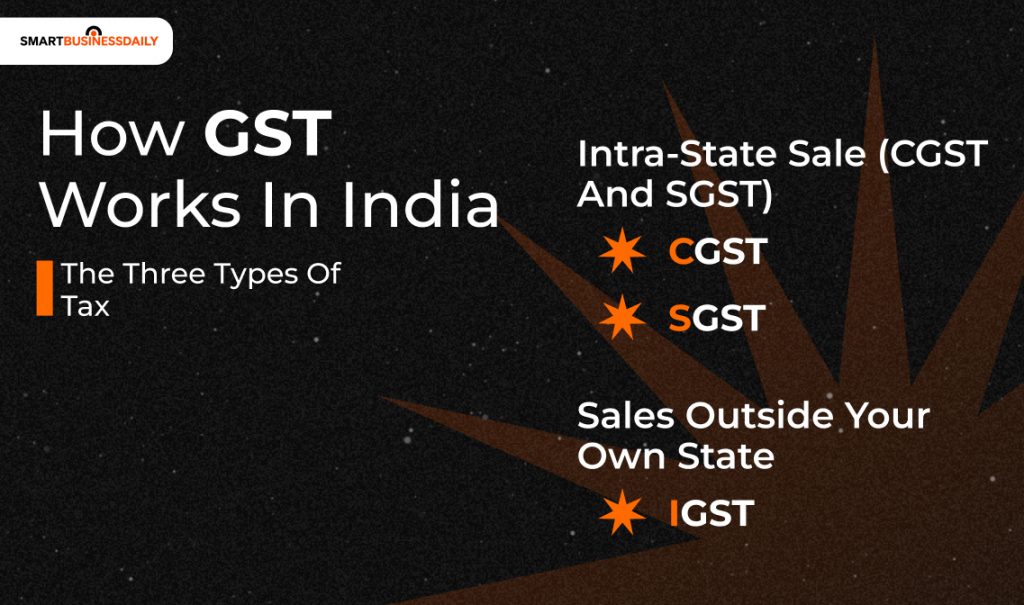
It gets straightforward because every sale falls under either an intra-state sale (CGST and SGST) or an inter-state sale (IGST).
Intra-State Sale (CGST And SGST)
If the customer is within your own state, you must split the tax amount equally. Half goes to the central government, and the other half goes to your state government.
Let’s say you run a bakery in West Bengal and you sell a cake to a customer in Kolkata. You divide your tax rate equally between the Center and your State.
- CGST: Part of your tax goes to the National Centre
- SGST: Part of your tax goes to your state.
If you have a standard 18%GST on your goods, your invoices should read 9%CGST+9%SGST.
Sales Outside Your Own State (IGST)
But suppose your goods are being transported out of your State or you’re providing a service to someone living in another State. In that case, you charge one consolidated tax.
For example, if a Kolkata studio designs a logo for a Mumbai shop, you don’t divide the tax.
- IGST: The National Center collects the full tax first, then divides it.
For instance, on the same 18% invoice, you charge just one line of tax showing 18% IGST.
GST Guide: The New GST 2.0 Tax Slabs Explained
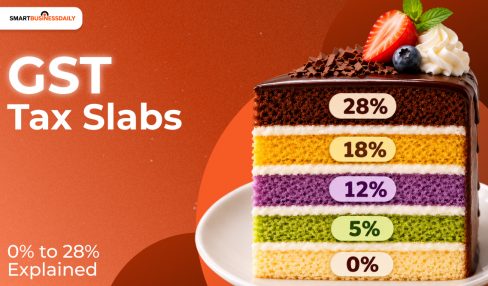
Many old blogs online still tell beginners to learn four tax slabs: 5%, 12%, 18%, and 28%. That advice is outdated.
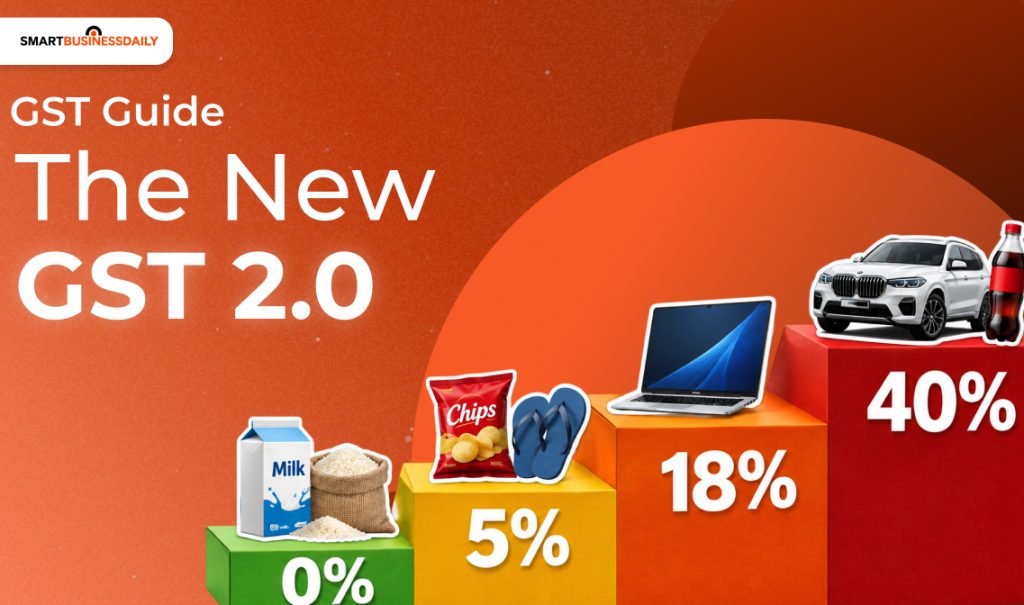
With India’s major GST 2.0 update, the government removed the old 12% and 28% slabs to reduce disputes over tax rates and simplify billing. Today, learning GST for beginners means knowing just three main tax rates plus a zero-tax group.
The Four Tax Groups You Need to Know
Every product/service in India has a unique government code. Goods have an HSN code and services have an SAC code. This code tells you what tax rate to charge on your bill.
- 0% Group (No Tax on Essential Goods)
Basic food and hygiene products are taxed at 0% by the government. This ensures that families aren’t paying more than they need to just to get by. If your business only offers goods in this category, you will never apply any GST on your customer’s bill.
Examples include loose rice and wheat, Milk, Fruits, Vegetables, Classes, Hospital Visits, and Personal/Health Insurance.
- 5% Group (Common Goods)
Goods that you would use daily, basic clothing, and goods produced in small workshops are taxed at 5%.
During the GST 2.0 changes, many common goods moved into this low tax bracket to help everyday people save money.
Examples include packaged snacks, Bath Soaps, footwear and clothing (up to ₹2500), Bicycles, Cheap Flights, and Local Gyms.
- 18% Group (Standard Rate)
Most services, electronics, and general goods sold in offices will be taxed at 18%. Unless your goods are on the government special list, you will almost always charge 18% on your bills.
Examples include computer software, Website Design, Mobile Phones, Laptops, Bags of Cement, Small Family Cars, and Clothing (over ₹2500).
- 40% Group (Luxury & Harmful Goods)
High-end luxury goods and harmful goods to public health will be taxed at 40%.
With only one rate instead of the previous 28% plus additional messy taxes, luxury shop owners can quickly work out what to charge customers.
Examples include luxury cars, Private Boats, Carbonated Cold Drinks, Pan Masala, and Tobacco.
(Quick Note: Gold and silver jewelry still have a special 3% tax rate, and rough diamonds have a 0.25% tax rate.)
You Can Also Check: Tax Slabs Made Easy: A Basic Overview Of The 0%, 5%, 12%, 18%, And 28% Rates.
Should You Register For GST? Picking The Right Plan
If you fall under the law, you must get a GST number once your yearly sales cross certain limits.
The threshold is ₹40 lakh for selling goods or ₹20 lakh for providing services.
For businesses in North-Eastern or hilly states, the limit is lower at ₹20 lakh for goods and ₹10 lakh for services.
Even so, waiting until you hit these numbers can easily hurt your growth. So, review these options to see which path best fits your small business.
Choice 1: Stay Without A GST Number
If you run a small neighborhood grocery shop, a local tuition class, or a home bakery selling only to local families, staying unregistered keeps things simple.
As long as your yearly sales stay under the limit, you never have to file tax forms.
Moreover, the only downside is that you cannot add GST to your bills.
The only downside is that you cannot add GST to your bills, and you can’t claim back the GST you pay on shop supplies.
Choice 2: The Composition Scheme (Easy Flat Tax)
The composition scheme mainly helps small local shops with yearly sales up to ₹1.5 crore (or ₹50 lakh if you sell services).
So, instead of doing complex math every month, you pay a small flat fee on your total sales: 1% for shops and factories, 5% for restaurants, and 6% for small service providers. Moreover, you also file a short form only once every three months.
The Catch: You cannot make collection of GST from your buyers, you cannot ship goods to other states, and you cannot claim back the GST you paid on your own purchases.
This plan works best when you sell straight to regular shoppers and buy very few taxed supplies.
Choice 3: Regular GST Registration
There are many smart founders who get a regular GST number from week one. Even before making a single rupee.
In fact, regular registration is strictly required from day one, even if your sales are ₹0, whenever you do any of these three things:
- Selling Across State Lines: Here, you courier or truck goods to buyers living in different states.
- Selling Online: In this case, you sell your items on websites like Amazon, Flipkart, or Meesho.
- Selling to Other Companies: Lastly, here you sell goods or services to other GST-registered businesses because they need a proper GST bill from you to claim input tax credit and reduce their tax liability.
Input Tax Credit (ITC): How To Avoid Losing Cash
The Input Tax Credit, or ITC is GST’s best feature since it stops you from paying tax twice.
Think of ITC as a digital piggy bank on the GST website. very time you buy a laptop, pay shop rent, or purchase raw goods from a registered seller, GST applies. The GST on that bill goes straight into your digital piggy bank.
Later, when you collect GST from buyers, you can use the balance saved in the piggy bank to pay your tax bill.
So, let us look at a quick example. Let’s say your repair shop collects ₹36,000 in GST from customers during October. In that same month, you pay ₹14,000 in GST on spare parts, tools, and internet bills.
Instead of sending all ₹36,000 to the government, you subtract your ₹14,000 piggy bank balance and pay only ₹22,000 from your bank account.
Now this math sounds easy. However, many new business owners fall into two painful cash traps.
Cash Trap 1: Waiting For Late Client Payments
A taxpayer under the GST system usually owes the tax to the government the moment s/he prints and issues a bill.
This is not the same day your customer pays you.
Assume you complete a ₹2,00,000 web development job for a huge enterprise. You add ₹36,000 in GST and give them two more months to settle the bill.
Even if your client’s payment has not cleared your bank account, GST rules still apply. You must pay the ₹36,000 GST amount by the 20th of next month.
Smart Fix: The good news is that there is a quick trick: Open a bank account under the GST Savings Scheme.
You should make a separate deposit of the GST amount received from every customer into that account so you always know the exact tax money you have to pay to the government.
Cash Trap 2: Suppliers Who Forget To File Returns (GSTR-2B)
Having a paper invoice from a supplier is not enough on its own to claim Input Tax Credit.
In addition to providing your invoice, your supplier should make all related filings. This includes the monthly return on which their tax liability is based.
When the supplier accounts for their GST by filing returns, your tax credit updates automatically on the GSTR-2B portal.
If a supplier collects GST from you without filing their return, you will lose your ₹18,000 tax credit.
The consequence is that you will lose ₹18,000 out of pocket without getting your money back.
Smart fix: The good news is that you need a well-defined agreement with the supplier for large invoice payments. If the major item price is a payment, you should do it immediately.
But for the 18% GST, you must wait and pay only after you see the invoice in your GSTR-2B list on the GST portal.
Hidden Blocked Credits: Bills You Cannot Claim Back
Many newcomers are of the view that they can get Input Tax Credit on every rupeek expenditure for their office, which is not the case really.
Under Section 17(5), the government denies tax credits on some items to prevent businesses from claiming luxury expenses for personal enjoyment.
You can only claim GST after checking this list of office expenses:
- Office Computers and Software (Allowed): You can claim 100% of the GST paid on laptops, printers, billing software, shop shelves, and raw materials.
- Expert Help and Ads (Allowed): The fees paid to chartered accountants, lawyers, courier companies, and online advertising platforms allow you to get full tax credit.
- Office Lunch, Tea, and Party Food (Blocked): If your business is not a food outlet or catering, you cannot claim GST on the cost of staff snacks, tea provisions, or festival lunches.
- Staff Health Insurance (Blocked): Health and/or life insurance purchased by the employee cannot be claimed back for GST unless a specific factory law requires you to buy the policy.
- Car or Cab Rides (Blocked): If your business isn’t in the car rentals/driving school sector, you are not allowed to claim GST back on buying a passenger vehicle (up to 13 seats), paying for petrol or repairs, and office cab bookings.
- Building and Renovating Your Office (Blocked): You cannot claim the purchase of cement, bricks, tiles, and the building fees for erecting/remodeling your shop building through GST.
Your Monthly GST Calendar: Three Dates To Remember
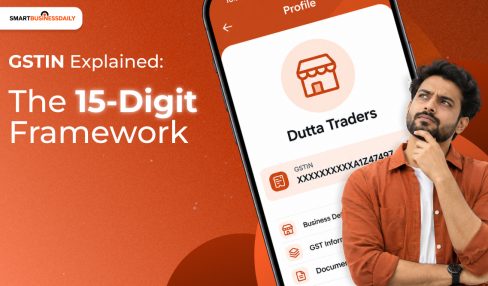
Once you get your 15-digit GSTIN, staying safe from penalties means following three dates every month. If you file monthly returns, mark these days on your wall calendar right now.
Date 1: Send Your Sales List By The 11th (GSTR-1)
Deadlines for various GST returns should be kept to for proper functioning.
This month, GSTR-1 should be filed by the 11th, where a taxpayer can list sales and the issue of goods or services to the buyer, along with the tax amount charged.
The purpose is not to pay money on the day you file GSTR-1. It is about informing customers and help them prepare their Input Tax Credit claims in a timely.
Date 2: 14th Of Every Month
You’ll receive the draft of your GSTR-2B from the portal, an invoice-wise summary of your purchases.
Compare the list online with your physical purchase bills for 10 minutes. If a supplier’s bill is missing, call them quickly to fix the upload before you pay any taxes.
Date 3: File GSTR-3B By The 20th
It’s the monthly summary return that consolidates total sales, deducts the credit available from GSTR-2B, and finally shows the tax payable. To make the balance payment, log in via Net Banking or UPI.
The Three Basic Rules On GST Website For Beginners
GST Return Filing, Even if There Are No Sales: A taxpayer should file Nil GSTR-1 and Nil GSTR-3B if they made no sales in the previous month.
Furthermore, missing the filing period when sales are zero will result in daily late fees, which will block your next filings.
Register Your Business Bank Account and Enable OTP Login: Link the business bank account you actively use to your GSTIN after you are issued the taxpayer identification number (TIN).
Moreover, MFA (Multi-Factor Authentication) is enabled through OTP (One-Time Password) and will be required for any portal login.
Do Not Put Off Your GST Filing Forever: If you make a simple change through the portal and the GST officer approves the change immediately, you do not have to pay any tax, just a fee.
However, the system will not permit filing any tax/return documents that are over 3 years overdue.
Quick Checklist Before You Print Your First GST Bill
Run through these four simple steps before sending out your very first tax invoice:
- Check Your HSN or SAC Code: Find the right code for your product or service, so you charge the correct 5%, 18%, or 40% GST 2.0 tax rate.
- Include All Bill Details: Make sure your invoice clearly prints your 15-digit GSTIN, a fresh serial bill number, your business buyer’s GSTIN, the buyer’s state name, and clear lines for CGST/SGST or IGST.
- Set Phone Alarms Early: Put reminders on your phone for the 9th, 15th, and 18th of every month so you always finish your paperwork two days before the deadline.
- Save Clean Photos of Every Bill: Keep clear digital copies of all supplier bills in monthly folders on Google Drive so you can check your GSTR-2B list in minutes.