













Designing your brand logo, website, product, or first customers can be exciting for a new startup, but completing legal government documentation generally isn’t.
Choosing the right legal structure of a business is extremely important, just like how a small shop on the side of the road can be built on a basic brick foundation, but a 20-storey building cannot be built on a brick foundation.
Choosing the right business structure impacts:
- How much tax you pay.
- Whether your personal savings, house, and car could be taken if the business fails.
- Whether you can get a loan from a bank or funding from investors.
- How much money and effort you have to put in annually for legal requirements.
This article explains, in simple terms (zero legal jargon), what different business structures exist in India.
We’ll include any hidden costs, common mistakes, and a decision tree to help you make the right choice for your business.
Quick Summary (TL;DR):
A business structure determines who owns a business, how it pays taxes, and who is liable for debt and legal issues.
The 4 most common business structures in India are:
- Sole Proprietorship businesses (best for sole founders),
- Partnership Firms (best for simple multiple-owner businesses),
- Limited Liability Partnerships (LLPs) (best for professionals or low-risk co-founders)
- Private Limited Companies (best for startups looking to get funding from investors).
Choosing the right business structure early can reduce tax burdens, protect your personal assets, and make future conversions easier.
What Is The Legal Structure Of A Business?
A business structure (sometimes called a business entity type) defines how Indian law governs a business’s ownership, operations, and taxes.
When selling products/services, you need to let the government, banks, customers, and tax authorities know whether:
You and your business are legally one and the same, or your business is a separate ‘legal person’.
Based on this, there are 2 general types of business structures:
- Unincorporated Businesses: You and your business are viewed as the same legal person. If your business owes 10 lakh to a supplier, you personally owe 10 lakh.
- Incorporated Businesses: Once registered with the Ministry of Corporate Affairs (MCA), your business is considered a separate legal entity.
This means that the business can hold assets, sign contracts, and apply for loans. As a result, your personal assets are protected.
The 4 Main Legal Structure Of A Business In India
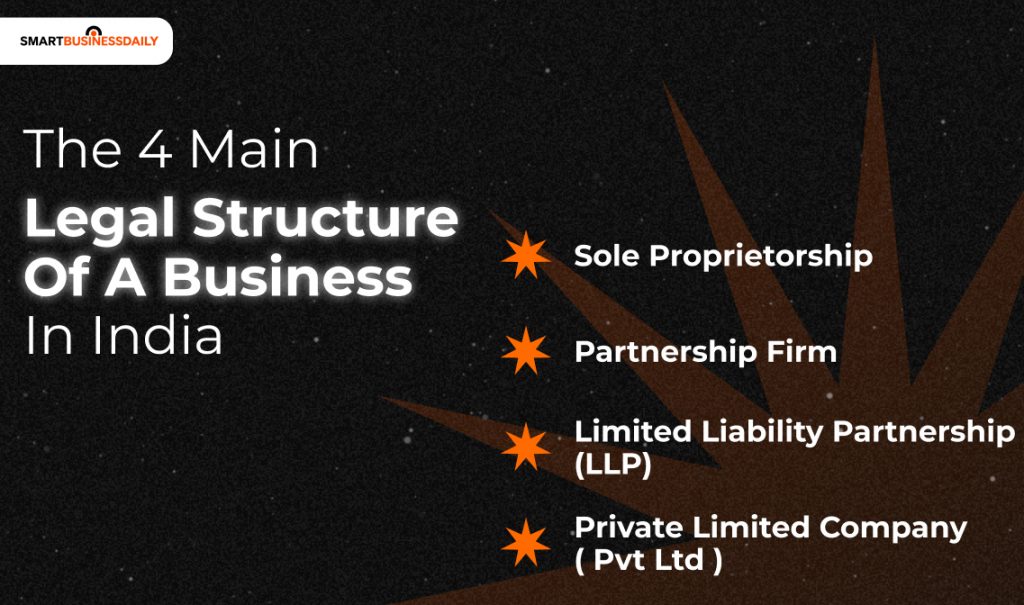
Most new businesses in India will fall into one of the following 4 categories of legal structure of a business based on the number of owners, and how large you would like your business to be.
1. Sole Proprietorship
A Sole Proprietorship is a business owned, managed and controlled by 1 individual. The business and owner are not legally separated.
All profits go to the owner, and the owner makes all decisions. Profits from this business are declared on the owner’s personal tax return.
Best for: Sole freelancers, retail shops, home baking, sole consultancy and testing out small ideas as a new founder.
Benefits: Extremely cheap to set up, very few ongoing requirements.
Risks: Unlimited liability. If the business takes out a loan or faces legal action and cannot pay back, creditors may claim your personal savings, gold, and property to repay the debt.
2. Partnership Firm
A Partnership Firm is a business run by 2 or more people (up to 50 people). How much each person invests, and how the profits are divided will be agreed in a legal Partnership Deed.
Best for: Family businesses, small trading businesses, local agencies and brick-and-mortar stores with trusted partners.
Benefits: Quick and easy to set up at a low cost. Money and skills from multiple people can be combined.
Risks: Just like sole proprietorships, partners face unlimited liability. However, under Indian law, in a partnership, if one partner makes a mistake or incurs debt in the business, all partners are legally responsible.
3. Limited Liability Partnership (LLP)
A Limited Liability Partnership takes elements from partnerships and companies. Within an LLP, the business is a separate legal entity.
Therefore, if one partner makes a mistake or incurs debt in the business, it is not the personal responsibility of any other partner.
Best for: Agencies, Software Consultancies, Chartered Accountants, Architects, Lawyers and bootstrapped co-founders (who don’t intend to seek venture capital).
Benefits: Limited liability, with less complicated and expensive legal compliance than a Private Limited Company.
Risks: You cannot offer shares to external investors (angel investors/Venture Capitalists) within an LLP. Therefore, LLPs are unsuitable for high-growth startups.
4. Private Limited Company ( Pvt Ltd )
A Private Limited Company is a legal entity with shareholders and directors.
It offers the highest level of protection for business owners, gives you the highest level of trust from banks and corporates, and allows you to offer shares to raise investment.
Best for: Tech Startups, E-commerce Businesses, Manufacturing Businesses and any founder looking to raise investment/fund rapid growth.
Benefits: Personal assets are fully protected within this structure (limited liability). Top talent can easily be attracted with ESOPs (Employee Stock Options), and investors can be brought on board.
Risks: Expensive to set up and requires strict legal compliance every year. Even if the company makes no money in the year, you will still have to appoint a Chartered Accountant to perform mandatory year-end audits and government filings.
Important Note: What About A One Person Company (OPC)?
Many sole founders may feel forced to choose a risky sole proprietorship because they have no co-founders.
However, in India, you can form a corporate entity with limited liability as a One Person Company (OPC).
You only need to name one nominee, so if something happens to you, they can take over.
OPCs cost more to maintain than sole proprietorships. Therefore, they best suit sole founders taking larger financial risks or working with big corporate clients.
Side-by-Side Comparison: Which Business Structure Fits You?
Use this quick comparison table of legal structure of a business to see how the four structures stack up across the factors that matter most to a new founder.
| Feature | Sole Proprietorship | Partnership Firm | Limited Liability Partnership (LLP) | Private Limited Company (Pvt Ltd) |
| Number of Owners | Strictly 1 | 2 to 50 | Minimum 2 (No maximum limit) | 2 to 200 (1 for OPC) |
| Separate Legal Identity | No | No | Yes | Yes |
| Personal Asset Protection | None (Unlimited risk) | None (Unlimited risk) | Yes (Limited to investment) | Yes (Limited to share value) |
| Ability to Raise Investor Funding | Very Difficult | Very Difficult | Low (Debt only, no equity) | High (Angel & VC friendly) |
| Setup Cost & Time | Lowest (1–3 days) | Low (3–7 days) | Moderate (10–15 days) | Higher (10–15 days) |
| Annual Compliance Burden | Minimal | Low | Moderate | High (Mandatory audit) |
| Tax Rate Structure | Personal income tax slab | Flat 30% + surcharge/cess | Flat 30% + surcharge/cess | ~22% to 25% corporate tax + surcharge/cess |
5 Key Factors To Consider Before Choosing Your Structure
Don’t simply copy what a friend has done. Consider these key questions first:
1. What Level Of Personal Risk Are You Taking?
If you are selling digital templates or providing freelance writing from your laptop, the risk of being sued for 50Lac is very unlikely. Therefore, a sole proprietorship is suitable.
However, if you are setting up a food business, a physical product, handling sensitive client data or taking out business loans, things may go wrong.
In that case, it is best to set up an LLP or Private Limited Company so a “corporate veil” separates you from your personal savings.
2. Are You Bootstrapping Or Raising Funds?
Bootstrapping (self-funded): An LLP or Proprietorship will mean very low legal costs per year as your business grows.
Raising external investment: If you plan to pitch to Angel Investors or startup incubators in the future, set up as a Private Limited Company from the beginning.
Investors legally cannot invest in equity shares in Proprietorships, Partnerships or LLPs.
3. Are You Running The Business Alone, Or With Co-Founders?
Always put a written agreement in place when working with co-founders. This can be a Partnership Deed, an LLP Agreement, or a Shareholders Agreement.
It will clearly outline what happens in difficult situations, such as:
- A co-founder quits after six months.
- A co-founder stops working.
- Co-founders disagree on how to spend company money.
4. How Will Taxation Impact Your Profits?
Many founders believe Private Limited Companies have lower taxes because they pay approx 22% corporate tax (plus surcharge and cess), compared to 30% for Partnerships and LLPs.
However, many beginner founders miss that a Private Limited Company pays 22% corporate tax on its profits.
When you take those profits into your personal account (as a dividend), you pay tax again on that amount, based on your personal tax bracket.
However, once 30% tax has been paid in an LLP, the partners can legally take all the profits into their personal accounts tax-free.
5. What Do Your Customers/Banks Expect?
Large corporate clients, government contracts and B2B clients may be reluctant to work with unregistered sole proprietorships as they may seem unreliable.
Setting up as a Private Limited Company or LLP immediately increases credibility. Opening current accounts and payment gateways will be much easier.
What Most Blogs Won’t Tell You: Hidden Costs & Switching Friction
It’s common to find advice online suggesting you start as a Sole Proprietorship and switch to a Private Limited Company once you grow.
However, in reality, it’s expensive, time-consuming, and complicated. Below are the reasons why:
1. You Cannot Simply Update Your Business Structure
If you change from a Sole Proprietorship to a Private Limited Company, you will have to create a whole new company. All assets, stock, and contracts must be moved to make this change.
2. New Tax And Bank Ids
As you change business structure, you must close or cancel your old ID’s (PAN, GST, MSME/Udyam, FSSAI and bank account), and apply for new ID’s. This can therefore cause interruptions in billing/payment gateways for weeks.
3. Re-Sign Contracts
Any contracts you have signed with suppliers, leases for offices, or agreements with clients in your old name must be updated/signed legally in the new company name.
4. Hidden Annual Costs
Even if your business makes zero revenue in its first year, you must still pay approximately ₹15,000–₹35,000 for mandatory statutory audits, ROC (Registrar of Companies) annual filings, and CA fees. Make sure you include this expense in your budget.
General Rule: If you are testing out an idea, and expect to make minimal revenue in 3-6 months, a sole proprietorship is best.
3 Costly Mistakes First-Time Founders Make (And How To Avoid Them)
Avoid these common mistakes to protect your business:
1. 50/50 Split Without An Exit Clause
Two friends start a business together with a 50/50 split. After 4 months, one friend joins full-time in a different role.
This means that the other person is now doing 100% of the work. Despite this, the other person still owns 50% of profits.
Solution: Always set an exit clause/ vesting schedule in place.
2. Registering A Pvt Ltd Without Validating Demand.
One person registers their business as a Pvt Ltd, incurring a cost of INR 25,000. They never make a single sale, and after 6 months realise the idea won’t work.
They must now pay INR 20k+ to legally strike off the company and avoid accumulating high government costs.
Solution: Only register as a Pvt Ltd if investors require this. Otherwise, validate your idea with a cheap business structure.
3. Using a Personal Bank Account For Business.
Using personal savings as your business bank account leads to a huge headache when you file taxes. It can also mean that you lose the limited liability protection.
Solution: Open a new current account with the business name.
Real-Life Scenarios: Which Structure Should You Pick?
If your business fits within any of the following scenarios, select the correct business type.
- Scenario A: Graphic Designer/Tutor working from home
Business Type: Sole Proprietorship. Register under Udyam (MSME) for free. Open a current account. Only register for a GST if you have exceeded the government turnover threshold, or if you have sales across states.
- Scenario B: Digital Marketing Agency/Software Studio with 2 friends
Business Type: Limited Liability Partnership (LLP) to protect your personal savings, fairly divide profits, and avoid heavy compliance requirements.
- Scenario C: Mobile App Startup with 3 co-founders. Aiming to raise investment in 12 months.
Business Type: Private Limited Company. Investors will require this, and it makes it easy to give ESOPs to early engineers.
- Scenario D: Hardware store with a father and son
Business Type: Partnership Firm. If you plan to take out large stock loans, consider an LLP instead. Having a registered Partnership Deed will clearly divide profit sharing between family members.
Step-By-Step Checklist Before You Register Your Business
If you have decided on a business type, complete the following checks:
- Check Name is Available: Search the MCA website and the Trademark website to check that the business name is not already taken/trademarked.
- Gather KYC Documents: All owners/directors should have their PAN, Aadhaar, passport-sized photo and most recent bank statements.
- Proof of Business Address: Even if you’re running the business from home, you will need to provide a recent utility bill (electricity/water) and a simple NOC letter from the property owner (parents/landlords).
- Ownership and Profit Sharing Agreement: Clearly define what percentage of ownership each person has (50/50 or 60/40), what roles people have and what happens if people leave the business before signing government documents.
Also, you must seek support from a Chartered Accountant (CA)/Company Secretary (CS).
Although there are Do-It-Yourself portals, speaking with a qualified professional can help you avoid expensive mistakes with your taxes or filings. This should take around 30 minutes.
Disclaimer: This article is for educational and informational purposes only and does not constitute formal legal or tax advice. Tax slabs and corporate regulations change periodically; always consult a licensed Chartered Accountant or corporate lawyer before registering your entity.