













Minimum wage in India is the lowest amount an employer can legally pay a worker for their time and effort.
Under the Code on Wages, 2019, which replaced the historic Minimum Wages Act, 1948, and the Code on Wages (Central) Rules, 2026. No boss, shop owner, or company can pay a worker less than this legal base limit.
Instead of a single pay rate for the entire country, minimum wage in India varies by state, city size, job type, and skill level.
Key Takeaways (Quick Summary)
The Code on Wages 2019 now protects almost all employees in India, whether they work in a large office, factory, or small shop.
It splits the minimum wage into:
- Basic Pay
- Variable Dearness Allowance (VDA)
To convert daily wages into hourly wages then simply divide by 8. To convert daily wages into monthly wages, simply multiply by 26.
By understanding employment regulations, you can determine how much provident fund (savings) or ESI (healthcare) you should receive in addition to your wages, depending on whether you are on contract or full-time.
It is illegal for an employer to pay you less than the minimum wage in India, regardless of whether the business made a loss that month.
What Does Minimum Wage Mean?
Imagine being in a room with a solid wooden floor. You can jump up as high as you like. However, if you jump too high, you cannot fall into a deep hole at the bottom.
In this analogy, the minimum wage in India represents the solid floor.
When you get a new job, depending on your skills and how hard you work, you could earn many thousands of rupees each month (30,000, 60,000, or 200,000).
However, employers can pay you only up to a certain limit. Employers cannot legally pay you less than the minimum wage.
Why Did The Government Create This Rule?
Without proper employee protection in place in the past, some cruel employers exploited those in dire need.
Employers may have offered workers 20 rupees for 12 hours of hard labor. Because workers had no other options, they had to accept.
The government introduced the minimum wage to protect workers from this exploitation.
In India, the minimum wage ensures that employers fairly pay people who work a full day’s work.
They can afford basic foods, clean clothes, a safe place to live, and basic medical treatments for their family.
It helps prevent workers from falling into poverty and ensures that all honest jobs pay a fair starting wage.
From The Minimum Wages Act 1948 To Modern 2026 Rules
For over 70 years, the Minimum Wages Act 1948 protected employees in India.
It marked a major improvement after India gained independence, as it stopped employers from paying extremely low wages to workers in factories, mines, and farms.
However, the existing act only applied to particular jobs (named ‘scheduled employments’). It did not protect millions of workers in small shops, offices, and service-based industries.
To address this issue, the government merged the Minimum Wages Act 1948, along with 3 other wage acts, into a single modern regulation.
The Code on Wages (Central) Rules 2026 backs this new regulation, named the Code on Wages 2019 (officially implemented nationwide in November 2025).
As a result, the minimum wage now protects all workers in both large organized businesses and small unorganized shops.
Why Doesn’t India Have Just One Single Minimum Wage?
If you asked someone in the US or UK what their basic wage was, they could likely tell you a single hourly wage in pounds.
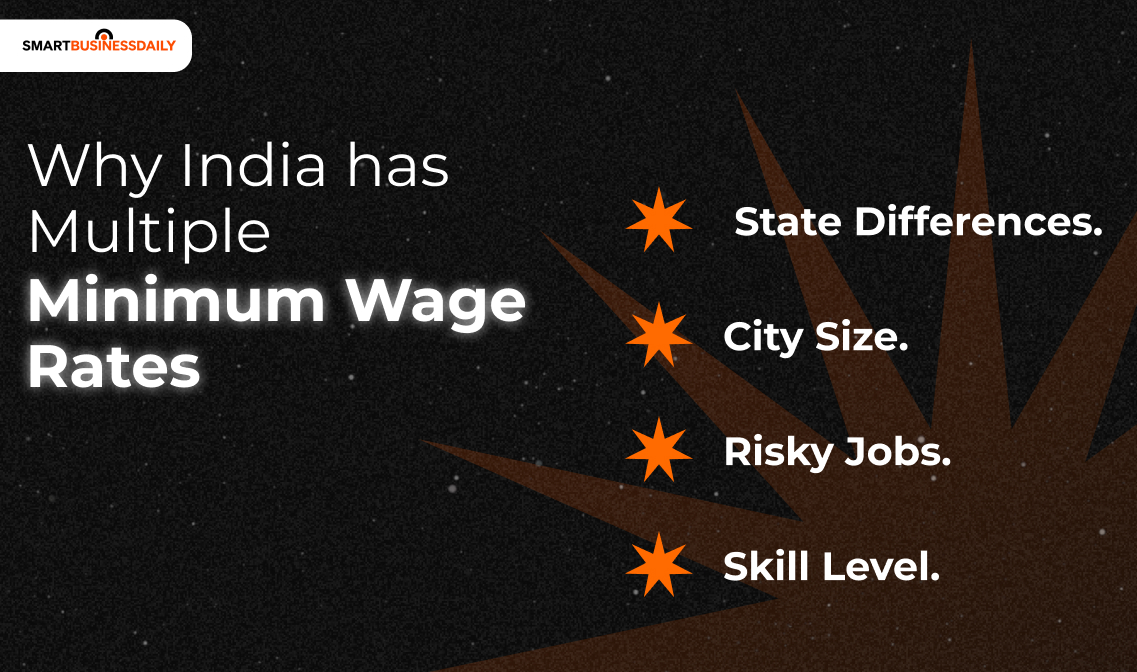
However, many people are confused to see that India doesn’t have a Single Minimum Wage. There are hundreds of different minimum wages due to:
1. State Differences.
India has 28 states and 8 union territories. Within busy states such as Maharashtra, West Bengal, and Delhi, the cost of a bowl of rice, renting a small house, and bus fare is much higher than in less busy states such as Bihar and Chhattisgarh.
Therefore, each state government sets minimum wages specific to their state.
2. City Size.
Even within the same state, living in a large metropolis will cost significantly more than living in a small village.
To be fair, cities within the same state are divided into zones. Zone A is large metropolitan cities (Kolkata, Mumbai, Delhi, Bengaluru, Chennai, Hyderabad).
Zone B is medium-sized cities and capitals. Zone C is small towns and villages. People working in Zone A will earn a higher minimum wage in India than people working in Zone C.
3. Risky Jobs.
Jobs involving dangerous conditions, such as working in deep mining or working on tall electricity poles, are far riskier than sitting at a clean desk and typing.
As a result, risky and hard jobs have a higher basic wage.
4. Skill Level.
A worker with 3 years of experience fixing complicated machines should earn a higher basic wage than a worker with no experience who is sweeping the floor on day 1.
How Is Minimum Wage Calculated In India?
To calculate minimum wages in India, add two sections together.
Minimum Wages = Basic Pay Rate + Variable Dearness Allowance (VDA)
Let’s take a closer look at what these sections mean.
Block 1: The Basic Pay Rate
The Basic Pay Rate is the basic starting wage for workers of a particular skill level in a particular job.
The Government sets it based on the amount of food (calories), clothes, rent, fuel, and education for children that a typical working family needs to survive.
The government reviews and updates this basic rate every 5 years or less.
Block 2: Variable Dearness Allowance (VDA)
Have you noticed recently that the prices of things you buy have increased compared to last year? This increase in price of everyday items is known as inflation.
If your wage remains the same for 5 years but the cost of food increases, you will slowly be able to afford less food for your family.
To help protect workers during times of rising prices, the government adds a second component to the minimum wage. Officials call this the Variable Dearness Allowance.
The government officials review the Consumer Price Index (CPI), on 1 April and 1 October each year.
This shows the cost of different grocery and household items. If prices have risen over the previous 6 months, the VDA will automatically increase.
This ensures that the minimum wage in India keeps up with the cost of living.
Step-by-Step Pay Math Table
In India, government notices most commonly publish minimum wages as daily-wage rates.
According to the Code on Wages (Central) Rules 2026, you can calculate hourly and monthly wages from daily wages (for a 6-day working week) using the table below.
| Pay Period | Simple Formula | Step-by-Step Example (If Daily Rate is ₹840) |
| Hourly Pay | Daily Rate ÷ 8 hours | ₹840 ÷ 8 = ₹105 per hour |
| Daily Pay | Base Daily Rate | ₹840 per day |
| Monthly Pay | Daily Rate × 26 days | ₹840 × 26 = ₹21,840 per month |
Why multiply by 26? Although months contain either 30 or 31 days, Indian employment laws entitle all workers to 4 paid weekly days off (Sundays). To account for these 4 paid days off, employers multiply daily wages by 26.
The Official Rounding Rule
If you reach a decimal amount in money (e.g., ₹105.60 or ₹105.30), you will need to round. According to Rule 3(2) within the 2026 Central Rules,
Secondly, if the decimal is 0.50 or higher, round up to the nearest whole number. (So ₹105.60 would be rounded to ₹106).
Thirdly, if the decimal is less than 0.50, ignore the decimal. (So ₹105.30 would be rounded to ₹105).
What Are The 4 Skill Categories For Minimum Wage?
To ensure fairness between employees, minimum wages in India depend on the worker’s skill level. Higher skill levels mean higher pay.
1. Unskilled
Definition: These jobs can be done by anyone, with no training or experience. They generally involve physical work or simple tasks.
Examples: Office cleaning, sweeping, unarmed security personnel, loading in warehouses, assistants in building projects, delivery runners, and garden assistants.
2. Semi-Skilled
Definition: These jobs require some practical skill. Or require basic knowledge of simple tools. Or may require support from a more experienced worker.
Examples: Junior chefs in restaurants, junior mechanics, machine assistants in factories, junior plumbers, and junior office runners (basic filing).
3. Skilled
Definition: These workers have received proper training or a certificate of skill (such as an ITI), or have many years of solid experience, allowing them to perform independent, careful tasks.
Examples: Carpenters, qualified electricians, commercial vehicle drivers (trucks/cars), tailors, data entry operators, bank clerks, and senior chefs.
4. Highly Skilled
Definition: These workers are experts. They may solve difficult problems, work with costly/complex machinery, manage other workers, or hold a highly technical degree.
Examples: Senior technicians in factories, site managers (civil engineers), software developers, accountants, senior engineers, and specialized machine programmers.
Understanding Hiring Laws: Benefits & Job Types Beyond Base Pay
When taking on a new job, or employing someone new, understanding employment law means knowing more than just the daily wage. A fully legal wage includes savings, safe health protection, and an employment agreement.
What Is The Provident Fund (EPF)?
This is a long-term savings fund. Under the Employees’ Provident Fund (EPF) scheme, 12% of your basic monthly wage (as decided by your employer) will be deposited into a savings account in your name, and the employer will add an equal amount of their own money.
This money will earn interest, so you will have a large amount of secure money if you retire or need to make a large purchase.
What Is ESI (Employees’ State Insurance)?
If a worker gets ill, they may quickly lose all of the money they have saved. If you are wondering what ESI means, it is a form of health protection for workers.
It applies to workers earning up to the legal maximum salary (currently ₹21,000 per month for general workers).
Both the employee and the employer pay a small percentage each month. In return, they and their family can visit doctors for free, get free medication, hospital treatment, and paid sick leave at ESIC hospitals.
Contract vs Full-Time: Does Minimum Wage Still Apply?
Many new workers may be confused about the difference between Contract and full-time jobs. In full-time jobs, you are employed permanently by the company.
In Contract jobs, you may be employed via an employment agency, or for a fixed time (6 months, 1 year, etc.).
Both Contract and full-time workers are entitled to the same minimum wage.
Whether you are employed directly by a large company or as a contract employee, you are entitled to at least the minimum wage (and additional benefits like PF and ESI, if applicable).
If a contract worker does not pay you correctly, the main company (Principal Employer) may be held accountable for paying you the wages you are owed!
Minimum Wage vs. Floor Wage vs. Living Wage
When reading news articles about the minimum wage in India, you will often see three terms that sound almost the same: Floor Wage, Minimum Wage, and Living Wage. Even though they sound similar, they mean three very different things.
| Pay Term | Simple Kid-Friendly Explanation | Is It a Strict Law Right Now? |
| National Floor Wage | The lowest line drawn by the Central Government for the entire country. No state can set a minimum wage lower than this national line. | Yes. States can go higher, never lower. |
| Minimum Wage | The exact legal base pay set by your State or Central Government for your specific job, city zone, and skill level. | Yes. Every boss must pay at least this much. |
| Living Wage | Enough money to afford a truly comfortable life—including good healthcare, children’s college savings, emergencies, and family vacations. | No. It is a happy goal for the future, not a strict law yet. |
5 Lesser-Known Rules About Minimum Wage in India
5 Lesser-Known Rules About Minimum Wage in India
Although many sources on the web give similar information, some interesting changes have been added to the Code that will impact employees’ wages right now:
1. Employees Working In 5-Day Work Weeks
Many workers in factories/shops work 6 days a week. Therefore, wages are calculated as 26 x daily wages.
However, if employees in your office work only 5 days per week (Mon-Fri), and as per Rule 3(3) of the Central Rules (May 2026), your exact payment should be calculated using hourly wages.
To find out your hourly wages, divide the daily wage by 8.
2. Higher Wages Apply
Minimum wages vary depending on whether you work in the railways, mines, banks, or central offices (set by the Central Government) or in local shops/factories (set by the State Government). However, if a worker falls into both categories, the higher wage applies.
3. Overtime = 2x Payment
A standard day is 8 hours. If your employer makes you work 10 hours in a day, you must be paid for the additional 2 hours at double your hourly rate.
4. Up To 50% Can Be In Allowances
The total of all allowances given (such as transport allowance, uniform allowance) must not exceed 50% of your total salary.
If an employer tries to pay you very low basic wages by offering excessive allowances (say 60% or 70%), the law automatically shifts the excess into your ‘Wages’.
This means that your Provident Fund and Gratuity are still safe.
5. Small Shops Don’t Pay Minimum Wages
Minimum wages are a strict rule in India. However, many small informal stores still underpay their workers because those workers do not know their rights.
Clear information can help bridge this gap.
What Can I Do If My Boss Isn’t Paying Me The Minimum Wage?
It is illegal for a boss to pay an employee below the minimum wage. Even if a desperate employee signs a contract to accept below minimum wage, it is not valid in court.
If you (or someone you know) is being paid below the legal wage:
Check What The Minimum Wage Should Be
Go to your State Labor Department or the Chief Labor Commissioner Central website (clc.gov.in) to view the most recent April/October VDA circular.
Collect Basic Evidence
Collect evidence such as payslips, SMS notifications, messages from WhatsApp, or a little notebook showing the number of days worked and cash received.
Claim Your Wages
File a complaint with your local Labor Commissioner, or via the Samadhan Portal.
If an employer breaks these rules, they may be made to pay full arrears. This can also include compensation of up to 10 times what they owed, plus a fine that can go up to Rs. 50,000.
Repeat offenses can result in a fine of up to Rs. 1,00,000, and/or 3 months in prison.
Minimum Wage In India: Frequently Asked Questions
- Is the Minimum Wages Act 1948 still in place?
No! The government updated and merged the Minimum Wages Act 1948 into the Code on Wages 2019 (along with the Code on Wages (Central) Rules, 2026).
Although many people still search for this old name, all minimum wage protections in place today fall under this new Wage Code.
- Are freshers/Interns entitled to minimum wages in India?
Yes. If a company employs you in a full-time or part-time role, even as a fresh graduate, they must pay you at least your local Unskilled minimum wage.
However, companies can only offer unpaid internships to current students completing short-term training.
- Are men and women paid the same minimum wages in India?
Yes! It is strictly illegal to pay women or transgender people less than men for doing the same/similar work. This falls within the Code on Wages, 2019.
- Where can I find out the exact minimum wage for my state?
Minimum wages change on April 1st and October 1st. To check the latest rates, visit your state’s official Labor Commissioner page.
Here are the official website names and domains for each:
- West Bengal Labor Commissionerate: wblc.gov.in (part of the West Bengal Department of Labor, which also uses labour.wb.gov.in)
- Delhi Labor Department: labour.delhi.gov.in (Office of the Labor Commissioner, Government of NCT of Delhi)
- Central Sector Jobs: clc.gov.in (Office of the Chief Labor Commissioner (Central), Ministry of Labor & Employment)