








What Are Sandblasting Cabinets? (And What Are The Different Uses Of Sandblasting Cabinets?)
5 Mins Read
Published on: 01 October 2022
Last Updated on: 15 June 2026

- What Are Sandblaster Cabinets?
- What Are The Different Types Of Sandblaster Cabinets?
- How Sandblasting Cabinets Work?
- Sandblasting Cabinets Usages:
- 1. Cleaning, Enhancing, And Finishing Of Objects:
- 2. Smoothening, Finishing, And Blending:
- 3. Removes Rust And Corrosion:
- 4. Restoring Artwork And Hardware:
- Features To Look For In Sandblasting Cabinets:
- How To Choose The Right Blasting Material?
Abrasive blasting cabinets are used in industrial applications to process materials and objects.
Sandblast cabinets can alter the exterior of components or objects in several ways, depending on the type of media and blasting conditions.
Paints can be carefully removed using a softer medium and reduced force. Exceptionally harsh abrasives can be forcefully used to change the pattern or cut objects when applied at elevated pressures.
This adaptable abrasive blasting chamber is ideal for washing, cleaning, and polishing metal components, and for eliminating rust, damage, and paint from many surfaces.
What Are Sandblaster Cabinets?
Sandblaster cabinets are modified, enclosed chambers that house abrasive-blasting gun operations. Moreover, abrasive blasting uses high-speed abrasive materials to change the surface of a part.
Depending on the process and pressure used, it can clean, smooth, strengthen, strip, or prepare a surface for coating.
Moreover, manufacturers often use abrasive blasting during production, rebuilding, deburring, cleaning, and finishing processes.
On top of that, sandblaster cabinets come in different types, including wet and dry blasting systems, along with siphon-feed, gravity-feed, and direct-pressure delivery setups.
The cabinet itself helps contain the blasting process while also collecting and recycling the abrasive material for repeated use.
Also, in dry blasting systems, compressed air pulls abrasive particles through the gun and pushes them through a nozzle at very high speeds. This is called siphon delivery.
Some systems use direct pressure instead, where the abrasive is forcefully pushed through the nozzle under pressure.
The process is similar to how a bullet propels from a gun barrel, with force building behind it before release.
What Are The Different Types Of Sandblaster Cabinets?
Sandblasting cabinets come in different types and variations – each variation has its own name. These names include:
- Abrasive Blast Cabinets.
- Web Blasting Cabinets.
- Dry Blast Cabinets.
- Micro-Abrasive Blast Cabinets.
- Micro-Jet Machines.
- Micro-Blasters.
- Shot Peening Cabinets.
Also, each type of cabinet generally serves a relatively specific purpose, but they all operate on the same basic principle: shooting a sort of blasting material at a surface to make the required changes.
How Sandblasting Cabinets Work?
To understand how sandblasting cabinets work, it is best to understand what exactly powers the entire process.
Moreover, most systems rely on compressed air, water, or a blast wheel to push abrasive materials, such as sand or metal shot, against a surface.
This impact helps clean, smooth, strip, or reshape the treated material.
Also, there are several types of sandblasting cabinets, but dry blast cabinets are among the most common.
These systems use compressed air to move abrasive material at high speeds and are generally divided into two categories:
1. Suction Blasters: These systems use air pressure to pull abrasive material into an airflow stream before directing it toward the surface. They are efficient for lighter applications but usually require higher air pressure to perform effectively.
2. Direct Pressure Blasters: These systems store abrasive material inside a pressurized tank and force it through the nozzle at much higher speeds. This creates a more powerful and precise blasting process, making them ideal for heavier-duty applications.
Sandblasting Cabinets Usages:
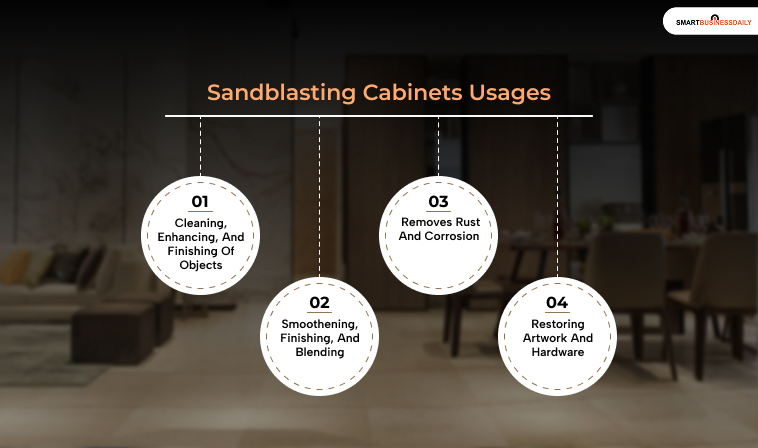
A sandblasting cabinet has many other uses – the following are a few.
1. Cleaning, Enhancing, And Finishing Of Objects:
Surface cleaning and scrubbing, or the elimination of rust, oxide layers, valuable minerals, corrosion grease, grime, coatings, sealants, incomplete combustion, and varnish, become much easier by abrasive blasting.
The most common usage of a sandblast cabinet is for pressure washing or manual cleansing.
Moreover, you can delicately remove paints and coatings with abrasive blasting without damaging the underlying substrate.
The abrasive blasting process helps in removing dirt that contaminates surfaces. The dust is handled using dust collectors, separators, and industrial vacuum cleaners.
2. Smoothening, Finishing, And Blending:
Sandblasting is used to erase traces of machining and grinding procedures or guidelines.
Surface treatments can be blended and refined particularly well with spherical materials such as steel shot.
The surface becomes clearer and more matte due to the circular corners’ hammering down to better levels.
Strong, diagonal abrasive blasting creates a greyer, satin surface with good adhesion properties. By improving the surface polish, you can increase the fatigue strength of metals by 20% to 200%.
The surface is next refined by being peppered with tiny spheres or microfibers. It is also used to smooth the surface.
3. Removes Rust And Corrosion:
The most typical application of sandblasting is to eliminate rust and corrosion. Iron and steel are the most common ferrous materials in which this occurs.
A sandblasting cabinet is mainly used to prevent rust and corrosion in metal. Also, people frequently use a pressure blaster with a stronger slicing medium, such as aluminum oxide, for such substances.
4. Restoring Artwork And Hardware:
Abrasive blasting cabinets restore decorative media by masking or sealing off specific areas.
It can blast patterns into glassware, plastics, and metals while keeping the medium confined to the region where it can eliminate material profiling.
This provides a long-lasting, personalized appearance and is a more durable alternative to painting. Also, people use a blasting cabinet to improve and restore the hardware condition.
Features To Look For In Sandblasting Cabinets:
You should have the option to choose between suction or pressure delivery systems, as each has its own advantages.
For example, suction-type cabinets are ideal for light-duty cleaning, low-production operations, and occasional maintenance jobs.
Pressure blasts are suitable for aggressive blast cleaning and large-volume applications. However, it requires more maintenance because the components wear out quickly.
Another thing you should look for is an abrasive media recovery system, enabling you to control the particle size.
A dust collection and filtration system is also necessary. Some types of dust collectors are baghouse, cartridge, and motorized.
The blasting system is usually of two types: dry and wet, each with distinct advantages.
Dry blasting is compatible with a wide range of materials, allows for faster cleaning, and is suitable for various applications, from surface preparation to high-volume production.
Wet blasting involves low dust production, enables a softer finish on most surfaces, uses fine abrasive media, and can withstand wet contaminants. It is also effective for cleaning partially greasy or oily parts.
Sandblasting removes all types of stains and dirt from surfaces, and surfaces must be ready for applying paints, adhesives, and sealants.
Also, you can mechanize the sandblasting process or carry it out by a machine to improve productivity and standard.
How To Choose The Right Blasting Material?
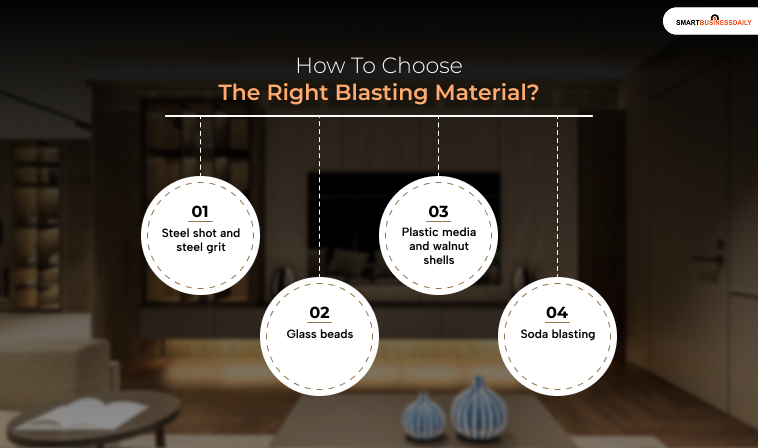
The type of abrasive material used in sandblasting depends on the surface and the result you want to achieve. Moreover, different materials create different finishes and levels of impact.
1. Steel shot and steel grit: These abrasives are highly durable and work well for heavy-duty cleaning, rust removal, and surface strengthening.
2. Glass beads: A softer option that produces a cleaner and smoother surface finish without causing significant damage to the material.
3. Plastic media and walnut shells: These are gentler abrasives that people often use for paint removal or delicate cleaning jobs where the surface needs extra protection.
4. Soda blasting: This method uses baking soda-based media to remove coatings and contaminants while minimizing damage to the underlying surface.
As a result, choosing the right abrasive material is important because it directly affects the surface finish, durability, and overall quality of the final product.
Additionals:




Related Articles



Comments Are Closed For This Article