








DCR Portal Verification: The Essential Guide To Solar Sourcing And Compliance In India
27 July 2026
4 Mins Read
- What Is The Significance Of The DCR Portal?
- Who Needs To Register On The DCR Portal?
- 1. Solar Cell Manufacturers
- 2. Solar Module Manufacturers
- 3. Resellers And Distributors
- 4. EPC Companies And Developers
- Step-By-Step Corporate Registration Framework
- How To Verify A Solar DCR Certificate
- Step 1: Access The Portal
- Step 2: Find The Verification Menu
- Step 3: Enter The Serial Parameters
- Step 4: Review The Live Results
- What Is The Latest Direction For Developers Of The DCR Portal?
India’s rapid expansion of clean energy infrastructure relies on heavy regulatory frameworks.
In fact, this is a key component that ensures supply chain transparency and domestic market growth.
For solar installers, Engineering, Procurement, and Construction (EPC) contractors, and project developers, staying compliant with these rules means mastering the DCR Portal.
Additionally, it is launched by the National Institute of Solar Energy (NISE) under the Ministry of New and Renewable Energy (MNRE).
This online hub tracks the entire deployment of Domestic Content Requirement (DCR) solar assets.
Sourcing non-compliant modules for a state-backed project can result in severe financial penalties or immediate subsidy rejections.
This comprehensive guide breaks down how the portal operates, who needs to use it, and how to verify your equipment records cleanly.
What Is The Significance Of The DCR Portal?
The Domestic Content Requirement (DCR) is a targeted policy directive that mandates that the solar cells and modules used in specific government-subsidized projects must be manufactured entirely within India.
To count as true DCR, both components must pass through domestic manufacturing pipelines.
It is generally advised that you don’t import raw foreign solar cells and merely assemble them inside an Indian factory.
This will immediately disqualify the hardware.
The DCR Verification Portal acts as a central national ledger.
Moreover, it tracks the manufacturing journey of every solar panel by matching unique factory serial numbers against official company invoices and billing records.
This digital record system ensures absolute authenticity.
Also, it eliminates the risk of fraud or unverified equipment mixing into state-funded energy grids.
Who Needs To Register On The DCR Portal?
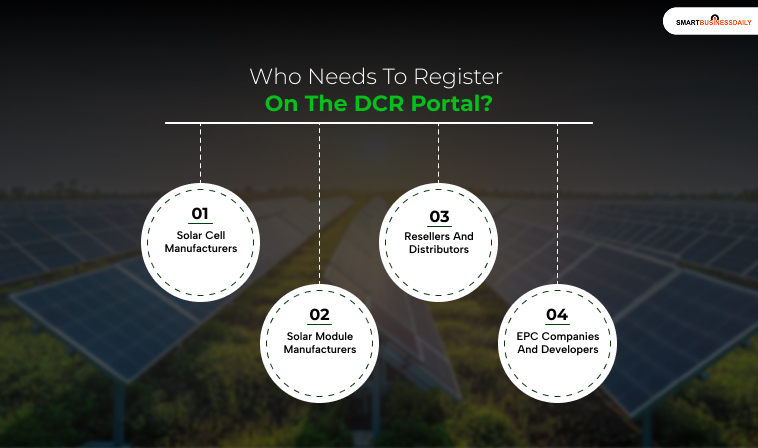
Any organization operating within the supply or deployment chain of domestic solar energy components must maintain a verified account profile on the platform:
1. Solar Cell Manufacturers
These manufacturers are responsible for documenting the tracking information of raw wafers.
In addition, they are responsible for validating the initial production milestones.
Also, they ensure quality and efficiency in the manufacturing process.
2. Solar Module Manufacturers
This group accesses the system to claim local cell stock, map serial numbers, and verify compliance with the Approved List of Models and Manufacturers (ALMM), which ensures adherence to industry standards.
3. Resellers And Distributors
These entities track and log Business-to-Business (B2B) billing data at the middle tier.
helps maintain supply chain integrity and prevents disruptions in the chain of custody.
4. EPC Companies And Developers
EPC companies and developers are tasked with generating the final Business-to-Consumer (B2C) certificates.
Additionally, these are essential for securing project approvals.
Moreover, these enable customers to receive subsidies for their solar installations.
Related Article For You: Top 10 Best Solar Panel Companies In India In 2026.
Step-By-Step Corporate Registration Framework
Setting up an official account requires submitting verifiable legal credentials to confirm your organization is a legitimate local entity.
| Registration Step | Required Inputs And Fields | Mandatory Document Uploads |
| Entity Profile Setup | Company Name, Address, and matching Phone Line. | Official corporate business license or registration. |
| Operational Category | Selection from the dropdown list matching your exact trade function. | Technical factory certificates or supply licenses. |
| Financial Validation | Verified GST Identification Number and Corporate CIN. | A clean digital file copy of the official Company PAN. |
| Account Activation | Administrator Email Address and live Mobile verification. | Real-time OTP clearance via the registered portal line. |
How To Verify A Solar DCR Certificate
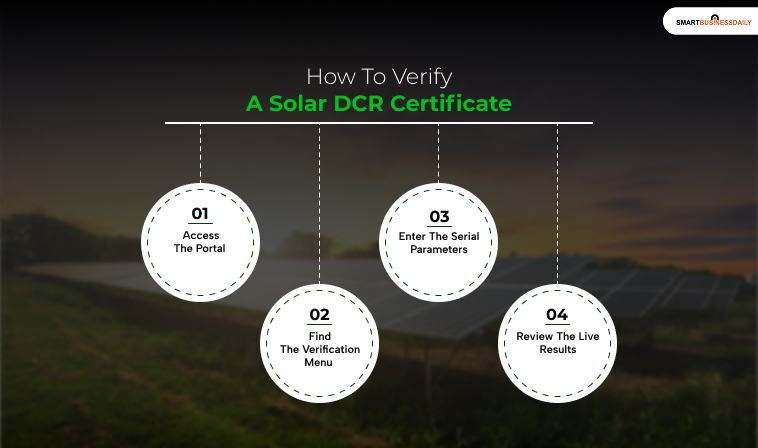
Verifying the validity of a component’s DCR (Domestic Content Requirement) data is a straightforward process.
Moreover, you can accomplish this directly from the homepage without logging in.
Follow these informative steps:
Step 1: Access The Portal
Open your preferred web browser and navigate to the official NISE Solar DCR Portal at solarDCRportal.nise.res.in.
Step 2: Find The Verification Menu
Once on the homepage, look for the top navigation menu and click on the link labeled “Verify DCR Certificate / Module.”
Step 3: Enter The Serial Parameters
In the search block provided, input the 16-digit DCR certificate number carefully.
Alternatively, you can scan the tracking QR code printed on the physical document using your device’s camera.
Step 4: Review The Live Results
The portal will promptly display the panel’s history.
This includes important information such as factory batch records and total kilowatt capacity.
Moreover, you will also find all the significant invoice details here.
Also, if you are looking for the current ALMM (Approved List of Models and Manufacturers) status, you will find it here.
What Is The Latest Direction For Developers Of The DCR Portal?
The latest advisory outlines a new process for developers. It directs them to use the dedicated DCR portal when filing extension requests.
This change is significant for industry stakeholders. They have been closely monitoring the implementation of ALMM List-II.
This requirement will likely increase reliance on domestically approved solar cells.
Additionally, it could impact procurement and commissioning schedules for ongoing utility-scale projects.
Moreover, the ministry has clarified that there will be no universal relaxation of these requirements.
As a result, developers whose projects are impacted by transition requirements must adapt.
They are now expected to seek relief only through the formal application process established by the Ministry of New and Renewable Energy (MNRE).
This formal route is essential for navigating the challenges posed by the new regulations.
In summary, developers must stay informed and proactive. They need to utilize the DCR portal effectively.
You will also soon realize that tracking the impact of ALMM List-II on their projects will be important.
For that matter and more, your compliance with the ministry’s guidelines is non-negotiable. As the industry evolves, these steps will be vital for successful project execution and sustainability.
Additional Resource: 3kw Solar Panel How Many Units Per Day? Real-World Generation Guide




Related Articles



Comments Are Closed For This Article