







USPS Parcel Select: The Ultimate Last-Mile Shipping Strategy For High-Volume Businesses
03 August 2026
5 Mins Read
- High-Density Operational Framework Matrix
- Dynamic Regulatory And Pricing Updates
- · The Ground Advantage Consolidation
- · The High-Volume Focus
- · Network Streamlining
- · Recent Rate Adjustments
- Strict Parcel Size and Weight Standards
- 1. Weight Capacity Thresholds
- 2. Maximum Dimensional Bounds
- 3. Dimensional Weight (DIM) Enforcement
- What Are The Pros And Cons Of USPS Parcel Select?
- Strategic Comparison: Bulk Parcel Select vs. Ground Advantage
- The Dynamics Of USPS Parcel Select Explained
Managing high-volume e-commerce fulfillment requires a continuous focus on optimizing your cost-per-package ratios without compromising delivery reliability.
Within the domestic shipping ecosystem, USPS Parcel Select is a specialized bulk shipping option for:
- Large Retailers
- Consolidators
- Third-Party Logistics (3pl) Providers
Instead of routing single packages through the standard postal retail network, shippers use Parcel Select to drop presorted batches of packages directly into regional sorting hubs.
By handling the long-distance line-haul transit independently and leveraging the United States Postal Service for final last-mile delivery, high-volume businesses can secure massive postage discounts.
This guide breaks down the program’s structural mechanics, maps out recent framework updates, and outlines best practices to help you scale your business operations.
High-Density Operational Framework Matrix
The program relies on a unique structural strategy built entirely around destination entry drop-offs.
Shippers drop off pre-sorted cargo containers at the closest local postal facility to the final customer address.
Therefore, this bypasses costly sorting stages along the way:
| Parcel Select Induction Level | Operational Sourcing and Logistics | Primary Economic Rationale |
| Destination Delivery Unit (DDU) | Shippers transport presorted parcels directly to the local post office, which handles final home routing. | Maximum Savings: Provides the lowest cost-per-package rate by utilizing USPS only for the local street delivery loop. |
| Destination Hub (DHub) | Shipments are dropped off at designated mid-tier regional sorting centers. | Balances lower line-haul truck transit overhead with competitive, presorted postal rate tiers. |
| Destination Sectional Center Facility (DSCF) | Sourced at centralized processing facilities covering large regional ZIP code clusters. | Streamlines bulk intake by consolidating expansive regional delivery zones into a single drop-off point. |
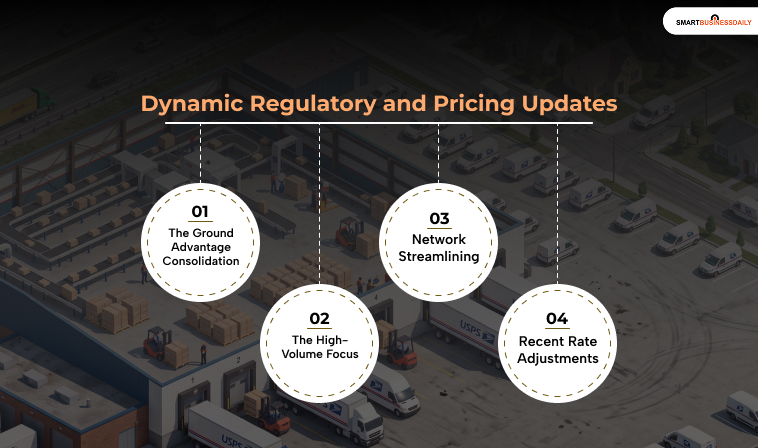
Dynamic Regulatory And Pricing Updates
The U.S. Postal Service continuously updates its competitive shipping architecture to keep its infrastructure aligned with modern commercial demands.
· The Ground Advantage Consolidation
In mid-2023, USPS phased out the consumer-facing Parcel Select Ground tier, merging it with First-Class Package services to form the new USPS Ground Advantage product line.
· The High-Volume Focus
Following this consolidation, the Parcel Select brand operates strictly as a specialized bulk option for deep-entry destination logistics.
This is a better option than a single-item retail mail class.
· Network Streamlining
To optimize operations, the Postal Service has eliminated older, inefficient entry levels.
One of the prime examples of this is the Destination Network Distribution Center (DNDC) layer—to prioritize faster routing through DDU and DSCF hubs.
· Recent Rate Adjustments
Standard shipping program changes have altered baseline rates, including a 6.0% increase for base Parcel Select programs.
Additionally, it comes with stricter dimensional weight (DIM) divisor matching across all major shipping frameworks.
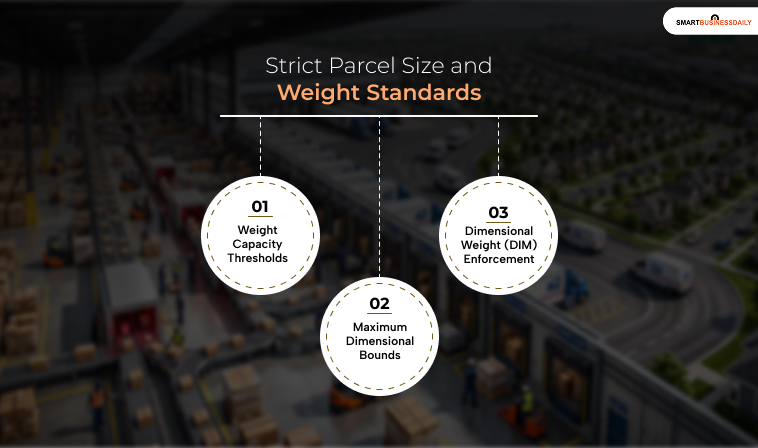
Strict Parcel Size and Weight Standards
To keep automated sorting machines running smoothly, bulk parcels must strictly comply with standard size and structural parameters before they are cleared for induction:
1. Weight Capacity Thresholds
When shipping individual packages, it is important to adhere to a maximum weight limit of 70 pounds (31.75 kg).
This policy ensures safe handling and efficient transport of packages.
Additionally, the program offers lightweight kitting options designed for flexibility and cost-effectiveness.
These options feature a structured pricing system with increments of 4, 8, and 12 ounces.
Therefore, this allows for tailored shipping costs based on the weight of the items being shipped.
2. Maximum Dimensional Bounds
To maintain appropriate shipping standards, the total combined measurement of a package—calculated by adding its length to its girth (the thickest part around the package)—must not exceed 130 inches.
This upper limit ensures that packages can be processed efficiently through the shipping network.
Furthermore, any package exceeding 108 inches in length will be classified as oversized, automatically applying specialized pricing tiers.
This classification is essential for managing the logistics of transporting larger items.
3. Dimensional Weight (DIM) Enforcement
For packages exceeding 1 cubic foot (1,728 cubic inches), the billing system uses dimensional weight pricing.
In such cases, the total shipping cost is determined by comparing the package’s actual physical weight with its dimensional weight, calculated based on its volume.
The higher of the two weights is used to determine shipping charges, ensuring that larger packages with lower weight still incur proportional costs based on the space they occupy within the shipping network.
This policy helps to optimize overall shipping efficiency and resource management.
What Are The Pros And Cons Of USPS Parcel Select?
When you are assessing this program, like the similar ones, you have t take a close look at its pros and cons:
| Feature Category | Advantages (Core Strengths) | Disadvantages (Core Vulnerabilities) |
| Financial Overhead | Bypasses the costly fuel adjusters, residential delivery surcharges, and weekend convenience fees routinely tacked on by private courier networks. | Shippers must absorb the internal time, fuel, and transit costs of handling the long-distance trucking to move freight to regional USPS drop-off points. |
| Delivery Scope and Insurance | Delivers seamlessly to every residential address in the nation, including secure PO Boxes, apartment lockboxes, and military installations that private carriers cannot legally access. | Unlike standard Ground Advantage labels, contract Parcel Select shipments typically lack automatic baseline insurance coverage and require separate third-party protection. |
| Pricing and Infrastructure Scale | Offers unmatched price-per-package efficiency for lightweight e-commerce goods when managed through an optimized, presorted logistics pipeline. | The platform is built strictly for high-volume enterprise logistics; it completely lacks consumer-facing retail drop-off options at local post office counters. |
You May Also Love To Read: The Ultimate Guide to USPS Priority Mail Boxes: Sizes, Prices, and Shipping Tips
Strategic Comparison: Bulk Parcel Select vs. Ground Advantage
Choosing the right shipping class depends on your business’s distribution scale and internal sorting capabilities:
| Shipping Requirement Scenario | Preferred Service Class | Operational Selection Rationale |
| Low-Volume E-Commerce (<50 pieces) | USPS Ground Advantage | Labels can be printed instantly via standard shipping apps, with no pre-sorting or minimum drop-off requirements. |
| High-Volume Consolidation (>500 pieces) | USPS Parcel Select | Pre-sorting packages to regional hubs unlocks rock-bottom postage rates, maximizing profit margins. |
| Built-In Capital Insurance Needs | USPS Ground Advantage | Includes $100 of automatic baseline insurance coverage to simplify shipping error claims. |
| PO Box Delivery Requirements | Both Services | Both options utilize official postal employees for the final last-mile drop-off, ensuring safe delivery into secure government lockboxes. |
The Dynamics Of USPS Parcel Select Explained
USPS Parcel Select remains one of the most powerful cost-saving tools available for high-volume e-commerce brands.
So, if your brand is looking to optimize its shipping operations, this is it.
Also, it takes responsibility for long-distance line-haul freight transit.
Therefore, high-volume businesses can eliminate the expensive residential fees and fuel surcharges that private couriers charge, which drive up costs.
Now, we must acknowledge the fact that independent startups and low-volume stores should stick to the simple, all-in-one convenience of Ground Advantage.
However, enterprise brands can leverage a hybrid, hub-induction Parcel Select framework. So, this way, they can significantly cut overhead and build a highly competitive, scalable fulfillment engine.




Related Articles



Comments Are Closed For This Article