







What Is A Root Cause Analysis? Definition, Tools & Examples
17 September 2026
8 Mins Read

- What Is A Root Cause Analysis?
- A Quick Look At The History Of RCA
- · The Early Beginnings
- · The Post-War Industrial Boom
- · High-Stakes Expansion
- The Core Benefits Of Digging Deeper
- Symptom Vs. Root Cause: Understanding The Difference
- Simple Frameworks To Find The Root Cause
- 1. The 5 Whys Analysis
- 2. The Fishbone/Ishikawa Diagram
- 3. FMEA
- 4. Pareto Chart
- 5. Fault Tree Analysis (FTA)
- How To Run Your Own Analysis In 4 Steps
- 1. Define The Problem
- 2. Gather Information
- 3. Identify And Analyze Potential Causes
- 4. Track And Implement Measures
- Common Pitfalls To Avoid During An Investigation
- Tools And Tech: What Should You Use?
- Real-World Example: Fixing A Customer Support Bottleneck
Imagine you wake up to a giant puddle of water on your kitchen floor. Your first instinct might be to grab a mop. Problem solved, right?
If you don’t figure out where the water came from, you will likely wake up to the same puddle the next morning.
The mop simply provides a superficial solution to the underlying problem. To prevent future puddles, you must find the source of the leak.
The professional business world calls this strategy root-cause analysis.
In this article, we will explore what is a root cause analysis, how it originated, why it matters, common pitfalls during an examination, and how companies can implement it across their workforce.
What Is A Root Cause Analysis?
At its core, Root Cause Analysis (RCA) is a structured, systematic method for uncovering the underlying reasons behind a specific problem or incident. Instead of just putting out fires or slapping a temporary bandage on a glitch, RCA digs deep down to find out exactly why a system or process failed in the first place.
This methodology originally gained traction in engineering and heavy manufacturing, where ignoring a tiny mechanical failure could lead to catastrophic results.
Meanwhile, it has become a staple strategy across almost every modern sector, including IT operations, healthcare, project management, and corporate leadership.
A Quick Look At The History Of RCA
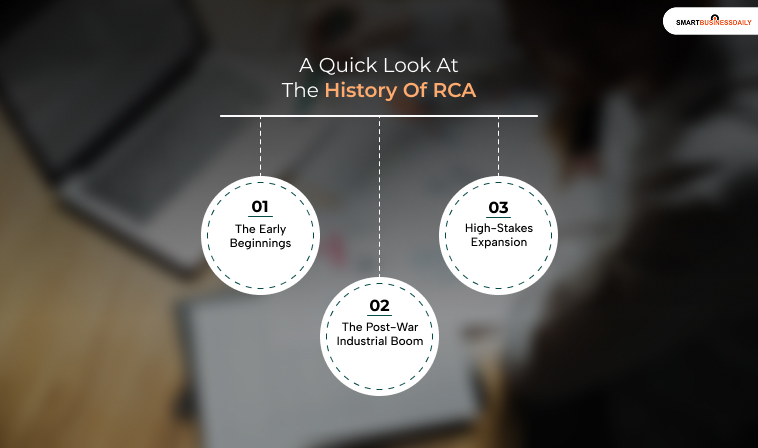
To truly understand how the strategy works, it helps to look at where it started. The concept of digging deeper into problems isn’t brand new!
· The Early Beginnings
The fundamental philosophy behind RCA is often credited to Sakichi Toyoda, the founder of Toyota Industries, back in the early 20th century.
He developed the famous “5 Whys” concept to improve his manufacturing plants.
· The Post-War Industrial Boom
In the 1950s, the process grew rapidly. Quality experts like W. Edwards Deming introduced data-driven cycles for continuous improvement.
Meanwhile, social scientists Charles Kepner and Benjamin Tregoe created specialized frameworks to help businesses make systematic decisions based on root causes.
· High-Stakes Expansion
By the late 20th century, government agencies and high-risk industries adopted RCA as the gold standard for safety.
The aviation sector, nuclear power plants, and naval engineering teams realized that finding systemic errors was the only reliable way to prevent fatal accidents.
Today, this strategy has expanded far beyond factories and cockpits. Agile tech startups, modern hospital networks, and financial institutions worldwide use it as an essential tool.
The Core Benefits Of Digging Deeper
The advantages of implementing a systematic root cause detection process are extensive.
The top benefits of using a structured approach to examining incidents include:
- Preventing Future Occurrences: The most apparent benefit is that the strategy helps organizations avoid reliving the same painful event.
- Saving Time and Money: Systematic analysis often identifies recurring flaws in procedures, so businesses can optimise their processes.
- Enhancing Safety Procedures: Companies and governments can utilize the strategy to create fail-safes in high-risk industries. Root cause analysis can reveal deep-seated problems that can seriously harm the public.
- Encouraging a Culture of Continuous Improvement: The strategy can help leaders identify the best ways to evolve their operations organically.
Symptom Vs. Root Cause: Understanding The Difference
It is incredibly easy to confuse a symptom with a root cause. However, treating a symptom only buys you a little bit of time, while fixing a root cause solves the issue for good.
Let’s look at a few quick real-world examples to highlight the difference:
| The Surface Symptom | The Immediate Reaction (Band-Aid) | The Actual Root Cause |
| A delivery truck driver gets into a minor car accident. | Reprimand the driver or send them to a quick safe-driving class. | The vehicle maintenance log was ignored, causing the brakes to fail. |
| A software company sees a sharp drop in mobile app downloads. | Spend thousands of dollars on a flashy new marketing campaign. | A recent update introduced a bug that makes the sign-up page crash. |
| A team member misses an important project deadline. | Give the employee a poor performance review for the quarter. | The project management tool did not send out automated reminders. |
As you can see, jumping to immediate conclusions usually targets the person or the visible glitch rather than the true underlying failure.
Simple Frameworks To Find The Root Cause

The good news is that most companies don’t need advanced expertise in fault-tree analysis to conduct a successful investigation.
Organisations can use a series of common-sense approaches and procedures to identify an event’s cause.
Below are some of the most popular tools that companies can use:
1. The 5 Whys Analysis
Perhaps the most famous strategy in root-cause analysis is “the 5 Whys.”
Moreover, this process is relatively simple: firms only need to ask “why” five times before concluding the primary source of a problem.
Although it is more of a guideline than a strict set of rules, the strategy is especially useful for small businesses and managers.
2. The Fishbone/Ishikawa Diagram
Companies can use this particular diagram to brainstorm all the possible causes of a specific incident.
Businesses can sketch out the tool on a whiteboard or design it digitally.
Teams can write the root-cause categories at the top of the “bones” of the fish.
The visual aid helps firms analyze human interactions in the workplace, equipment failures, process malfunctions, and more.
3. FMEA
Failure Mode and Effects Analysis is an especially powerful tool for large-scale business units.
The examination process takes much longer but offers critical insights on a granular level.
FMEA requires teams to go over every step of a process and assign risk values to each stage.
After identifying the riskiest points, firms can strategize ways to prevent system failures.
4. Pareto Chart
Also known as the 80/20 analysis, this tool helps organizations identify the vital few from the many.
In other words, companies can use the chart to determine what 20% of issues account for 80% of first-world problems.
The tool is especially useful in high-pressure environments.
5. Fault Tree Analysis (FTA)
This tool is similar to the 5 Whys procedure but offers a more in-depth examination of the issue.
Experts use the visual aid to depict exactly how a particular event unfolded. This strategy is deductive.
Moreover, this means the companies must understand the root causes before moving on to lower-level failures.
How To Run Your Own Analysis In 4 Steps
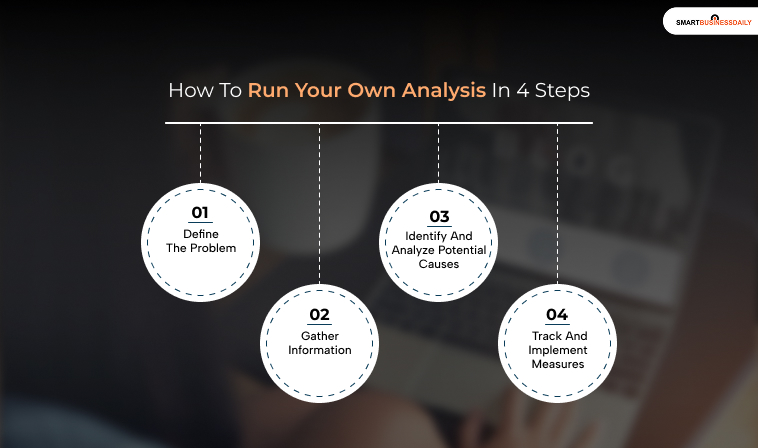
Companies can use the following steps as a guideline when performing a root-cause examination:
1. Define The Problem
The first step is to develop a problem statement. Firms should attempt to be as specific and objective as possible.
For example, companies should avoid vague terms such as “poor customer service.”
Moreover, instead, they can revise it to something like “a 40% increase in customer response time in the third quarter.”
2. Gather Information
Before developing a list of potential causes, firms should collect relevant data.
Organizations can review error messages and other data if an incident has already occurred.
If the scenario is hypothetical, companies should meet with the stakeholders involved and review the timeline of events.
3. Identify And Analyze Potential Causes
After compiling a list of facts, businesses can use graphical tools such as the 5 Whys or Ishikawa analysis to identify the incident’s root cause.
Firms should focus on processes, equipment, and human interactions.
4. Track And Implement Measures
After identifying the real culprit, firms should develop a strategic initiative that will prevent future occurrences.
However, companies should continue to monitor the issue in the following months or quarters to ensure that their solution is effective.
Common Pitfalls To Avoid During An Investigation
Although root-cause examinations are relatively simple in theory, companies tend to make some common mistakes during the systematic examination:
1. The Blame Game: One of the most damaging behaviours that firms should avoid is assigning responsibility to individuals.
So, if the primary goal of an examination is to assign disciplinary action, the stakeholders will resort to counterproductive measures.
2. The First Solution Fallacy: It can be easy to assume that the first solution that the company detects is the most viable one.
3. Confirmation Bias: Another human tendency that can hinder the effectiveness of a root-cause analysis is confirmation bias.
Moreover, if researchers look only for information that confirms their theory, they may miss the vital few among the regular many.
4. The Lack of an Execution Strategy: There is no doubt that the identification process plays a much more important role than the implementation phase.
However, some companies ignore long-term sustainability measures.
Even when a firm identifies a root cause, it should remember that a strategic initiative’s success depends on execution.
Tools And Tech: What Should You Use?
Depending on the company’s size and the complexity of the issue, teams can choose from a wide selection of mediums:
- Whiteboards and Sticky Notes: First, these are for collaborative, spontaneous sessions. Nothing beats whiteboards and sticky notes.
The medium encourages productivity and engagement. Companies can rearrange sticky notes and revise assumptions in real time.
- Digital Diagramming Tools: Second, if a company has remote workers or needs a more permanent, organized version of a whiteboard, it can use digital programs such as Lucidchart.
- Spreadsheets: Thirdly, if a firm wants to review an incident timeline, track the risk of various components, and perform basic statistical analysis, they can use spreadsheet programs.
- Specialised Tools: Lastly, enterprise-level companies can use sophisticated programs to handle all the data points and organise them intuitively.
Real-World Example: Fixing A Customer Support Bottleneck
Below is an example of a customer support company that had to perform a root-cause analysis due to a surge in customer complaints:
During a peak season, the customer support team at an e-commerce company noticed a long delay in customer response time.
After observing that the issue persisted well after the busy season, the team manager held an impromptu 5 Whys session.
- Why are our customers waiting so long for a response? Because our agents are spending too much time addressing password-related inquiries.
- Why are the agents spending too much time addressing password-related inquiries? Because the “forgot password” link on the web application malfunctions.
- Why is the “forgot password” link malfunctioning? Because the newest software update broke compatibility with the email servers.
- Why did the update break compatibility with the email servers? Because the engineering team forgot to update the production code with the latest master branch.
- Why did the team forget to update the production code with the latest master branch?
Because the deployment checklist didn’t include a step-by-step guide for external integrations.
After identifying the root cause, the company needed to update the deployment checklist and modify the production code.
By doing so, the customer service team could remove the task from their daily operations. The company realized that hiring additional customer service agents would only offer a temporary solution.




Related Articles