







What Is A Geofence? The Definitive Strategic Guide To Location-Based Architecture
06 August 2026
5 Mins Read
- High-Density Operational Comparison: Geofencing Data Signals
- Structural Architecture: How The Backend Processing Works
- Stage 1: Radius And Boundary Definition
- Stage 2: Constant Device Monitoring
- Stage 3: Instant Event Ingestion
- Real-World Applications Across Industries
- · Location-Based Marketing
- · Logistics And Fleet Management
- · Workplace Security And Smart Homes
- Advanced Geofencing Archetypes: Circular vs. Polygon Boundaries
- Archetype A: Circular Geofencing (Radial Model)
- Archetype B: Polygon Geofencing (Custom Geometry)
- Addressing Privacy Concerns And Optimization Limits
- Privacy Safeguards And Permissions
- Technical Performance Friction
- What Is A Geofence And Its Overall Dynamics Explained
Modern digital infrastructure relies heavily on contextual data to deliver automated, real-world experiences.
Businesses will definitely need proximity tracking when it comes to on-demand logistics apps.
These apps track delivery drivers to local retail storefronts that broadcast location-specific promotions.
Therefore, it is quite safe to say that proximity tracking shapes our daily digital interactions.
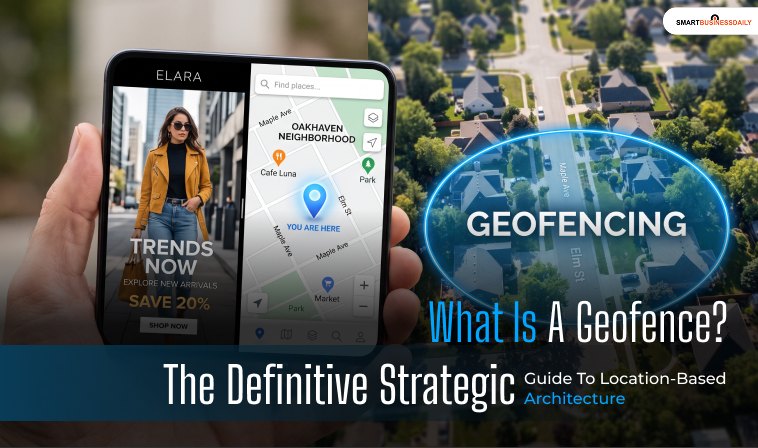
If you are trying to understand exactly what is a geofence, think of it as a virtual perimeter for a real-world geographic area.
Firstly, it is completely unlike physical fencing.
A geofence is an invisible, software-defined boundary.
Additionally, it triggers automated actions on devices the moment a user crosses its digital coordinates.
This guide breaks down the underlying positioning technologies and evaluates core application frameworks.
Furthermore, it outlines strategic implementation workflows
High-Density Operational Comparison: Geofencing Data Signals
A geofence does not rely on a single tracking mechanism.
Instead, developers choose between different location-based protocols depending on the target radius size, precision goals, and battery efficiency constraints:
| Location Signal Source | Optimal Tracking Radius | Technical Precision Level | Battery Resource Overhead | Primary Operational Use Case |
| GPS Tracking | 100+ Meters (Large Scale) | High (Outdoor zones) | Heavy (Requires active chip firing) | Enterprise fleet management, regional transit boundaries, and broad city-wide zones. |
| Wi-Fi Positioning | 20–50 Meters (Mid Scale) | Moderate (Excellent indoors) | Low (Leverages existing router scans) | Shopping mall customer tracking, corporate campus logins, and dense-urban marketing. |
| Cellular Triangulation | 500+ Metres (Macro Scale) | Low (Dependent on tower density) | Minimal (Passive network pings) | Regional population traffic tracking and state-wide emergency alert broadcasts. |
| Bluetooth Beacons | 1–10 Meters (Micro Scale) | Extreme (Centimeter accuracy) | Negligible (Uses low-energy BLE chips) | Micro-aisle retail product prompts, museum exhibit guides, and indoor gate check-ins. |
Structural Architecture: How The Backend Processing Works
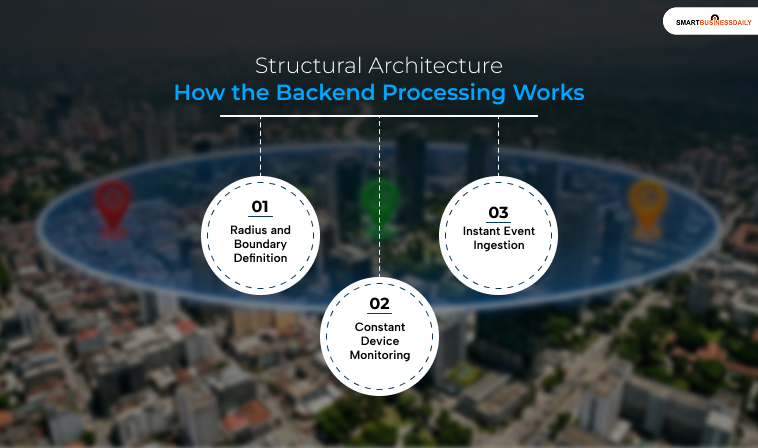
The backend execution of a geofence relies on a continuous loop of spatial calculations managed between a client device application and a centralized server API.
Stage 1: Radius And Boundary Definition
An administrator logs into a spatial dashboard or mapping interface to outline their target perimeter.
The boundary can be set as a perfect circle (a fixed radius centered at a specific latitude and longitude) or as a custom polygon (a hand-drawn shape that matches precise real estate property borders, streets, or industrial complexes).
Stage 2: Constant Device Monitoring
When a user installs an app with active location-tracking permissions, the app sets up local boundary checkers.
To prevent draining the device’s battery, the operating system uses low-power cell-tower tracking to monitor overall movement.
Once the user approaches the target boundary zone, the app fires up high-precision GPS sensors to track the exact crossing line.
Stage 3: Instant Event Ingestion
The second the device crosses the virtual boundary line, the app registers a state change.
The system processes three distinct spatial events:
- Dwelling Event: Triggers when a device stays within the virtual zone for a set number of minutes.
- Entry Event: Fires an immediate database alert the moment the hardware passes inside the boundary lines.
- Exit Event: Launches secondary cleanup scripts or logouts when the device moves back outside the perimeter.
Also Check: How To Fix GPS Not Working: Quick Ways To Restore Your Location Services.
Real-World Applications Across Industries
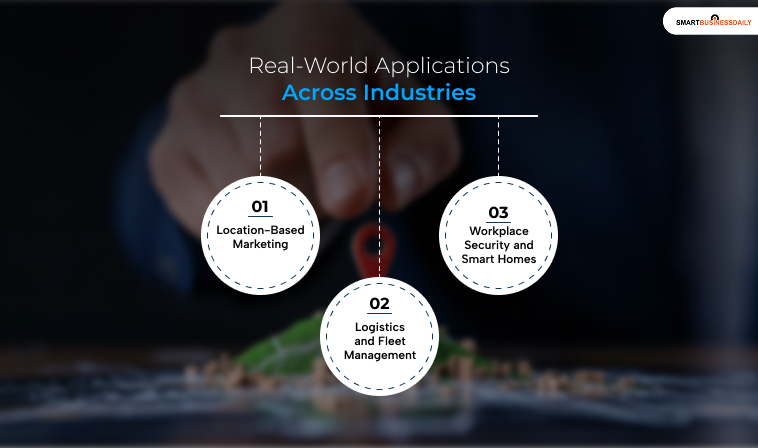
Geofencing architecture has grown into an indispensable tool across diverse commercial and enterprise spaces:
· Location-Based Marketing
Retail brands set up perimeters around their competitors’ physical storefronts.
When a customer enters a competitor’s zone, the app sends an instant discount notification to encourage them to switch stores.
· Logistics And Fleet Management
Transport companies build virtual barriers around distribution hubs.
As a cargo truck passes the entry line, the system automatically sends arrival notifications to warehouse managers without:
- Manual Paperwork
- Schedules Dock Crews
- Logs Delivery Times
· Workplace Security And Smart Homes
Corporate data labs use geofencing to protect sensitive data.
If an employee takes a secure work tablet outside the corporate building perimeter, the device automatically locks down and encrypts its local storage.
You Can Also Check: What Time Does Amazon Deliver? – Review of Its Shipping Timeline
Advanced Geofencing Archetypes: Circular vs. Polygon Boundaries
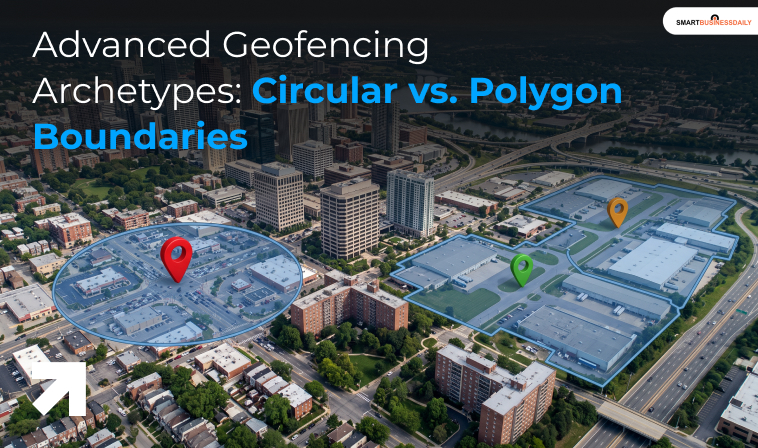
Engineers use two primary geometric models when programming geofencing solutions, balancing computing speeds with real-world map accuracy.
Archetype A: Circular Geofencing (Radial Model)
This model maps a simple circle around a fixed central point with a fixed radius (e.g., 200 meters around a storefront).
- Computing Overhead: Very low; requires minimal processing power since the system only checks a single distance metric.
- Best Suited For: Broad proximity marketing campaigns, regional shipping hub alerts, and tracking highway transit checkpoints.
Archetype B: Polygon Geofencing (Custom Geometry)
This model allows developers to draw complex, multi-sided shapes that match exact real estate property lines, airport boundaries, or specific warehouse floor plans.
- Computing Overhead: High; requires continuous point-in-polygon mathematical checks that can slow down older processing hardware.
- Best Suited For: High-security construction sites, restricted airport taxiways, and localized asset tracking inside industrial complexes.
Addressing Privacy Concerns And Optimization Limits
While geofencing provides immense operational help, developers must balance data tracking with user privacy and technical system constraints.
Privacy Safeguards And Permissions
Modern mobile operating systems enforce strict data collection transparency.
Apps cannot track user movements in the background unless the user grants explicit, ongoing “Always Allow” location access permissions.
Top platforms use data anonymization to protect user identities, storing coordinates as encrypted tokens rather than linking raw location files back to personal profiles.
Technical Performance Friction
Deploying too many high-precision geofences can cause severe resource drain.
If an application requires continuous, active GPS updates to monitor complex polygon shapes, the device’s battery life drops rapidly.
To minimize this drain, smart engineers use a practice called coarse-to-fine filtering, using low-power cell tower signals for general tracking and activating precise GPS tracking only when the user is within a close, pre-vetted buffer zone.
What Is A Geofence And Its Overall Dynamics Explained
Understanding what a geofence is unlocks a powerful framework for blending digital automation with physical locations.
By choosing the right location signals, businesses will benefit greatly when leveraging macro-level GPS coordinates.
This is often needed for cross-country shipping tracking.
In fact, businesses can use micro-level Bluetooth beacons in indoor retail layouts to build highly responsive user experiences. When implemented with clear privacy protections and smart battery optimization habits, geofencing serves as a highly scalable, future-proof asset for the modern hyper-local marketplace.




Related Articles



Comments Are Closed For This Article