














A private limited company is a form of business owned by a limited number of people (2-200 shareholders).
As a legal entity, your personal money and assets are protected if the company goes into debt. This also makes it easier to bring on co-founders, pitch to venture capitalists, and save on tax.
In this article, wewill cover how a private limited company can be owned by multiple people, common pitfalls often skipped in basic guides, and how to register your company.
The Big Picture: Understanding the Private Limited Company
Starting a new business with a co-founder is a big step. However, choosing the wrong structure can put your personal bank account at risk.
A private limited company is a legal shield under section 2(68) of the Companies Act, 2013. As a legal entity, the company can purchase property, sign contracts, and take out loans in its own name. This keeps your personal finances safe.
Think of your company as a secure vault that you and your co-founders can access. The number of shares you have determines how much of the company you own. Shares cannot be purchased or sold by just anyone as the law restricts them, unlike a public company on the stock market.
Core Pillars Of This Business Structure
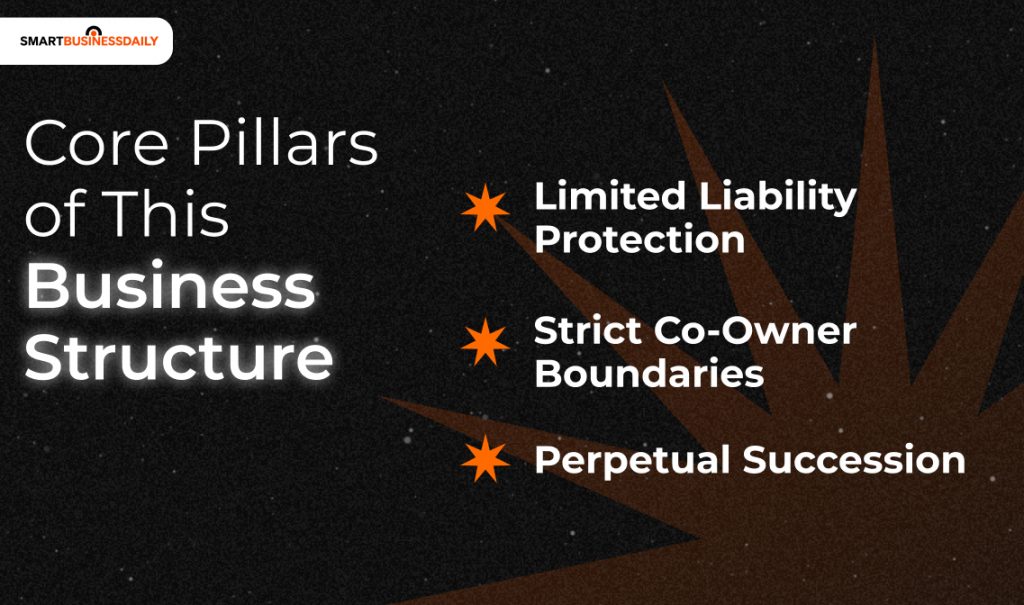
Every private limited company operates on three foundational rules that protect co-owners and build market trust.
Limited Liability Protection
Limited liability means your financial risk is limited to the amount of money you invest in your company shares.
Consequently, if your startup faces an unexpected lawsuit or cannot repay a business loan, creditors can only claim company assets.
They cannot touch your personal house, family car, or private savings account.
Strict Co-Owner Boundaries
To form this business, you must have at least 2 shareholders and directors. You can have up to 200 members.
Existing shareholders also have the right of First Refusal. This means if your co-founder wants out, they must offer you their shares before selling them to an external buyer.
Perpetual Succession
A company is a separate entity, so it can outlive its owners. If one of your co-owners resigns, retires, or passes away, the business will continue as normal.
Simply transfer their shares to their legal heirs or another partner.
What Most Guides Miss: The Hidden Trap Of Traditional Partnerships
Most guides cover only the basics of setting up your company. However, most don’t mention the risks associated with starting a general partnership firm.
Many new entrepreneurs will register as a partnership firm because it seems cheap and easy. However, the risks are significant.
1. The “Joint And Several” Liability Nightmare
When registering as a partnership firm, there isn’t a separation between you and your business partner.
This means if your co-founder signs a bad contract with a vendor or incurs huge business debt without your knowledge, creditors can take your personal assets to pay the debt in full.
With a private limited company, your company debt stays within the company bank account.
2. Forced Dissolution When A Co-Owner Exits
Most guides won’t mention how delicate a partnership firm can be. If a partner passes away, goes bankrupt, or resigns without a complicated clause.
Then, according to the Indian Partnership Act, your partnership firm will dissolve. This means you’ll have to freeze your bank accounts, sell your assets, and register as a new partnership firm to continue serving your customers.
With a private limited company, however, there is no issue. Simply transfer its shares.
3. The Punitive Tax Rate Gap
Many small business owners assume partnerships are cheaper. However, this isn’t the case.
Partnership firms have a high tax rate of 30% (surcharge + cess) on all profits made from the first rupee.
In contrast, a private limited company in India has a base tax rate of 22% (or 15% for qualifying new manufacturing units).
| Feature | Private Limited Company | Traditional Partnership Firm |
| Personal Asset Risk | Zero personal risk beyond unpaid share value. | Unlimited risk; personal property can be seized. |
| Co-Founder Exit | Smooth share transfer; business stays alive. | Often triggers dissolution of partnership firm. |
| Base Income Tax | Starts at 15% to 22% (plus applicable surcharge). | Flat 30% partnership firm tax rate (plus surcharge). |
| Investor Readiness | High; VCs and angels invest directly via equity. | Very low; investors avoid unlimited liability structures. |
| Legal Identity | Separate legal entity with perpetual life. | No separate legal identity from its partners. |
You May Also Love To Read: What Is A Sole Proprietorship: The Simplest Way To Start A Single-Owner Business
How Co-Ownership Actually Works: Directors vs. Shareholders

When forming a private limited company with a partner, you will have two roles. Knowing the difference can prevent disputes as your company grows.
Shareholders: The Owners Of The Pie
These are the owners of your company. They own shares of the company. For example, you might own 60% of the shares and your co-founder 40%.
This means you own 60% of the company value and will receive 60% of the profits/dividends.
So, they are not responsible for the day-to-day running of the company. However, they will vote on big decisions such as selling the company or changing the mission.
Directors: The Captains Of The Ship
Directors oversee the day-to-day running of the company. They will sign contracts with clients and employ staff.
Most of the time your original shareholders will also be your directors. You must ensure at least one director has been in India for 182 days or more in the last calendar year.
Protecting Co-Founders With A Vesting Schedule
Never give your co-founder 50% of the company on day one. Ask your company lawyer to put a vesting schedule in place. This should be 4 years with a 1-year cliff in your Founders’ Agreement.
- 1-Year Cliff: If your co-founder leaves after 8 months, they will not receive any shares.
- Monthly Vesting: After 1 year, they will receive 25% of their shares. Then they will receive the remaining 75% evenly over the next 36 months.
This prevents dead equity. This means if your partner leaves early, they won’t own half of your company.
Step-By-Step Guide: How To Register Your Private Limited Company
You won’t have to go to any government offices to register your company. You’ll do everything online via the MCA. Below are the 7 steps you need to follow:
Step 1 – Get DSC And DIN
Since everything will be completed online, your directors will need to obtain a Digital Signature Certificate (DSC) from an authorized agency.
Moreover, you will also apply for a Director Identification Number (DIN) in the same form.
Step 2 – Choose A Company Name
Use the SPICe+ Part A portal to submit 2 names for your company. Your name needs to consist of 3 parts: Brand name, activity, and then ‘Private Limited’. For example, ‘GreenLeaf Logistics Private Limited’.
Always check the Indian Trademark Registry to make sure you’re not infringing on any existing brands.
Step 3 – Prepare Your Company Documents
Prepare your Memorandum of Association and Articles of Association.
- Memorandum of Association
This document shows what your company will do and the limits of what it can do. You cannot legally make money from anything outside of what is written in your Memorandum of Association.
- Articles of Association
This document sets out how your directors will run board meetings, issue new shares, and approve share transfers between co-owners.
Step 4 – Submit SPICe+ Form
Upload your signed Memorandum of Association and Articles of Association. You’ll also need to upload your ID’s (PAN and Aadhaar/Passport) and proof of your registered address.
If your office is rented, you’ll also need to upload a recent utility bill and signed No Objection Certificate (NOC) from your landlord.
Step 5 – Receive Certificate Of Incorporation, PAN And TAN
Once the Registrar of Companies verifies your documents (usually within 7-15 working days), you will receive your Certificate of Incorporation. You’ll also receive your PAN and TAN automatically.
Step 6 – Open Bank Account And Pay Capital
Take your Certificate of Incorporation, Memorandum of Association, Articles of Association, and Board Resolution to any commercial bank.
Each co-owner should transfer the agreed capital amount from their personal bank account to your new company account.
Step 7 – File INC-20A Form
You cannot legally charge your clients or take on loans until you’ve filed your INC-20A form.
This shows the government that all your co-owners have paid their initial capital into the company bank account. This must be filed within 180 days of incorporation.
Common Risks And Compliance Mistakes To Avoid
Setting up a private limited company can provide huge growth opportunities. However, if you don’t follow basic compliance rules, you could face high daily fines.
Not Appointing Your First Auditor
Every private limited company must appoint a Chartered Accountant as its Statutory Auditor within 30 days of incorporation.
If you fail to do this, the board must hold an Extraordinary General Meeting to appoint an Auditor within 90 days. Otherwise, you’ll face heavy fines.
Using Your Company Debit Card
Never use your company debit card to pay for personal items such as food shopping, holidays, or anything not approved.
This breaks the ‘separate legal entity’ rule, and the courts can pierce the corporate veil. This removes your limited liability.
Not Filing INC-20A Form
Many excited founders will start their website and take payments from customers as soon as they receive their certificate of incorporation.
However, you cannot operate without filing your INC-20A form. This will result in a flat £50,000 fine for your company and £1,000 per day for all your directors.
Not Filing With RoC Annually
Even if your startup doesn’t make any money in the first year, you must still hold 4 board meetings, hold an AGM, and file your annual returns (AOC-4 and MGT-7).
This keeps your company up to date and ready when an investor asks to see your books.