








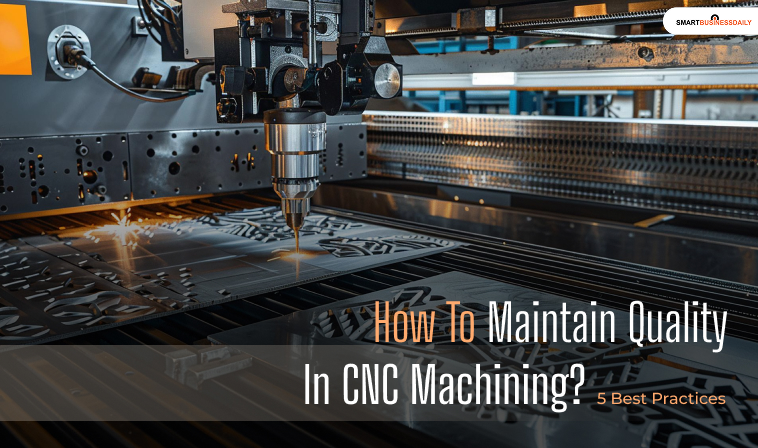
How To Maintain Quality In CNC Machining? 5 Best Practices
5 Mins Read
Published on: 02 April 2025
Last Updated on: 03 July 2026
- Best Practices For Maintaining Quality In CNC Machining:
- 1. Start With Proper Machine Setup And Calibration:
- 2. Select The Right Tools And Parameters:
- 3. Control Material And Environmental Factors:
- 4. Implement In-Process Monitoring And Quality Control:
- 5. Standardize Processes And Train Operators:
- Common Mistakes That Reduce CNC Machining Quality:
- Ensure Quality And Dimensional Accuracy In Your CNC Machining!
Precision is the foundation of successful CNC machining.
Even minor deviations in dimensions or surface finish can lead to rejected parts, production delays, increased material waste, and higher manufacturing costs.
So, whether you’re producing prototypes or high-volume production runs, maintaining consistent quality is essential for meeting customer specifications and keeping operations efficient.
Moreover, achieving that level of consistency requires more than a well-programmed CNC machine.
Machine calibration, cutting tools, material quality, machining parameters, environmental conditions, and quality control all influence the final result.
This guide explores the key practices manufacturers can follow to improve dimensional accuracy, maintain consistent part quality, and reduce costly machining errors.
Stay tuned.

Best Practices For Maintaining Quality In CNC Machining:
The CNC machining process overcomes the limitations of manual control. No live operators are needed, and they do not have to command the tools via wheels, levers, and buttons.
However, you have to make sure of certain things to ensure proper calibration and product quality. Here is everything you should take care of.
1. Start With Proper Machine Setup And Calibration:
The foundation of Consistent CNC-machined parts lies in the machinery itself. A machine that needs calibration will make errors that worsen with time, leading to dimensional problems in the parts.
CNC machine functionality depends heavily on routine maintenance checks that focus on accurate alignment among axes, true spindle accuracy, and low backlash.
Parts shift slightly off-center when the X-axis does not align properly, and the lead screws develop too much backlash, resulting in imperfect depths of cut.
Setting up CNC machining requires proper workpiece fixation together with the selection of suitable fixturing. The material can shift when insufficient clamping is used, resulting in dimensional changes.
Workpiece stability can be achieved by using precision vises, custom jigs, and vacuum tables to keep CNC-machined parts within their designed geometry.
Each operation requires verification of machine and tool offset settings before starting, as this prevents errors from accumulating and maintains operational accuracy.
2. Select The Right Tools And Parameters:
The selection of tools, along with machining parameters, determines how precise CNC-machined parts will be.
Tools in substandard condition, alongside improper choice, result in surface faults and manufacturing dimension problems, in addition to breakdowns.
A dull end mill causes heat concentration, leading to workpiece expansion and affecting its dimensional accuracy.
High-helix end mills dedicated to aluminum, combined with coated carbide tools built for stainless steel, produce neat cutting results and minimize tool wear.
Three vital cutting parameters exist, which include spindle speed and feed rate, along with depth of cut.
The optimization process applies to the specific material that requires machining.
The machining of titanium becomes problematic at high speeds because work hardening occurs, leading to unacceptable dimensional variations.
The combination of manufacturer guidelines and CAM software for cutting simulation can help fine-tune settings, ensuring CNC-machined parts are produced with consistent precision across batches.

3. Control Material And Environmental Factors:
Manufacturing consistency in CNC operations depends on both the material’s properties and the environment where cutting occurs.
Changes in material composition, including variations in hardness or internal stresses, alter the machining behavior of the material.
The erratic grain structure in an aluminum batch leads to imbalanced cutting forces, which negatively affect the dimensions of CNC-machined parts.
Applying standard procedures for evaluating desirable suppliers, combined with pre-machining hardness tests, enables risk management.
Environmental temperature and humidity conditions affect the results of machining processes.
The phenomenon of thermal expansion in machines, tools, and workpieces due to temperature changes results in dimensional changes.
The parts in an uncontrolled machine shop facility can experience minimal dimensional changes that correspond with daily temperature fluctuations.
A controlled facility environment at 20°C (68°F), combined with material acclimatization before machining operations, leads to greater consistency.
Coolant use during machining operations helps control heat, thereby protecting CNC-machined parts from damage.
4. Implement In-Process Monitoring And Quality Control:
Achieving consistent quality requires active monitoring systems during machining operations.
The real-time detection systems, consisting of tool wear sensors with vibration detectors, actively identify problems before they influence part accuracy.
Rapidly rising vibration signals may indicate that a tool has become dull or that the setup needs adjustment, as such conditions can generate dimensional errors.
The installation of quick solutions to production process problems stops defective items from advancing through the manufacturing pipeline.

The organization must carry out thorough quality assurance checks as the final step after machining operations.
Part specifications are checked using precision measurement tools, including coordinate measuring machines (CMMs), calipers, and surface profilometers.
SPC helps manufacturers monitor their processes to detect any changes that impact allowed tolerances.
A machine requires calibration adjustment or tool replacement when part diameter progression occurs during production to ensure accuracy.
The quality of CNC-machined parts remains intact when operators conduct inspections at the beginning of the process.
5. Standardize Processes And Train Operators:
The human factor stands as a major contributor to CNC machining variation.
Consistency throughout a CNC production process is achieved by adopting standardized work instructions and checklists.
Proper tool change procedures, when properly carried out, will prevent dimensional errors caused by inaccurate tool offsets.
Operator training is equally crucial for maintaining precision.
Experienced machinists develop the skills to interpret machine systems, adjust parameters, and troubleshoot issues promptly.
Training sessions must address optimal practices for setup configuration and tool selection. Moreover, it needs to address quality control procedures and the operation of the adaptive control system.
Common Mistakes That Reduce CNC Machining Quality:
Even experienced manufacturers can encounter quality issues when small details are overlooked. As a result, some of the most common mistakes include:
- Using worn or damaged cutting tools.
- Incorrect spindle speed or feed rate settings.
- Poor workpiece clamping and fixturing.
- Ignoring machine calibration schedules.
- Failing to inspect the first completed part.
- Using inconsistent material batches.
- Delaying preventive maintenance.
Identifying these issues early helps manufacturers reduce scrap, improve repeatability, and maintain tighter production tolerances.
Ensure Quality And Dimensional Accuracy In Your CNC Machining!
Producing high-quality CNC-machined parts is the result of disciplined processes rather than a single piece of equipment.
Moreover, accurate machine calibration, proper tooling, material consistency, effective quality control, and skilled operators all contribute to reliable manufacturing outcomes.
As a result, by standardizing workflows, investing in preventive maintenance, and continuously monitoring machining performance, manufacturers can improve dimensional accuracy, reduce production costs, and consistently deliver parts that meet demanding industry standards.
READ MORE:




Related Articles



Comments Are Closed For This Article