








Copyright Vs Trademark: Key Differences Every Creator And Business Must Understand
14 January 2026
6 Mins Read
- What Is Copyright?
- What Is A Trademark?
- Copyright Vs Trademark: What Are The Key Differences?
- Copyright Vs Trademark: Typical Scenarios To Use Each One
- Uses Of Copyright:
- Uses Of Trademark
- Copyright Vs Trademark: Practical Tips To Secure Each Of These
- For Copyright
- For Trademark
- Overlaps And When You Might Need Both
- Copyright Vs Trademarks: What Are The Common Misconceptions And Pitfalls?
- Copyright Vs Trademark: What Are The International Considerations?
Since the day I started writing about all things business, I have heard a very common confusion lying around.
Sometimes, I also come across it as a debate. What is it? Of course, I will tell you! Patience is the key!
Before I get into it, I want to talk about intellectual property protection. As an entrepreneur myself, I can assure you that it plays a vital role in today’s digital and business-driven world.
I have, like everyone else, invested time, skill, and money into building something original.
In my case, it’s a business. In your case case it could be anything such as a:
- Book
- Song
- Logo
- Software
- Brand Name
Without legal protection, these creations can be copied. Additionally, someone can easily misuse it. In fact, anyone can claim it to be theirs.
Okay, you might have figured that out by now. Yes, I am talking about measures like copyright and trademark.
But even though these two are extremely important, I have seen people are extremely confused about the purposes they serve.
Additionally, I have come across a very popular debate of Copyright vs Trademark, which signifies that maybe you need only one of these.
In this guide, I aim to clarify everything about these two. Let’s get into it!
What Is Copyright?
Copyright is a legal protection that protects original works of authorship.
So, the moment you have created something, this protection begins automatically. Additionally, it comes in a tangible form. This means the work is:
- Being Written On Paper
- Saved Digitally
- Recorded
- Filmed
Also, I want to clarify that copyright applies to creative expression, not ideas. You cannot copyright an idea alone. Legal experts consistently clarify that copyright does not protect:
- Facts
- Systems
- Methods
- Concepts
Copyright duration varies by country, but in many regions it lasts for the life of the author plus a fixed number of years after death.
During this time, the copyright owner has exclusive rights. These include the right to:
- Reproduce the work
- Distribute copies
- Create adaptations or derivative works
- Perform or display the work publicly
ClearTax explains that while copyright exists automatically. Additionally, a registration strengthens enforcement rights.
In fact, it also enhances the legal remedies in case of infringement.
What Is A Trademark?
A trademark is a form of intellectual property that protects brand identity. The primary function of a trademark is to prevent consumer confusion.
It ensures that customers can identify the source of a product or service and associate it with a specific level of quality or reputation.
Trademark protection gives businesses exclusive rights to use a mark in connection with specific goods or services.
This exclusivity helps build trust, recognition, and brand value. It also allows businesses to stop others from using similar marks that may mislead consumers.
LegalZoom emphasizes that trademarks are essential for long-term brand strategy, especially for businesses planning expansion, franchising, or licensing.
Copyright Vs Trademark: What Are The Key Differences?
Understanding the differences between copyright and trademark helps clarify which protection applies to your work.
While both fall under intellectual property law, they serve very different purposes.
| Aspects | Copyright | Trademark |
|---|---|---|
| Subject Of Protection | original creative works | brand identifiers |
| Examples | Books, music, films, artwork, and software | Names, Logos, Slogans, and Symbols |
| Purpose | Focuses on creative ownership | Focuses on consumer recognition and market distinction. |
| Duration | Usually lasts for the life of the creator plus several decades | It can last forever if maintained properly |
| Requirement Of Registration | Exists automatically at creation. | Stronger and easier to enforce when registered |
| Scope Of Rights | Prevents unauthorized copying or adaptation | Prevents others from using confusingly similar branding |
| Limitations | Does not protect names or short phrases | Does not protect the underlying creative content |
Copyright Vs Trademark: Typical Scenarios To Use Each One
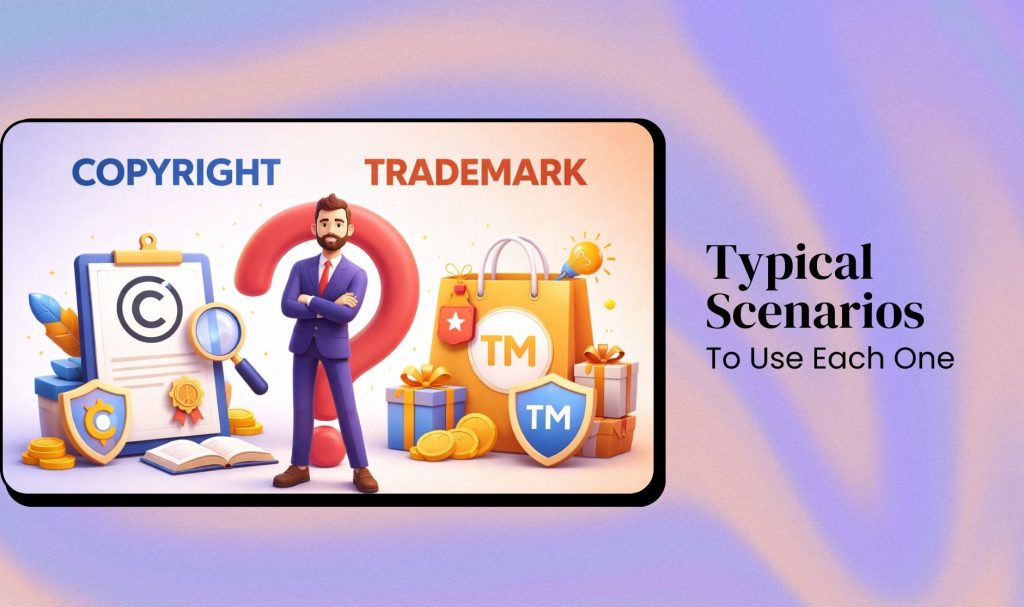
Copyright is the right choice when you create original content that can be copied or reproduced. Trademark protection is essential when building a brand.
Uses Of Copyright:
- Writers publishing books, blogs, or articles rely on copyright to protect their written work.
- Musicians and composers use copyright to safeguard songs and recordings.
- Photographers and artists depend on copyright to control the use of their images and artwork.
- Software developers use copyright to protect source code and program structure.
- Video creators, filmmakers, and animators use copyright to protect visual and audio content.
Uses Of Trademark
- Businesses launching a new product or service need to protect their brand name and logo.
- Startups often register trademarks early to secure identity before entering the market.
- E-commerce sellers use trademarks to protect product names and packaging.
- Manufacturers rely on trademarks to preserve brand reputation.
- Businesses expanding into new regions or countries use trademarks to prevent competitors from using similar branding.
Copyright Vs Trademark: Practical Tips To Secure Each Of These
Understanding the difference between copyright and trademark is only the first step.
The next step is knowing how to secure and maintain these rights properly.
While both protections aim to safeguard intellectual property, the process and requirements for each are different.
For Copyright
- Copyright protection begins automatically when an original work is created and fixed in a tangible form.
- This means the moment you write an article, compose music, record a video, or save software code, copyright exists.
- Although registration is not mandatory, it provides significant legal advantages.
- Registering copyright with the relevant national authority creates a public record of ownership.
- It also strengthens enforcement rights and may allow statutory damages and legal fee recovery in infringement cases.
- Creators should always maintain proof of creation. This includes drafts, raw files, timestamps, metadata, emails, and version histories.
- These records can be critical in disputes. Legal platforms like ClearTax and iPleaders recommend registration for creators who intend to commercialize or license their work.
For Trademark
- Trademark protection requires a more proactive approach. Firstly, you need to select a distinct and non-generic name or logo.
- Before you file, you must do a trademark search. This helps confirm that the mark is not already in use or registered.
- Additionally, you must not file without a search. It can lead to objections or legal conflicts.
- Once you clear these, the trademark application is filed in the relevant jurisdiction. Registration grants stronger legal rights and makes enforcement easier.
- However, registration alone is not enough. You ned to use the mark in commerce. Continuous use helps maintain rights.
- Trademark owners should monitor the market for infringement. Additionally, you need to renew filings at regular intervals.
Overlaps And When You Might Need Both
In some situations, copyright and trademark overlap. This happens when a creative work also functions as a brand identifier.
For example, a logo design is an artistic work protected by copyright. Now, let’s say that the logo represents a business.
Additionally, it also distinguishes its products or services. So, it qualifies for trademark protection.
Similarly, a musical jingle may be copyrighted as a sound recording and trademarked if it identifies a brand.
Another example is product packaging. The artistic elements may be protected by copyright, while the overall trade dress may be protected under trademark law.
Understanding this overlap is important. Copyright protects creative expression.
A trademark protects brand identity. When a work serves both purposes, applying both protections strengthens ownership and enforcement options.
Copyright Vs Trademarks: What Are The Common Misconceptions And Pitfalls?
We are all aware of the biggest confusion regarding the dynamics of these two.
From this confusion arise many other misconceptions. Now I sternly believe that when I am writing a guide about anything, I must remove any remaining misconceptions.
So, let’s take a closer look at all the common pitfalls and misconceptions regarding these two:
- One common misconception is that registering a domain name automatically provides trademark rights.
- Another mistake is assuming copyright protects brand names or logos. Copyright does not protect names, titles, or short phrases. These fall under trademark law.
- Some believe trademark registration protects the underlying product or content. It does not.
- Trademarks protect brand identifiers only, not the creative or functional aspects.
- Many people assume copyright lasts forever. It does not. Copyright expires after a defined period.
- Trademarks can last indefinitely, but only with proper use and renewal.
- Ignoring international differences is another major pitfall. Intellectual property laws vary across countries.
- What is protected in one jurisdiction may not be protected in another. iPleaders highlights that a lack of jurisdictional awareness often leads to the loss of rights in global markets.
Copyright Vs Trademark: What Are The International Considerations?
Copyright and trademark laws are territorial. This means protection is generally limited to the country where rights exist.
For copyright, many countries recognize protection under international treaties.
However, registration requirements and enforcement options differ. Some countries require local registration to enforce rights effectively.
For trademarks, registration is usually required in each country where protection is needed.
A trademark registered in one country does not automatically protect the brand elsewhere.
Businesses operating internationally must evaluate intellectual property laws in each target market.
Using international agreements can simplify filing, but local compliance remains essential. ClearTax notes that early international planning prevents conflicts and costly rebranding later.
Tags:



Related Articles



Comments Are Closed For This Article