








What Is The Secret Behind Growth Navigate Funding, And Why Are Startups Running Towards It?
02 March 2026
6 Mins Read

- What Role Does Growth Navigate Funding Play For Startups?
- What Are The Various Stages Of Growth Navigate Funding?
- 1. Pre-Seed and Seed Funding
- 2. Series A Funding Strategy
- 3. Series B and Beyond
- What Are The Different Sources Of Growth Navigate Funding?
- 1. Venture Capital Funding
- 2. Angel Investors and Private Backers
- 3. Bank Loans and Commercial Lending
- 4. Alternative Funding Approaches
- What Are The Criteria Investors Need In Growth Navigate Funding Strategies
- 1. Market Opportunity and Size
- 2. Traction and Revenue Metrics
- 3. Team Quality and Experience
- How Can You Build Strong Investor Relationships?
- What Are Some Strong Strategies For Growth Navigate Funding?
- 1. Strategic Partnerships and Corporate Venture
- 2. Grants and Non-Dilutive Capital
- 3. Setting Concrete Capital Goals
- 4. Maintaining Financial Discipline
When I had just started with my company, I had to face one of the biggest challenges known to entrepreneurs.
Yes, I am talking about securing funding. Rather, it is the main challenge for businesses looking to grow.
But I quickly passed the challenge with flying colours. This is because I understood a very helpful concept very fast.
I am talking about the concept or strategy of growth navigate funding.
I also know many other founders who understand Growth Navigate Funding principles clearly.
And guess what? They can access resources that help speed up product development. Also, you can use this to market growth.
And what did I do to succeed? I will explain my strategies here in this article.
I want to ensure that companies have everything they need to plan strategically.
Also, they would align with investors to build sustainable businesses.
What Role Does Growth Navigate Funding Play For Startups?

Growth Navigate Funding is the way companies systematically secure capital at different stages of development.
So, all the successful businesses connect their funding choices with key goals. Also, they give a lot of importance to market trends.
How companies manage their funding affects their:
- Ownership Structure
- Board Makeup
- Overall Direction
Additionally, all the early decisions can have lasting effects. So, this will help you if you want to prioritize sustainable growth.
This is precisely what I did. I stopped looking for just quick expansion. Additionally, there are a lot of reasons companies need money for:
- Hiring Staff
- Creating Products
- Growing Operations
Research from CB Insights shows that 38% of startups fail because they run out of cash or can’t raise more capital.
Using capital wisely allows businesses to gain market share before their competitors.
Timing funding raises to align with product launches or market validation helps reduce the risk of losing ownership.
What Are The Various Stages Of Growth Navigate Funding?
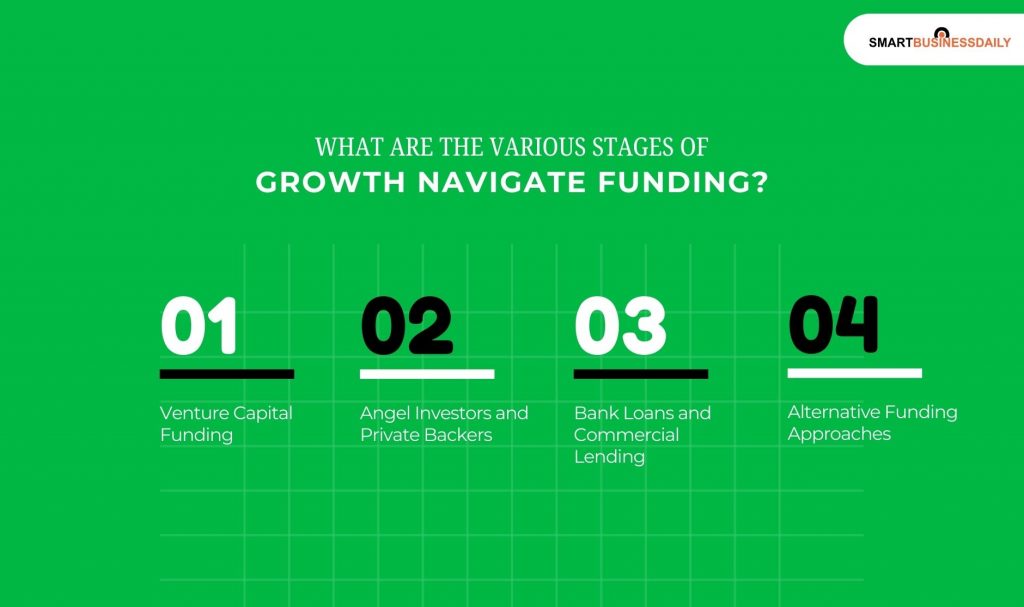
Startups go through different funding stages. Eventually, these stages match their growth.
So, I suggest that you properly understand these stages. It helps founders create the right materials.
Also, I used these to find the right investors.
1. Pre-Seed and Seed Funding
I am a huge fan of pre-seed funding. It supports initial product development. Also, I use this to test the market.
So, I usually raise between $50,000 and $500,000 from angel investors and accelerators. In fact, I also use my personal networks.
Seed funding helps launch products efficiently. Additionally, it also attracts early customers. In 2024, the median seed round reached $3.5 million.
Have a very good example for this. Google began with $100,000 in seed funding from Andy Bechtolsheim in 1998.
2. Series A Funding Strategy
Series A funding is for scaling businesses that have proven their product works in the market.
So, the venture capital firms usually lead these rounds. They are investing between $10 million and $20 million.
Investors look at the unit economics, customer retention, and market size.
Amazon raised $8 million in Series A funding from Kleiner Perkins in 1996, which helped it expand its catalog quickly.
3. Series B and Beyond
Series B funding supports market expansion and team growth. Companies raise between $25 million and $50 million to enter new markets or acquire other businesses.
Later funding rounds (Series C, D, E) prepare companies for going public or being acquired.
PayPal raised several rounds before its 2002 IPO. This valued the company at $1.2 billion.
What Are The Different Sources Of Growth Navigate Funding?
As an entrepreneur, I try to find growth navigate funding through several channels. So, I would agree that each source has its own benefits.
Additionally, it also requires different preparation.
1. Venture Capital Funding
Venture capital firms invest money from institutions in high-growth startups.
In 2024, VC investments reached $285 billion worldwide, according to PitchBook.
So, I started to study firms like Sequoia Capital and Andreessen Horowitz. They offer a lot of things, such as:
- Money
- Strategic Advice
- Industry Connections
Investor AB shows how institutional investors diversify their portfolios across different sectors.
2. Angel Investors and Private Backers
Angel investors provide early-stage funding from $25,000 to $500,000.
These individuals often share their industry knowledge along with financial support.
Angel networks work together to evaluate potential investments, which helps lower the risk for each investor.
Successful investments pay off when startups reach Series A valuations or have exit events.
3. Bank Loans and Commercial Lending
Traditional bank loans offer very efficient funding. It does not require giving up ownership for established businesses with income.
US Bancorp and other commercial banks offer term loans and lines of credit based on credit scores.
SBA-guaranteed loans help reduce risks for banks lending to eligible small businesses.
Interest rates usually range from 6% to 13%, depending on the type of loan and the borrower’s profile.
4. Alternative Funding Approaches
Crowdfunding platforms allow entrepreneurs to raise money directly from customers and get validation for their ideas.
Revenue-based financing gives businesses access to capital that they repay with a percentage of their monthly revenue.
Government grants support research-focused projects without requiring equity.
SBIR and STTR programs allocated $4.1 billion to small businesses in 2024.
What Are The Criteria Investors Need In Growth Navigate Funding Strategies
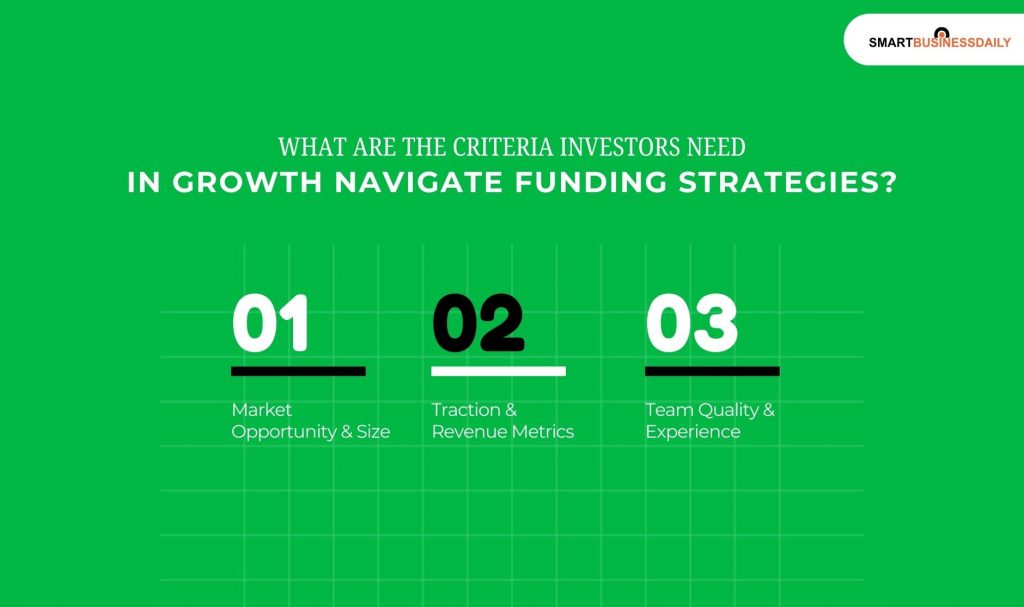
Investors look at startups using specific criteria at each funding stage.
So, I suggest that you know these factors by heart. It can help improve pitch effectiveness.
Also, it can increase the chances of getting funding.
1. Market Opportunity and Size
Venture investors want to see a potential market worth more than $1 billion.
The size of the market influences expected returns. Also, it impacts the level of risk for investors.
So, I suggest that the founders should show the market opportunity through detailed calculations. Also, they can refer to the industry research.
I always target large and growing markets. I believe it attracts institutional investors looking for good returns.
2. Traction and Revenue Metrics
I would always suggest that you have measurable traction. I can assure you that it helps confirm business ideas.
Additionally, the important metrics will improve your skillset altogether. These include:
- Monthly recurring revenue
- Customer acquisition costs
- Lifetime value ratios
Also, I would like to mention that at early stages, growth rates are more significant than absolute numbers.
Then, what does the consistent growth of 20% month-over-month indicate? It indicates product-market fit and scalable business models.
3. Team Quality and Experience
Do you know what the investors actually prefer? Founders with relevant experience. Also, they focus a lot on the ability to execute their plans.
So, this is a very important point for technical founders working in familiar industries. They surely have a better chance of success.
The team’s makeup also affects investor confidence. Teams that balance skills reduce risks. Also, they tend to make better decisions.
How Can You Build Strong Investor Relationships?

Listen. Successful fundraising takes time. I knew this. So, I connected with investors early. If you do so, you will build trust before seeking funds.
Also, you must track all the regular updates. They show progress and keep investor interest high.
In addition, I also follow monthly newsletters with updates on:
- Metrics
- Milestones
- Challenges
All of these keep potential backers informed.
Use financial projections to show you understand your costs. Being conservative with estimates builds trust.
On the other hand, the ambitious growth plans highlight market potential.
What Are Some Strong Strategies For Growth Navigate Funding?
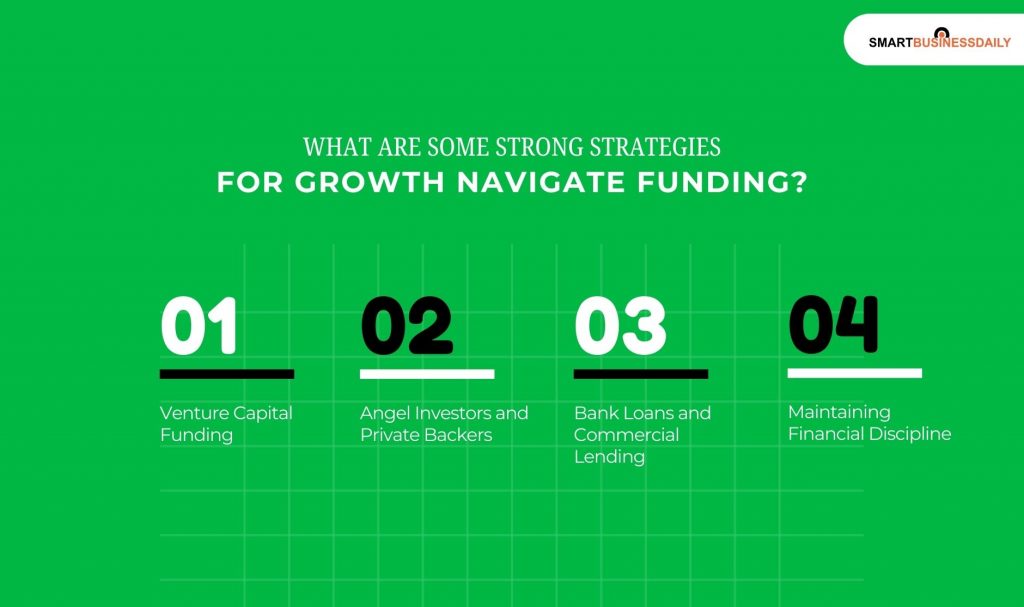
Once you understand these strategies and actually start following them, you will ace the game of funding for your company.
1. Strategic Partnerships and Corporate Venture
Corporate ventures can provide both money and strategic help. So, I suggest that you partner with established companies.
It can give you access to their customer base and distribution channels.
Revenue-sharing agreements align the goals of both partners. Joint ventures in similar markets can help you grow without competing directly.
2. Grants and Non-Dilutive Capital
Government and foundation grants can support specific projects without taking equity.
Startups focused on research can apply for
- SBIR Grants
- NSF Funding
- State Programs
Accelerator programs like Y Combinator, Techstars, and 500 Startups offer $125,000 for 7% equity, plus support and mentorship.
3. Setting Concrete Capital Goals
Set clear funding goals linked to your business milestones to boost investor confidence.
Creating detailed budgets that outline spending on hiring, marketing, and product development shows you are organized.
Aim to raise the right amount to prevent diluting ownership while ensuring you have enough resources.
Underfunding can pressure you later, while overfunding can complicate matters.
4. Maintaining Financial Discipline
Managing your burn rate can help you extend your runway and show that you run your business efficiently.
Monthly financial reviews help you track actual spending against planned budgets.
Analyzing variances can highlight ways to better manage resources and extend your cash reserves.




Related Articles



Comments Are Closed For This Article