







Corrugated Box Manufacturing Business: The Complete Strategic Industry Guide
08 July 2026
5 Mins Read
- Why Is Corrugated Box Manufacturing Business Becoming So Popular?
- 1. Boom In The Ecommerce Industry
- 2. Growth Of The Export Industry
- 3. Rising Demand For Eco-Friendly Packaging
- 4. Expansion Of The Manufacturing Sector
- 5. Affordable Manufacturing Costs
- Essential Machinery Infrastructure
- Different Requirements To Start A Corrugated Box Manufacturing Business
- 1. Legal Licensing And Environmental Clearances
- 2. Capital Investment And Working Funds
- 3. Plant Location And Zonal Layout
- 4. High-Capacity Power And Utility Infrastructure
- 5. Raw Material Supply Chains
- What Is The Manufacturing Process Of A Corrugated Box?
- 1. Initial Paper Selection
- 2. The Technical Corrugation Process
- 3. Precision Cutting And Slotting
- 4. Custom Flexographic Printing
- 5. Final Folding And Gluing
- 6. Rigorous Quality Control Evaluation
- The Corrugated Box Manufacturing Business Has Quite A Future
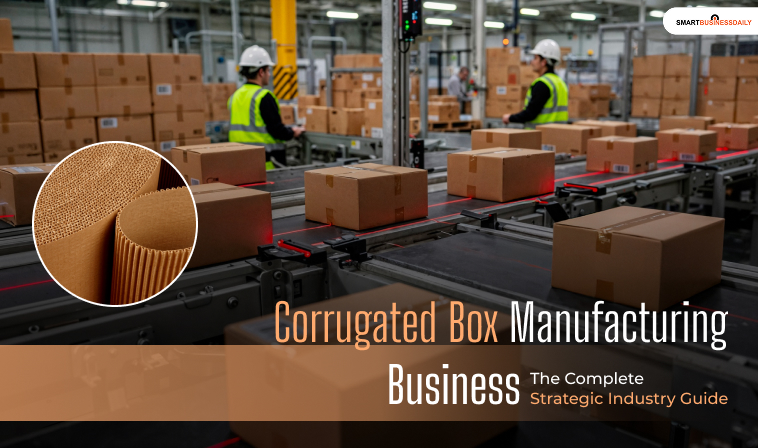
The global surge in e-commerce, consumer goods distribution, and industrial logistics has transformed the industrial packaging sector into a high-demand manufacturing market.
At the center of this supply chain network sits the corrugated box manufacturing business.
Additionally, corrugated fiberboard offers an exceptional:
- Strength-To-Weight Ratio
- Structural Customization Options
- Full Recyclability
These are the core reasons that it remains the standard for protective shipping containers worldwide.
For industrial investors, entrepreneurs, and supply chain strategists, launching or scaling a corrugated box manufacturing business represents a highly profitable, scalable opportunity.
This definitive guide delivers the complete structural layout needed to build and optimize
Also, it will provide all the necessary information you need to manage a rigid box manufacturing plant.
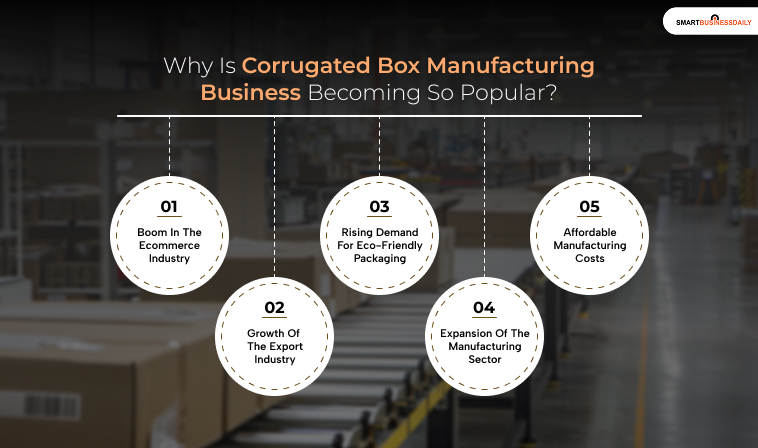
Why Is Corrugated Box Manufacturing Business Becoming So Popular?
The packaging industry is experiencing rapid growth.
Additionally, the increasing need for packaging solutions across various sectors is continually driving demand.
Several factors contribute to this expansion:
1. Boom In The Ecommerce Industry
As online shopping continues to flourish, businesses in this sector rely heavily on robust packaging materials.
Therefore, this helps them ensure safe delivery of products to customers.
This need creates a consistent demand for corrugated boxes.
2. Growth Of The Export Industry
Exporters require high-quality packaging boxes for international shipments.
Durable packaging is essential to prevent product damage during transit.
In addition, this further supports the demand for corrugated materials.
3. Rising Demand For Eco-Friendly Packaging
In response to environmental concerns, many companies are transitioning from plastic packaging to recyclable corrugated boxes.
This shift towards sustainable options is driving growth in the packaging sector.
4. Expansion Of The Manufacturing Sector
Currently, the market is being ruled by the manufacturing industry, which produces:
- Electronics
- Fast-Moving Consumer Goods (FMCG)
- Pharmaceuticals
- Machinery
These sectors continuously require packaging boxes to ensure product safety and integrity.
5. Affordable Manufacturing Costs
The production of corrugated boxes benefits from relatively low raw material and machinery costs compared to other manufacturing sectors.
Therefore, this makes it an accessible investment for businesses.
Essential Machinery Infrastructure
A modern production line requires a mix of automatic processing units to keep operating costs low:
| Machine Classification | Core Operational Function | Strategic Production Impact |
| Automatic Corrugating Line | Heats, moistens, and shapes the flutes while gluing the liners. | Serves as the high-speed heart of the entire facility. |
| Flexo Folder Gluer | Prints multi-color graphics, cuts slots, scores fold lines, and glues seams. | Combines four independent steps into one single automated process. |
| Rotary Die-Cutter | Uses custom steel blades to punch out non-rectangular, specialized box shapes. | Opens up lucrative markets like custom mailers and display trays. |
| Semi-Automatic Stitching Machine | Uses industrial wire staples to reinforce heavy-duty box joints. | Vital for producing rugged, export-grade industrial packaging. |
Different Requirements To Start A Corrugated Box Manufacturing Business
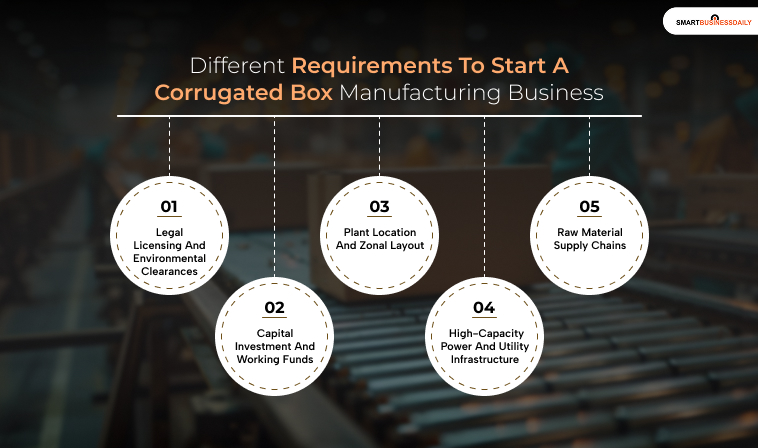
These are the various categories that you will have to sort out once you have decided to go forward with this business idea.
1. Legal Licensing And Environmental Clearances
To operate your facility legally, you must obtain various permits, including factory registrations.
Also, you have to arrange municipal land-use permits.
Additionally, you have to secure clearances from the pollution control board.
This way, you can ensure compliance with regulations concerning:
- Industrial Waste Management
- Noise Control
- Handling Of Paper Dust
2. Capital Investment And Working Funds
A well-structured financial plan is vital for success.
This includes a fixed capital investment for the purchase of high-speed machinery.
In addition, you would need to have a rolling working capital reserve. A lot of people seem to ignore this.
But this is very important for you to maintain a consistent inventory of raw paper reels.
3. Plant Location And Zonal Layout
You have to select an appropriate location for your plant.
Consider this as one of the most vital steps, where you ned to pay a bit more attention than usual.
Ideal industrial property should range from 10,000 to 25,000 square feet.
Additionally, it should be designed with specific zones to facilitate the efficient storage of:
- Raw Reels
- Active Corrugation
- Drying
- Staging Of Finished Products
4. High-Capacity Power And Utility Infrastructure
Your facility will require a reliable and robust utility infrastructure.
This includes a dedicated 3-phase industrial power connection that meets your machinery’s power demands.
Additionally, a commercial steam boiler system and a water-softening plant will likely be needed to support operational efficiency.
5. Raw Material Supply Chains
Establishing strong relationships with suppliers is key to ensuring uninterrupted production.
It is important for your procurement team to secure rolling supply contracts with paper mills for various types of Kraft paper, as well as:
- Specialized Bonding Starches
- Flexographic Inks
- Stitching Wire To Meet Demand
What Is The Manufacturing Process Of A Corrugated Box?
The process is quite simple and doesn’t involve many steps. Let’s take a look.
1. Initial Paper Selection
To begin the production lifecycle, manufacturers carefully select high-quality Kraft paper based on the specific strength and structural requirements of the final box.
This initial step dictates the overall bursting factor and load capacity of the packaging material.
2. The Technical Corrugation Process
Next, the selected paper rolls are fed into heavy machinery for corrugation.
During this stage, continuous fluted layers are structurally engineered and glued between flat sheets of paper to create rigid, multi-layered corrugated boards.
3. Precision Cutting And Slotting
Once the corrugated boards are securely bonded, they are transferred immediately to automatic cutting tables.
Here, the large sheets are trimmed and slotted with absolute precision to meet the client’s exact dimensional requirements.
4. Custom Flexographic Printing
Following the cutting stage, the blank sheets pass directly into high-speed printing units.
At this point in the workflow, brand logos, mandatory barcodes, shipping markers, and specific product details are printed cleanly onto the exterior liners.
5. Final Folding And Gluing
After the ink has fully dried, the printed layouts move sequentially into the assembly phase.
The boards are then folded along predefined score lines and permanently joined using industrial adhesives or heavy-duty wire stitching.
6. Rigorous Quality Control Evaluation
Finally, the finished boxes pass through a strict quality checking station before they are bundled for shipment.
During this ultimate step, inspectors thoroughly verify the final dimensions, structural durability, and edge crush resistance to ensure a flawless finish.
The Corrugated Box Manufacturing Business Has Quite A Future
The packaging industry is poised for significant growth, driven by the ongoing rise in online shopping and exports.
A key trend in this sector is the increasing demand for sustainable and recyclable packaging.
Therefore, this reflects a global shift toward environmentally friendly practices.
So, if you wish to enhance brand image and ensure product safety, you must take this into account.
In fact, all companies are making substantial investments in high-quality packaging solutions.
This dynamic environment presents promising opportunities for corrugated box manufacturers across the globe.




Related Articles