








Growth Navigate Startup Tools: The Hidden Tech Stack Behind 10x Startup Growth
30 June 2026
9 Mins Read

- The Quick Comparison Table
- What Makes A Great Tool For Navigating Startup Growth?
- · The Shortest Time-To-Value
- · Integration Without Change
- · Scalability That Does Not Come At A Cost
- Top Growth Navigate Startup Tools: 2026 Guide
- 1. HubSpot
- 2. Google Analytics 4
- 3. Slack
- 4. Notion
- 5. Salesforce Starter Suite
- 6. Zapier
- 7. Puzzle
- 8. Miro
- 9. Jasper
- How Do These Tools Fit Into Your Daily Routine?
- Why Do These Startup Platforms Matter So Much Right Now?
- The Most Frequent Errors That Will Drag Your Team Down
- Free vs. Paid: What Makes the Most Sense For Your Budget?
- How To Keep Your Tech Stack Fresh And Ahead Of The Curve?
Are you looking for a quick answer? HubSpot is hands down the best all-in-one platform for startups.
When it comes to performing certain tasks, consider Google Analytics 4 for tracking, Slack for chatting, Notion for note-taking, Salesforce for sales, Zapier for automation, Puzzle for money, Miro for planning, and Jasper for AI writing.
By 2026, building a thriving startup will require much more than just a brilliant idea.
There will be a need to make wise, well-organized changes regarding marketing, financing, and daily business operations.
Without a well-organized system, you will end up with a haphazard collection of random apps, and growth will be stressful
Your team will feel less pressured as you equip yourself with the right growth and navigate startup tools.
This will also help you to stay organized, handle financial risks, and grow disarmingly.
A neat collection of tools is what ultimately keeps a team focused on achieving higher performance and increasing sales, rather than wasting time.
The Quick Comparison Table
| Tool | Best For | Scalability | Cost-to-Value | Core Value for Startups |
| HubSpot | Unifying Sales & Marketing | 5/5 | 4/5 | Keeps sales and marketing perfectly aligned from day one. |
| GA4 | User Behavior Analytics | 5/5 | 5/5 | Delivers deep insights into customer and visitor behavior. |
| Slack | Team Communication | 5/5 | 4/5 | Enables instant team chat and reduces messy emails. |
| Notion | Company Knowledge Base | 4/5 | 5/5 | Acts as your company’s brain to organize documents and notes. |
| Salesforce | Enterprise B2B Sales | 5/5 | 3/5 | Scales up corporate, business-to-business sales pipelines. |
| Zapier | Workflow Automation | 5/5 | 3/5 | Eliminates manual grunt work by connecting different apps. |
| Puzzle | Financial Runway Management | 4/5 | 4/5 | Tracks startup money, budgets, and financial health. |
| Miro | Visual Collaboration | 4/5 | 4/5 | Provides virtual whiteboards for remote team brainstorming. |
| Jasper | AI Content Production | 4/5 | 3/5 | Speeds up marketing copy and content creation at scale. |
What Makes A Great Tool For Navigating Startup Growth?
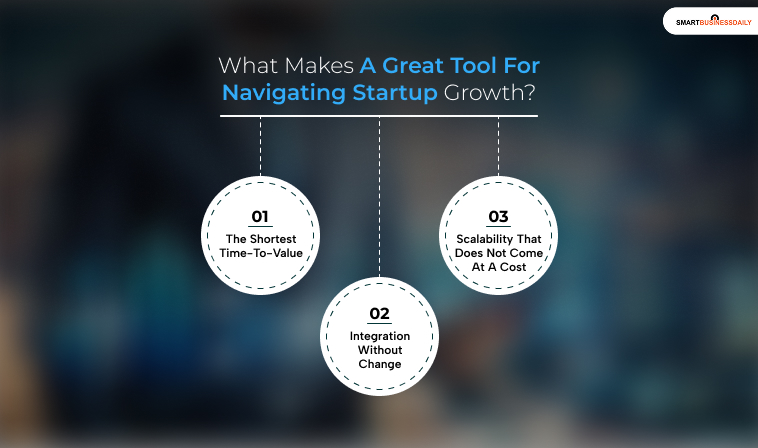
Choosing the right growth navigation startup tools means choosing software that actively saves you time and money without causing more subscription fatigue.
Software that understands these three major pillars is the best one:
· The Shortest Time-To-Value
The software should be so simple to use and set up that it can get you the first actual, measurable results within days rather than months.
· Integration Without Change
It should be possible to make it work with the other components of your tech stack without writing complex, custom code.
· Scalability That Does Not Come At A Cost
Let the software have a reasonably priced first tier for small teams, while also being capable of providing support to thousands of users.
A really good startup tool, in the end, will take care of a major operational headache you have today, and at the same time will not restrict your business from growing at a later time.
Read further to know more about low-cost business ideas with high profit.
Top Growth Navigate Startup Tools: 2026 Guide
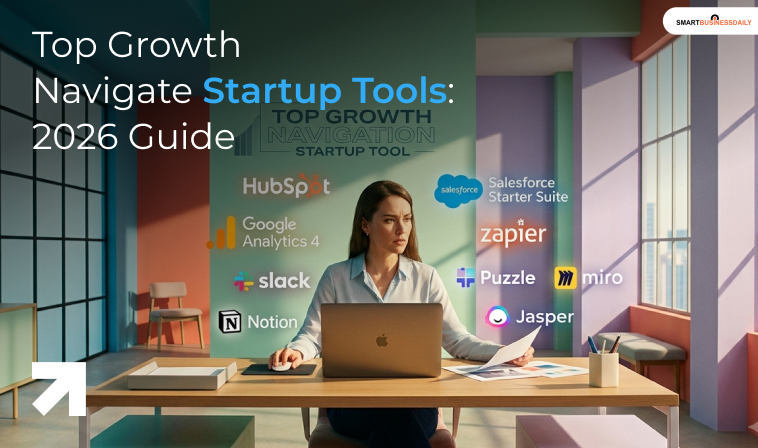
Here is a quick breakdown of the growth-navigate startup tools you need to beat subscription fatigue.
1. HubSpot
HubSpot is an all-in-one growth engine. It combines your marketing, sales, and service tools into one single dashboard.
The Good: The free CRM is genuinely great for small teams. It stops your data from getting trapped in lonely silos. Plus, it includes excellent time-savers like automated email tracking and easy meeting schedulers.
The Bad: Upgrading from the “Starter” plan to the “Professional” tier comes with a massive, painful price increase.
The huge amount of features can also feel overwhelming for beginners.
Pricing:
Free plan available
Starter: ~$20–$50/month
Professional: ~$800+/month
Overall Rating: ⭐ 4.6/5
Quick Scores:
- Scalability: 5/5
- Integration: 5/5
- Ease of Use: 4/5
- Cost-to-Value: 4/5
- Data Visibility: 5/5
2. Google Analytics 4
GA4 remains an unmatched platform for understanding user behavior. It provides detailed information on user interactions with your website or app.
The Good: It is practically free for most startups. Besides tracking simple page views, it measures specific user behavior, such as button clicks and video plays.
Additionally, it has a great synergy with Google Ads.
The Bad: One has to struggle with it for quite some time to understand how to use it. It is not easy to comprehend the main screen, and you might even feel the need for some tutorials to create your first custom report.
Price:
Free: $0
GA4 360: Starting at around $50, 000/year
Overall Rating: ⭐ 4.4/5
Quick Scores:
- Scalability: 5/5
- Integration: 4/5
- Ease of Use: 3/5
- Cost-to-Value: 5/5
- Data Visibility: 5/5
3. Slack
Slack is becoming the virtual main office for teams these days. It eliminates those unmanageable email chains and substitutes them with clean, structured chat channels.
On top of that, it brings all other growth tools you use to one single place.
The Good: You can communicate in real time. With its powerful search tool, getting to old files or decisions is lightning quick.
Moreover, it supports integration with 500+ apps, bringing all your alerts together in one place.
The Bad: If you are not careful with managing notifications, the constant buzzing can completely annihilate your focus. The free version also restricts your message archive to just 90 days.
Price:
Free version available
Pro: Approximately $7, $10/user/month
Business+: Approximately $12, $15/user/month
Overall Rating: ⭐ 4.5/5
Quick Scores:
- Scalability: 5/5
- Integration: 5/5
- Ease of Use: 5/5
- Cost-to-Value: 4/5
- Data Visibility: 3/5
4. Notion
Notion is like the ultimate platform for your work. It merges your wikis, project boards, and documents into a single, flexible interface.
By combining several software subscriptions into one, it even helps you to save money.
The Good: It can easily replace four or five disparate tools. You have the flexibility to design the exact layout and workspace your team requires. With real-time collaboration, working together on editing is a breeze.
The Bad: The open-canvas design may become very disorganized if there are no strong rules for organizing. Moreover, the mobile application may feel laggy when compared to the desktop one.
Pricing:
A Free plan is available
Plus: ~$8, $10/user/month
Business: ~$15, $18/user/month
Overall Rating: ⭐ 4.5/5
Quick Scores:
- Scalability: 4/5
- Integration: 4/5
- Ease of Use: 3/5
- Cost-to-Value: 5/5
- Data Visibility: 3/5
5. Salesforce Starter Suite
Salesforce Starter Suite delivers enterprise-grade sales capabilities to a growing startup.
It provides smaller groups with a strong backbone that will serve them even when their B2B sales pipeline becomes very large.
The Good: There will be no need to perform a difficult data migration to a larger system later.
The reporting and analytics features are extremely strong. It maintains the sales, service, and marketing profiles jointly.
The Bad: Most of the time, it is a very powerful vehicle for quite simple businesses that will have a difficult time operating it.
Also, the value score is lower because it is more expensive than other competitors.
Pricing:
Starter Suite: ~$25, $35/user/month
Overall Rating: ⭐ 4.2/5
Quick Scores:
- Scalability: 5/5
- Integration: 5/5
- Ease of Use: 3/5
- Cost-to-Value: 3/5
- Data Visibility: 5/5
6. Zapier
Zapier is like the invisible digital strand that holds the web together, facilitating a smooth flow of your work.
It rescues small teams from tedious data-entry drudgery by merging your various growth-navigation startup tools to work automatically.
The Good: Zapier can save you from doing hundreds of hours of manual copy-pasting.
Besides, the non-technical founders can make complex integrations fully code-free. The program runs efficiently in the background 24/7 without requiring human intervention.
The Bad: The price increases rapidly as your monthly task quantity grows.
Highly advanced automated workflows can fail without warning if an app updates its backend API.
Pricing:
Free plan available
Starter: ~ $20/month
Professional: ~ $70, $300+/month (usage-based)
Overall Rating: ⭐ 4.4/5
Quick Scores:
- Scalability: 5/5
- Integration: 5/5
- Ease of Use: 4/5
- Cost-to-Value: 3/5
- Data Visibility: 4/5
7. Puzzle
Puzzle is a great choice if you are thinking of changing your old accounting software to a smart, modern one.
It uses AI to analyze complex financial data and turn it into a clear, easily understandable strategy that a founder can confidently present to an investor.
The Good: It takes only a few minutes to generate deep financial statements, whereas it used to take days.
It also explains complicated burn rate and runway metrics in a way that a founder can understand. Besides, it is only a startup model.
The Bad: Compared to the industry giants like QuickBooks, it is a relatively new player.
It doesn’t have some features commonly used by traditional brick-and-mortar businesses.
Pricing:
Estimated: ~$100, $500/month (varies by company size)
Overall Rating: ⭐ 4.3/5
Quick Scores:
- Scalability: 4/5
- Integration: 4/5
- Ease of Use: 4/5
- Cost-to-Value: 4/5
- Data Visibility: 5/5
8. Miro
Miro offers an endless online whiteboard for collaborative visual thinking. It is considered the best digital canvas.
This further supports hybrid teams in conducting agile sprints and bridging the gap between creative brainstorming and product strategy.
Good things: This is very easy to use, even for first-time users. Secondly, it greatly helps in demonstrating complex thoughts that cannot be expressed through regular text alone.
Lastly, it is highly effective at keeping remote teams engaged at all times.
Bad things: Large project boards with thousands of items may take a long time to load. Also, it can be quite challenging to locate specific items in an enormous, packed workspace.
Pricing:
Free plan available
Starter: ~$8/user/month
Business: ~$16/user/month
Overall Rating: ⭐ 4.5/5
Quick Scores:
- Scalability: 4/5
- Integration: 4/5
- Ease of Use: 5/5
- Cost-to-Value: 4/5
- Data Visibility: 3/5
9. Jasper
Jasper is a top AI platform designed especially for business marketing. It differentiates itself from other chatbot tools on the market by using your brand voice.
This further enables small production teams to confidently scale content production and compete with larger companies.
Good things: It creates focused copy in huge amounts that human teams alone cannot match.
The tool has been trained in-depth on core marketing concepts to help generate actual conversions. This ensures that the message is consistent in all your social media platforms.
Bad things: The pricing model is considerably above what basic AI writing tools cost. Besides, the outputs have to be strictly reviewed, edited, and fact-checked by humans.
Pricing:
Creator: ~$49/month
Teams: ~$125+/month
Enterprise: Custom pricing
Overall Rating: ⭐ 4.1/5
Quick Scores:
- Scalability: 4/5
- Integration: 3/5
- Ease of Use: 4/5
- Cost-to-Value: 3/5
- Data Visibility: 3/5
Related Article For You: Best Ways To Support Local Businesses In 2026: An Overview
How Do These Tools Fit Into Your Daily Routine?
These platforms connect with the software that you are already using.
For example, using a CRM system, contacts will be automatically synchronized with email marketing tools.
While the numbers shown in the reports will be fetched directly from the sales pipeline.
Hence, this way, double data entry is avoided, and the information is always kept the same.
Another benefit of these tools is that when time-consuming tasks, such as sending follow-up emails, are automated.
Thus, people have more time on their hands and, instead of low-level work, can concentrate on important projects.
So, who would most likely be interested in these solutions? Here’s the list:
- Business Owners and Board Members decide on the software, define the company’s objectives, and monitor overall results.
- Staff in the Sales and Marketing Departments are mainly concerned with lead generation, advertising activities, and conversion rate analysis.
- Team members in Operations & Product who deal with managing work processes, preparing company resources, and delivering product features according to the schedule.
Regardless of such differences, the common purpose remains the same: achieving the least resistance/lowest friction.
Why Do These Startup Platforms Matter So Much Right Now?
They address three major issues simultaneously. For one thing, they accelerate customer acquisition by guiding you through successful methods.
For another, automated reports minimize internal waiting periods and ensure that everyone is on the same page.
Finally, they help eliminate guesswork and replace it with solid data.
As a case in point, startups that leverage purpose-built platforms reach profitability 8 months earlier and cut customer acquisition costs by 40%.
The Most Frequent Errors That Will Drag Your Team Down
- Introducing too many tools: This results in heavy platform overlap and really confuses your team.
- Neglecting staff training: Besides the low adoption rate, you essentially throw away your subscription fees.
- Failure to consider system compatibility: Your precious business data will be locked inside segregated, isolated tools.
Make sure you explore possible integrations before you decide to pay for a subscription.
Planning to start a business, check out our blog on top 10 most successful businesses to start and begin your journey today!
Free vs. Paid: What Makes the Most Sense For Your Budget?
Free plans are perfect for early testing. However, paid tiers unlock advanced automation, deeper analytics, and priority customer support.
Most bootstrapped startups spend 15% to 20% of their budget on software.
Start simple with free options, then upgrade your tiers once your team completely outgrows the basic features.
How To Keep Your Tech Stack Fresh And Ahead Of The Curve?
Choosing software is not a one-time choice. Regular reviews help your team retire outdated platforms and safely test new alternatives.
Leaders should follow trusted reviews and encourage a data-first mindset. Consistently measuring your tools ensures they deliver long-term value, turning limited startup resources into real growth momentum.




Related Articles



Comments Are Closed For This Article