








Life Insurance And Inflation: Can An Inflation Rider Protect Your Coverage?
9 Mins Read
Published on: 31 October 2022
Last Updated on: 17 August 2026

- How Does Life Insurance Work?
- Term Life Insurance:
- Permanent Life Insurance:
- How Does Inflation Affect Life Insurance?
- A Simple Inflation Example:
- Why Is Inflation Not Good For Life Insurance?
- What Is A Life Insurance Inflation Rider?
- What Are the Benefits Of An Inflation Rider?
- 1. Protects Your Death Benefit Against Inflation
- 2. Grows your life insurance coverage
- 3. Offers flexibility
- What Are The Drawbacks Of An Inflation Rider?
- 1. Higher Premiums:
- 2. The Increase May Be Limited:
- 3. It May Not Match Actual Inflation:
- 4. Not Every Policy Offers The Same Option:
- Inflation Rider vs. Buying More Life Insurance Later:
- How Much Life Insurance Coverage Do You Need?
- How To Choose An Inflation Rider?
- Should You Add An Inflation Rider To Your Life Insurance Policy?
- How Often Should You Review Your Life Insurance?
- Guard Your Life Insurance Policy Against Inflation:
Inflation can change how much money your family needs in the future.
So, a $500,000 life insurance death benefit, for instance, may sound substantial today. But if you bought the policy decades before your family needs it, that same $500,000 may not cover the same expenses.
This raises an important question: Does life insurance protect the purchasing power of your death benefit against Inflation?
Usually, you should not assume that it does.
Many life insurance policies provide a stated death benefit under their terms. So, if the coverage amount does not increase over time, Inflation can reduce what that benefit can buy.
Some insurers offer riders or policy features that can increase coverage over time. Also, these options vary by insurer and policy, and they may increase the cost of coverage.
Before buying or changing a policy, review the specific terms and ask the insurer how the benefit can change over time.
In this context, I will do a deep dive into a life insurance account and break down in detail how an inflation rider can protect your coverage.
Stay tuned.
How Does Life Insurance Work?

Life insurance is designed to provide money to the beneficiaries named in the policy when the insured person dies. The death benefit can help replace lost income, pay debts, cover final expenses, and support a family’s longer-term financial needs.
The two broad categories are term life insurance and permanent, or cash-value, life insurance.
Term Life Insurance:
Term life insurance provides coverage for a specified period.
For example, a policy might provide coverage for 10, 20, or 30 years. If the insured dies while the policy is active, the beneficiaries generally receive the policy’s death benefit.
Also, term insurance is often less expensive than permanent insurance, particularly when coverage is purchased for a defined period.
Many level-term policies keep the death benefit and premium level throughout the term, subject to the policy terms.
Permanent Life Insurance:
Permanent life insurance is designed to provide coverage for the insured’s lifetime as long as the policy remains in force. Some permanent policies also build cash value. Whole life and universal life are examples of cash-value life insurance.
Moreover, the way cash value grows and how policyholders can access it depends on the type of policy and its terms.
Policyholders may have options to borrow against or withdraw from cash value, but these actions can affect the policy and the amount ultimately available to beneficiaries.
How Does Inflation Affect Life Insurance?
Inflation does not necessarily change the stated death benefit on a life insurance policy. Instead, it changes the purchasing power of that benefit.
Consider a simple example: Suppose you purchase a $500,000 policy today. So, if the policy continues to provide a $500,000 death benefit for several decades, your beneficiaries may receive $500,000 when you die.
But the cost of housing, education, healthcare, food, and other necessities may be considerably higher by then. That means the nominal benefit remains the same while its real-world purchasing power falls.
This is why Inflation should be considered when deciding how much life insurance you need.
The National Association of Insurance Commissioners specifically recommends considering how Inflation could affect future financial needs when evaluating life insurance coverage.
A Simple Inflation Example:
Imagine that Inflation averages 3% per year.
At that rate, prices roughly double over about 24 years.
So, if you buy $500,000 of coverage today and the death benefit never increases, that $500,000 could have significantly less purchasing power two decades later.
This does not mean your policy has lost money.
It means the same dollar amount buys less. That distinction is important when planning long-term financial protection.
Why Is Inflation Not Good For Life Insurance?
There are three reasons not to consider Inflation for a life insurance account. Let’s check them out.
- Inflation can affect your life insurance. Those who have medical or education Inflation have the chance to lose effective life insurance policies.
- Inflation has played the role of insurance policies. Sometimes people buy term policies for the future. In this case, Inflation can’t help to fulfill the dreams.
- Last but not least, Inflation can decrease purchasing power.
However, life insurance holders are curious about life insurance vs savings accounts. However, both accounts maintain a distinct line. They are not the same. In fact, people get more interest from life insurance than from savings accounts.
What Is A Life Insurance Inflation Rider?

A life insurance rider is an optional provision that modifies or adds benefits to a policy.
Riders vary by insurer and policy. Some increase coverage, while others provide different types of protection or flexibility. Adding a rider can also increase your premium.
An inflation rider, when offered by an insurer, is designed to help address the impact of Inflation by increasing coverage according to the terms specified in the policy.
However, there is no single standard inflation rider that works the same way across every life insurance policy. The increase might be based on a fixed percentage, an inflation index, or another formula defined by the insurer.
That is why you should read the rider carefully rather than assuming that it will automatically keep your coverage fully aligned with Inflation.
What Are the Benefits Of An Inflation Rider?
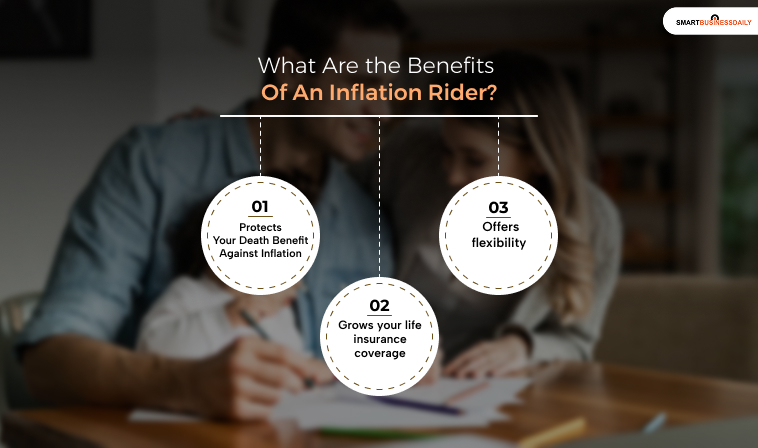
If your policy offers an inflation-related rider, it may provide several advantages.
1. Protects Your Death Benefit Against Inflation
Inflation riders guard your death benefit’s value against being lost to Inflation. This helps your loved ones receive the same or similar value from your death benefit instead of letting Inflation eat it away.
The inflation rider is especially beneficial if you have a long life expectancy. Without it, your death benefit could be at risk of losing tens of thousands of dollars in value.
2. Grows your life insurance coverage
An inflation rider could help you increase your death benefit over time, depending on the inflation rate. This can offer your loved ones a larger amount of money if you pass away while the policy is active.
For example, if Inflation is 3%, but your inflation rider increases your death benefit by 5%, your death benefit will be worth 2% more yearly. This can be especially helpful on whole-life insurance policies since these last for a lifetime and don’t let you adjust your death benefit after taking out the policy.
3. Offers flexibility
The inflation riders available will vary depending on the insurance provider, allowing you to choose how your coverage amount increases. Simple inflation protection and compound inflation protection are examples of two options to choose from.
Simple inflation riders increase the death benefit amount automatically each year. The percentage can be selected with your insurer and typically ranges from 3-5%. Compound inflation riders also increase the coverage amount by a percentage each year but increase with compound interest rather than a flat amount.
What Are The Drawbacks Of An Inflation Rider?
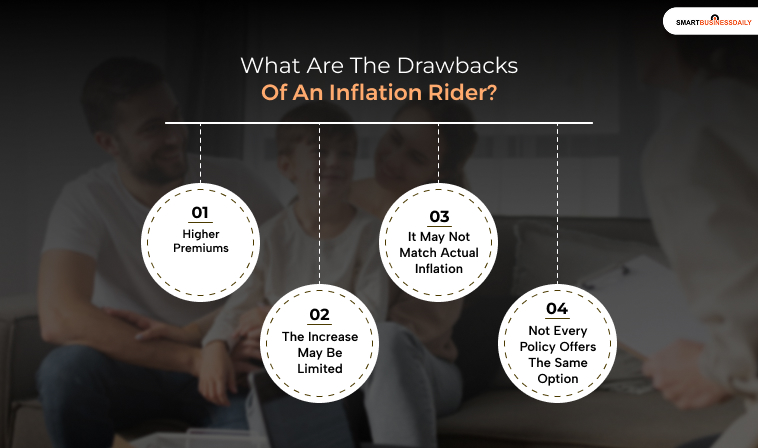
An inflation rider is not automatically the best choice for every policyholder. So, there are several factors to consider before adding one.
1. Higher Premiums:
Adding a rider can increase what you pay for the policy. The additional cost needs to make sense compared with the amount of additional coverage you receive.
2. The Increase May Be Limited:
Some riders may have a maximum increase, a maximum death benefit, or a specific period during which increases apply. Read the rider’s terms carefully.
3. It May Not Match Actual Inflation:
A rider that increases coverage by a fixed percentage does not necessarily track the actual inflation rate. For example, a policy that increases coverage by 3% annually may not fully offset a period when Inflation is higher. Likewise, if Inflation is lower, you may be paying for an increase that exceeds the actual change in prices.
4. Not Every Policy Offers The Same Option:
Life insurance products differ considerably. The availability and structure of riders depend on the insurer, policy type, and contract. So, ask the insurer whether an inflation-related rider is available and exactly how it works.
Inflation Rider vs. Buying More Life Insurance Later:
An inflation rider is not the only way to address changing insurance needs.
Also, you may be able to purchase additional life insurance later, depending on your circumstances and ability to qualify for coverage.
However, waiting can have disadvantages – your age, health, income, and financial situation may change. Moreover, those changes can affect whether you qualify for new coverage and how much you pay.
In addition, some policies also offer features that allow policyholders to increase coverage at specified times without additional evidence of insurability. A guaranteed insurability rider, for example, can allow increases under certain conditions.
The right approach depends on your financial situation and the terms of the policy.
How Much Life Insurance Coverage Do You Need?

Inflation is only one factor when deciding how much life insurance to buy. So, start by looking at what your family would actually need if you died.
Also, in this context, you need to consider:
1. Income Replacement: How much of your household income would disappear?
2. Debts: Would your family need to pay a mortgage, personal loans, or other debts?
3. Education: Would you want the death benefit to help pay for your children’s education?
4. Final Expenses: Consider funeral and other end-of-life costs.
5. Future Financial Goals: Think about the financial goals your family would still need to meet without your income.
6. Inflation: Finally, consider how those expenses could change over the period you expect the policy to remain in force.
Also, NAIC recommends considering factors such as household income, dependents, debts, education costs, final expenses, and the effect of Inflation when determining coverage needs.
How To Choose An Inflation Rider?
If an insurer offers an inflation-related rider, do not compare policies based only on the headline percentage. You can just ask these questions:
- How does the death benefit increase?
- Is the increase fixed or tied to an inflation measure?
- Is the increase simple or compounded?
- Is there a maximum increase?
- How long does the increase continue?
- Does the rider increase my premium?
- Can I decline future increases?
- Does the rider affect the policy’s cash value?
- What happens if I stop paying premiums?
- What happens to the rider if I change or convert the policy?
The answers should be included in the policy documents or explained by the insurer or licensed insurance professional.
Should You Add An Inflation Rider To Your Life Insurance Policy?

There is no universal answer.
An inflation rider may make sense if you expect to keep your coverage for a long time and want a mechanism that can increase the death benefit over time.
Moreover, it may be less attractive if the additional premium is high or if you have another strategy for reviewing and increasing your coverage.
Your decision should also account for the type of life insurance you have, how long you expect to need it, your current coverage, your family’s future financial needs, and the specific terms of the rider.
So, if you already have a policy, do not cancel it simply because you are considering another option – just compare the existing policy with the proposed coverage and understand the consequences of replacing it.
NAIC specifically advises consumers to study both policies before replacing existing life insurance.
How Often Should You Review Your Life Insurance?
Life insurance should not necessarily be a set-it-and-forget-it decision. So, it’s best to review your coverage when your circumstances change.
On that note, the important events can include:
- Marriage or divorce
- Birth or adoption of a child
- Buying a home
- Taking on significant debt
- Starting or selling a business
- A major change in income
- Retirement
- Changes in your family’s financial responsibilities
Also, you should consider reviewing your coverage periodically to determine whether the death benefit still matches your family’s needs.
Guard Your Life Insurance Policy Against Inflation:
Life insurance can protect your loved ones if you pass away, but Inflation can eat away at the value of your death benefit and leave them with less.
Fortunately, an inflation rider can protect against that and even grow your death benefit for slightly higher premiums. Plus, this rider is very flexible. So if you want to guard your policy against Inflation, consider an inflation rider as you shop for life insurance quotes from insurers.
Read Also:
- Plan a Career as a Life Insurance Agent and Have a Lucrative Career Ahead
- Cover your Life with the Best Life Insurance
- How To Qualify For No-Exam Life Insurance




Related Articles



Comments Are Closed For This Article