








What Is A Self Managed Super Fund And How Does It Work?
13 Mins Read
Published on: 17 April 2025
Last Updated on: 07 August 2026

- What Is A Self Managed Super Fund (SMSF)?
- Advantages And Disadvantages Of An SMSF:
- SMSF vs Industry Super Fund vs Retail Super Fund
- Comparison Table:
- Which Super Fund Is Right for You?
- How Does A Self Managed Super Fund Work?
- A) Contributions And Rollovers:
- B) Investment Management:
- C) Accessing Benefits:
- Setting Up And Running An SMSF:
- Is A Self Managed Super Fund (SMSF) Right For You?
- Who Benefits Most From An SMSF?
- When Should You Avoid An SMSF?
- How Much Super Should You Have Before Starting An SMSF?
- Who Shouldn't Run An SMSF?
- Common SMSF Mistakes To Avoid:
- 1. Poor Record Keeping:
- 2. Failing To Create Or Review An Investment Strategy:
- 3. Missing Audit And Compliance Deadlines:
- 4. Investing In Inappropriate Assets:
- 5. Ignoring Diversification:
- 6. Using Fund Assets For Personal Benefit:
- 7. Failing To Update The Trust Deed:
- Key Takeaways:
- Frequently Asked Questions (FAQs):
- 1. How much money do I need to start an SMSF?
- 2. Can one person have an SMSF?
- 3. Can an SMSF buy residential or commercial property?
- 4. Can an SMSF borrow money?
- 5. What are the annual costs of running an SMSF?
- 6. What happens if an SMSF breaks the rules?
- 7. Can I transfer my existing super into an SMSF?
- 8. Do SMSFs pay tax?
- 9. Can I access my SMSF whenever I want?
- 10. Is an SMSF the right choice for everyone?
Self Managed Super Funds control $868.7 billion in assets throughout Australia. These funds represent 26% of all superannuation assets.
More than 605,000 SMSFs manage retirement savings for over 1.1 million members, making them a crucial part of Australia’s superannuation system.
A self-managed super fund differs from traditional super funds in several ways.
Regular super funds rely on professional trustees to manage investments, but SMSFs put you at the helm as both member and trustee.
Your role includes making all investment decisions and ensuring legal compliance. Most trustees spend more than eight hours each month managing their funds effectively.
Let’s dive into SMSFs’ structure and day-to-day operations. This guide will help you understand setup requirements and management duties. You’ll also discover if an SMSF aligns with your retirement goals.
What Is A Self Managed Super Fund (SMSF)?
A Self Managed Super Fund (SMSF) is a form of retirement savings. The Australian Taxation Office (ATO) regulates these private superannuation funds where members also serve as trustees.
Your SMSF can include up to six members. Most members come from the same family, though business partners can also team up.
Many people set up SMSFs with their spouse or partner, while some run them solo. Every member must act as a trustee or become a director of the corporate trustee.
This means everyone takes equal responsibility for decisions and for following the law.
You can structure your SMSF’s trustee arrangement in two ways:
- Individual trustees – members serve as trustees with assets in their names
- Corporate trustee – a company becomes the legal trustee with members as directors
Your SMSF works as a legal tax structure that aims to secure your retirement. Trustees must:
- Act honestly in fund operations
- Show skill and care in management
- Protect all members’ interests
- Keep fund and personal assets separate
- Create and follow an investment strategy
SMSFs differ from APRA-regulated funds mainly in how much control you have and what you need to do.
Regular super funds have professional trustees handling everything, but SMSF members make their own investment choices, follow super laws, and work directly with the ATO.
These funds must follow strict guidelines. Trustees can only access their benefits under specific conditions, like reaching retirement age or paying dependents after death.
Breaking these rules leads to heavy penalties – from administrative fines to mandatory education or losing the fund’s compliance status.
Advantages And Disadvantages Of An SMSF:
Like any retirement investment option, a Self Managed Super Fund (SMSF) comes with both benefits and responsibilities.
While an SMSF offers greater control over your retirement savings, it also requires active management and strict compliance with Australian superannuation laws.
Moreover, understanding the advantages and disadvantages can help you determine whether managing your own super is the right choice.
| Advantages | Disadvantages |
|---|---|
| Greater control over investment decisions and retirement planning | Trustees are legally responsible for managing the fund and ensuring compliance |
| Access to a broader range of investment options, including direct property and shares | Ongoing administration, accounting, and audit costs can be higher than traditional super funds |
| Flexibility to create an investment strategy tailored to your financial goals | Strict ATO regulations and reporting requirements must be followed |
| Greater estate planning flexibility for distributing retirement benefits | Managing an SMSF requires a significant time commitment and financial knowledge |
| Potential tax planning opportunities through strategic investment and retirement planning | Non-compliance with superannuation laws can result in financial penalties or the fund losing its complying status |
Before establishing an SMSF, carefully weigh these advantages against the responsibilities involved.
So, if you’re comfortable making investment decisions, maintaining detailed records, and meeting ongoing compliance obligations, an SMSF can provide greater flexibility and control over your retirement savings.
However, if you prefer a hands-off approach, an industry or retail super fund may be a more suitable option.
SMSF vs Industry Super Fund vs Retail Super Fund
Choosing between a Self Managed Super Fund (SMSF), an industry super fund, and a retail super fund depends on:
a) How much control you want over your retirement savings.
b) Your investment experience.
c) The level of responsibility you’re willing to take on.
While SMSFs offer greater flexibility and investment choice, they also require active management and strict compliance with Australian superannuation laws.
Comparison Table:
So, the table below highlights the key differences between these three superannuation options.
| Feature | Self Managed Super Fund (SMSF) | Industry Super Fund | Retail Super Fund |
|---|---|---|---|
| Who manages the fund? | Members act as trustees and manage the fund themselves. | Professional trustees manage the fund on behalf of members. | Professional fund managers and trustees oversee investments. |
| Investment control | High – trustees make all investment decisions. | Limited – choose from pre-selected investment options. | Moderate – select from various investment portfolios and products. |
| Investment options | Wide range including shares, ETFs, property, cash, bonds, term deposits, and some alternative investments. | Limited to the fund’s available investment options. | Broad range of managed investment options, depending on the provider. |
| Compliance responsibilities | Trustees are legally responsible for meeting ATO requirements, record keeping, audits, and reporting. | Managed by the fund. Members have minimal compliance responsibilities. | Managed by the provider. Members have minimal compliance responsibilities. |
| Administration | Managed by trustees or outsourced to SMSF professionals. | Handled entirely by the fund. | Handled entirely by the provider. |
| Annual costs | Vary depending on fund complexity and professional services required. May be more cost-effective for larger balances. | Fees are deducted from your super balance. | Fees vary based on the products and services selected. |
| Property investment | Direct residential and commercial property investments may be possible, subject to SMSF rules. | Direct property ownership is generally not available. | Usually offers indirect property exposure through managed funds. |
| Insurance options | Trustees must arrange insurance separately if required. | Insurance options are often included or available through the fund. | Insurance products are commonly offered through the provider. |
| Best suited for | Investors who want greater control and are comfortable managing trustee responsibilities. | Individuals seeking a low-maintenance retirement solution with professional management. | Investors looking for a wide range of professionally managed investment products and financial advice. |
Which Super Fund Is Right for You?
An SMSF can be an excellent choice if you want complete control over your investment decisions, have sufficient retirement savings, and are willing to manage the legal and administrative responsibilities that come with being a trustee.
On the other hand, industry and retail super funds are generally better suited to people who prefer professional investment management, lower administrative involvement, and a simpler approach to building retirement savings.
Before deciding, consider your financial goals, investment experience, available time, and the ongoing costs of each option.
Also, you can consider speaking with a qualified financial adviser. It will help you determine which superannuation structure best supports your long-term retirement objectives.
How Does A Self Managed Super Fund Work?

SMSFs operate through four main functions: accepting contributions, managing investments, following regulations, and paying benefits.
A) Contributions And Rollovers:
Your SMSF journey starts with funding. The fund accepts employer contributions, personal contributions, and rollovers from other super funds.
Trustees must document all contributions and add them to member accounts within 28 days after the month-end they receive them.
SuperStream handles all rollovers electronically within 3 business days after getting the required information – this has been mandatory since October 2021.
B) Investment Management:
SMSFs give you much more flexibility with investments than retail funds. Your fund can invest in:
- Shares (Australian and international)
- Property (residential and commercial)
- Cash and term deposits
- Bonds and fixed income
- Physical commodities
- Collectibles (with restrictions)
The rules around these investments are strict. You must conduct all transactions at “arm’s length” with market value prices. The fund usually can’t lend money to related parties or buy their assets. Borrowing options also face heavy restrictions.
C) Accessing Benefits:
Members can only access their benefits after meeting a condition of release or retirement. Your super fund can be:
- A pension or a recurring income
- A one-time payment of a hefty amount
- A combination of a pension and a lump sum amount
Members aged between preservation age and 64 who still work can use a Transition to Retirement Income Stream (TRIS). This gives limited access to super while working.
TRIS needs minimum yearly payments but caps maximum withdrawals at 10% of the account balance.
The most important rule is that SMSF operations must serve one purpose – providing retirement benefits to members. Personal use of fund assets or breaking investment rules can lead to big penalties from the ATO.
Setting Up And Running An SMSF:
Setting up an SMSF needs careful planning and strict regulatory compliance. The proper setup involves several key steps to meet superannuation law requirements.
Your first decision will be the trustee structure—either individual trustees or a corporate trustee. Individual trustees cost less and work more simply at the start.
A corporate structure gives better asset protection and makes administration easier when members change. Corporate trustees should budget around $920 for ASIC fees plus $620 for documentation.
Also, after choosing your structure, you must:
- Create a trust deed that sets out the fund’s rules and operation
- Select trustees who know their legal duties
- Register with the ATO within 60 days of setup
- Set up a separate bank account under the fund’s name
- Get an electronic service address (ESA) to receive employer contributions
- Create a documented investment strategy
Your SMSF comes with ongoing compliance tasks that take about 100 hours yearly or 2 hours each week. Each year brings the need to hire an independent SMSF auditor who checks financial statements and confirms compliance with superannuation laws.
SMSF costs change based on how complex your fund is. You’ll pay the ATO supervisory levy (about $400 yearly), accounting fees, audit costs ($460-1,070), and possible administration service fees.
Most trustees work with professionals to help manage their funds. Seeking professional SMSF advice is highly recommended by the ATO, which suggests getting help from:
- Financial advisers to develop investment strategies
- Accountants to handle financial systems and statements
- Tax agents to lodge returns and provide advice
- Legal experts to update trust deeds and ensure compliance
Record keeping plays a crucial role—you must document all transactions, member contributions, meeting minutes, and investment decisions. These records help satisfy audit requirements and ATO regulations.
Is A Self Managed Super Fund (SMSF) Right For You?
A Self Managed Super Fund (SMSF) isn’t the right choice for everyone. While it offers greater control over your retirement savings and investment decisions, it also comes with significant legal, administrative, and compliance responsibilities. Before setting up an SMSF, it’s important to evaluate whether it aligns with your financial goals, investment knowledge, and willingness to actively manage your retirement fund.
Who Benefits Most From An SMSF?
An SMSF may be a suitable option if you:
- Want greater control over how your retirement savings are invested.
- Have a diversified investment strategy that includes assets such as shares, exchange-traded funds (ETFs), commercial property, or fixed-income investments.
- Have sufficient superannuation savings to make the ongoing costs of running an SMSF cost-effective.
- Are comfortable taking on trustee responsibilities and complying with Australian Taxation Office (ATO) regulations.
- Prefer tailoring your retirement strategy to your long-term financial objectives rather than relying on a professionally managed super fund.
- Want greater flexibility in estate planning or managing retirement income.
When Should You Avoid An SMSF?
An SMSF may not be the best option if you:
- Prefer a hands-off approach to managing your retirement savings.
- Have limited knowledge of investing or superannuation regulations.
- Don’t have the time to manage administration, record-keeping, audits, and compliance requirements.
- Have a relatively small superannuation balance where ongoing administration costs may outweigh the benefits.
- Are uncomfortable making important financial and investment decisions without professional guidance.
Also, in these situations, an industry or retail super fund may offer a more practical and cost-effective solution.
How Much Super Should You Have Before Starting An SMSF?
There is no legal minimum balance required to establish an SMSF in Australia.
However, because trustees are responsible for annual accounting, auditing, taxation, and compliance costs, many financial professionals suggest that larger super balances are generally more cost-effective.
Rather than focusing solely on your account balance, consider whether the benefits of greater investment flexibility and control justify the ongoing costs and responsibilities associated with running an SMSF.
Who Shouldn’t Run An SMSF?
Managing an SMSF requires commitment, financial discipline, and an understanding of trustee obligations. It may not be suitable for individuals who:
- Want professional fund managers to make investment decisions.
- Frequently make emotional investment choices.
- Are unwilling to maintain detailed financial records.
- Cannot dedicate time to ongoing compliance and reporting.
- Are unlikely to seek professional advice when needed.
Before establishing an SMSF, carefully assess your financial objectives, available time, investment experience, and willingness to meet your legal responsibilities.
Also, consulting a qualified financial adviser or SMSF specialist can help you determine whether an SMSF is the right fit for your retirement strategy.
Common SMSF Mistakes To Avoid:
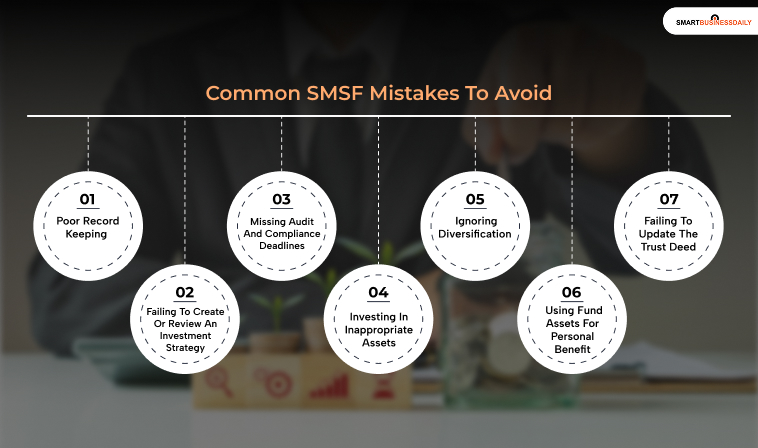
Managing a Self Managed Super Fund (SMSF) comes with significant responsibilities.
Even experienced trustees can make mistakes that lead to compliance issues, financial penalties, or reduced investment performance.
So, understanding these common pitfalls can help you manage your fund more effectively and stay compliant with Australian Taxation Office (ATO) regulations.
1. Poor Record Keeping:
Trustees are responsible for maintaining accurate records of all financial transactions, member contributions, investment decisions, meeting minutes, and annual reports. Incomplete or inaccurate records can create problems during audits and may result in compliance breaches.
2. Failing To Create Or Review An Investment Strategy:
Every SMSF must have a documented investment strategy that reflects the fund’s objectives, risk tolerance, diversification, liquidity needs, and retirement goals. Many trustees create one during setup but fail to review and update it regularly as market conditions or member circumstances change.
3. Missing Audit And Compliance Deadlines:
SMSFs are required to undergo an independent audit every financial year and lodge annual returns with the ATO. Missing important deadlines can result in administrative penalties and additional scrutiny from regulators.
4. Investing In Inappropriate Assets:
While SMSFs offer broad investment flexibility, every investment must satisfy the fund’s sole purpose of providing retirement benefits. Purchasing high-risk assets without proper research or making investments that do not align with the documented investment strategy can expose the fund to unnecessary financial and compliance risks.
5. Ignoring Diversification:
Concentrating the fund’s investments in a single asset class, such as one property or a handful of shares, increases investment risk. A well-diversified portfolio helps reduce exposure to market volatility and supports more stable long-term retirement outcomes.
6. Using Fund Assets For Personal Benefit:
SMSF assets must never be used for personal purposes. Whether it’s living in an SMSF-owned residential property, using fund money for personal expenses, or enjoying collectibles owned by the fund, personal use generally breaches superannuation laws and can attract significant penalties.
7. Failing To Update The Trust Deed:
Superannuation legislation changes over time, and your SMSF trust deed should reflect current legal requirements. An outdated trust deed may restrict your ability to implement new strategies or cause compliance issues. Reviewing the deed periodically with a legal professional helps ensure your fund continues to operate within the law.
Key Takeaways:
Self-managed super funds give you amazing control over your retirement savings. This freedom comes with some of the most important responsibilities.
You must think over time commitments, costs, and legal obligations before switching from traditional super funds.
Running an SMSF well takes about 100 hours each year. You’ll also need to work with financial advisers, accountants, and legal professionals.
These mutually beneficial alliances help you stay compliant and tap into the full potential of your investments within regulatory limits.
Your role as both trustee and beneficiary creates unique obligations.
This position means you must follow superannuation laws, keep detailed records, and make investment decisions that line up with the sole purpose test – securing retirement benefits for members.
A thorough review of your personal situation, financial goals, and ability to manage funds is crucial before starting an SMSF.
People who enjoy hands-on retirement planning often find SMSFs rewarding. Others might be better off with traditional super fund arrangements.
Frequently Asked Questions (FAQs):
Check out the most frequently asked questions about SMSFs.
1. How much money do I need to start an SMSF?
There is no legal minimum balance required to establish a Self Managed Super Fund (SMSF). However, because SMSFs involve setup and ongoing administration costs, many financial professionals suggest they become more cost-effective for individuals with larger super balances. Before setting up an SMSF, consider whether the benefits outweigh the annual costs based on your financial situation.
2. Can one person have an SMSF?
Yes. An SMSF can have a single member. In this case, the member can either act as the sole director of a corporate trustee or serve as one of two individual trustees, depending on the trustee structure chosen.
3. Can an SMSF buy residential or commercial property?
Yes. An SMSF can invest in both residential and commercial property, provided the investment complies with the Superannuation Industry (Supervision) Act and the fund’s documented investment strategy. Commercial property may also be leased to a related business if it meets regulatory requirements.
4. Can an SMSF borrow money?
Borrowing is generally restricted. However, SMSFs may borrow under a Limited Recourse Borrowing Arrangement (LRBA) to purchase certain assets, such as property, provided they comply with ATO regulations and superannuation laws.
5. What are the annual costs of running an SMSF?
Annual costs typically include the ATO supervisory levy, accounting fees, independent audit fees, tax return preparation, administration services, and, where applicable, financial advice or legal assistance. The exact cost depends on the complexity of the fund and the investments it holds.
6. What happens if an SMSF breaks the rules?
Failure to comply with SMSF regulations can result in administrative penalties, mandatory trustee education, disqualification of trustees, or the fund losing its complying status. Trustees are responsible for ensuring the fund meets all legal and reporting obligations.
7. Can I transfer my existing super into an SMSF?
Yes. Most people fund an SMSF by rolling over their existing superannuation balance from another complying super fund. Rollovers are processed electronically through SuperStream once the SMSF has been established and registered.
8. Do SMSFs pay tax?
Yes. SMSFs generally pay concessional tax on investment earnings and concessional contributions while members are in the accumulation phase. Different tax rules may apply once members begin drawing a retirement income stream, subject to current superannuation legislation.
9. Can I access my SMSF whenever I want?
No. SMSF benefits can only be accessed after meeting a condition of release, such as reaching preservation age and retiring, commencing an eligible retirement income stream, or satisfying another condition permitted under Australian superannuation law.
10. Is an SMSF the right choice for everyone?
Not necessarily. An SMSF is generally best suited to individuals who want greater control over their retirement savings, have sufficient time to manage trustee responsibilities, and understand the legal and compliance obligations involved. Those seeking a hands-off approach may find an industry or retail super fund more suitable.
Read Also:




Related Articles



Comments Are Closed For This Article