








What Happens If You File GST Late In Canada? Penalties, Interest And CRA Consequences:
6 Mins Read
Published on: 10 July 2025
Last Updated on: 03 July 2026
- What Happens When You File GST Late, And How Can Expert Opinion Help Avoid Consequences?
- What Happens When You File GST Late?
- 1. Late Filing Penalties And Interest Can Add Up Quickly:
- 2. Repeated Late Filings May Trigger CRA Enforcement:
- 3. Impact On Input Tax Credits And Refunds:
- 4. Rebuilding Compliance And Moving Forward:
- You Should Still File Even If You Can't Pay:
Missing a GST/HST filing deadline can be more expensive than many business owners realize.
While a late return may seem like a minor administrative issue, it can quickly lead to penalties, daily interest charges, delayed refunds, and increased scrutiny from the Canada Revenue Agency (CRA).
Businesses often fall behind on their GST/HST obligations for practical reasons.
Moreover, cash flow problems, incomplete bookkeeping, staffing changes, or simple filing mistakes can all contribute to missed deadlines.
Unfortunately, delaying a return rarely makes the situation better. In many cases, the financial consequences continue to grow until the outstanding returns are filed and any taxes owing are paid.
As a result, understanding what happens when you file GST late in Canada can help you avoid unnecessary costs and respond appropriately if you’ve already missed a deadline.
This guide explains the potential consequences of late GST/HST filing, how the CRA handles overdue returns, and what steps businesses can take to regain compliance.
Stay tuned.
What Happens When You File GST Late, And How Can Expert Opinion Help Avoid Consequences?
Businesses have to manage several things; therefore. Therefore, businesses find it difficult to manage various things altogether.
Owners and management should not forget that everything they have built should also be secured.
Filing GST late causes your business to suffer; hence, it is wise to take an expert’s opinion.
Businesses should prioritize their late filing penalties as an immediate concern. However, that is not the only concern. Therefore, companies should also be concerned about several other things, like interest charges.
Interest charges apply to unpaid balances, and repeated non-compliance can result in CRA scrutiny or audits. Therefore, businesses often require the expert’s help. This is where guidance from the expert tax lawyers at Taxpage can help.
The expert tax lawyers have experience helping clients navigate CRA enforcement actions and resolve GST/HST disputes. Therefore, the expertise of the lawyers often makes a massive difference.
Business owners should understand the rules and proactively address late filings, as these are the best steps any business owner can take to ensure compliance.
The experts manage your GST Filings on time while you grow your business. Therefore, this allows businesses to focus on the more important tasks, while the expert tax lawyers take care of their taxes.
Businesses should rather choose to pay the fees of the expert tax lawyers instead of paying penalties later.
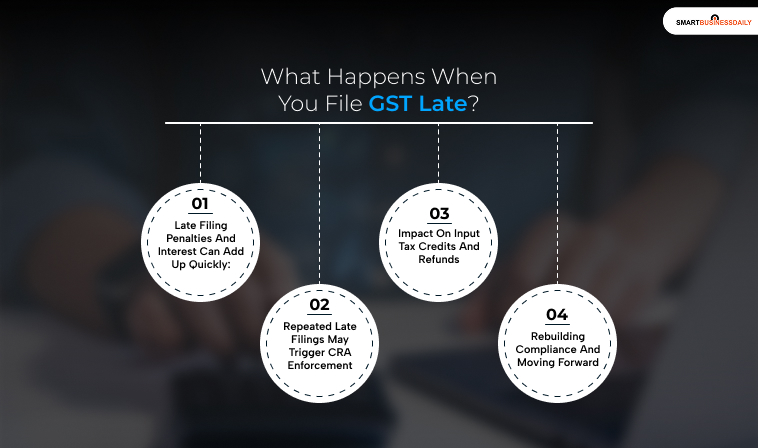
What Happens When You File GST Late?
Filing a GST/HST return after the deadline can have consequences that extend well beyond a late filing penalty.
Depending on your circumstances, the CRA may charge financial penalties, apply daily interest to outstanding balances, delay refund processing, or take enforcement action if returns remain unfiled for an extended period.
The longer a return remains outstanding, the more expensive the situation can become.
Even businesses experiencing temporary financial difficulties are generally expected to submit their returns on time, regardless of whether they can pay the full amount immediately.
As a result, understanding these consequences allows business owners to make informed decisions and address filing issues before they become significantly more difficult to resolve.
So, if your business has multiple outstanding returns, has received notices from the CRA, or is facing an audit or collections action, obtaining professional legal advice early can help you understand your options and develop an appropriate strategy for resolving the matter.
Now, let’s look at all the possible consequences in detail.
1. Late Filing Penalties And Interest Can Add Up Quickly:
The CRA imposes penalties when GST/HST returns are filed after the due date, and taxes remain unpaid. \
In addition to the initial late-filing penalty, interest begins accruing on outstanding balances and continues until the amount is paid in full.
For businesses that already operate on tight margins, these additional charges can become a significant financial burden.
Also, a delay of only a few months may substantially increase the total amount owed, making it even more difficult to catch up.
For example, if a business owes GST/HST and postpones filing while waiting for cash flow to improve, the outstanding balance continues to grow because of accumulating interest and penalties.
Filing the return as soon as possible, even if full payment isn’t immediately available, can often reduce the overall financial impact.
2. Repeated Late Filings May Trigger CRA Enforcement:
Occasional filing mistakes happen, but repeated late GST/HST returns can attract additional attention from the CRA.
Consistent non-compliance may indicate underlying bookkeeping or tax reporting issues, increasing the likelihood of a review or audit.
As a result, if returns remain outstanding for an extended period, the CRA may estimate the taxes owing using available information and issue an assessment before receiving your actual return.
Also, these estimates are not always accurate and may result in a higher tax liability than expected.
In more serious situations, the CRA has broad collection powers that may include:
- Garnishing bank accounts.
- Placing liens on certain assets.
- Applying future tax refunds against outstanding GST/HST balances.
Needless to say, addressing overdue filings before enforcement begins often provides businesses with more options for resolving the issue.
3. Impact On Input Tax Credits And Refunds:
Businesses registered for GST/HST should claim Input Tax Credits (ITCs) for the tax paid on eligible purchases.
However, you should file returns within the required timeframe to claim these credits. Late filings result in the denial of ITCs.
The CRA often determines that the documentation is insufficient or the delay is unreasonable due to late filing.
The loss of ITCs financially damages businesses with high operating costs or capital expenditures.
CRA applies a strict time limit for claiming refunds. Therefore, businesses should file refund claims within 4 years of the end of the reporting period.
Failure to file on time may result in permanent forfeiture of those refunds, even if the CRA has acknowledged the underlying transactions.
4. Rebuilding Compliance And Moving Forward:
If your business has fallen behind on its GST/HST filings, the most important step is to address the issue promptly.
Delaying further generally increases penalties, interest, and the likelihood of CRA enforcement action.
Moreover, businesses that voluntarily correct outstanding filings before the CRA begins enforcement may qualify for relief under certain circumstances, including programs designed to encourage voluntary compliance.
Whether relief is available depends on the facts of each case.
Also, maintaining accurate financial records, filing returns on time, and regularly reviewing your GST/HST obligations can help reduce future compliance risks.
So, if your business has accumulated multiple years of unfiled returns, received CRA collection notices, or is involved in a GST/HST dispute, consulting an experienced tax lawyer can help you understand your rights and determine the most appropriate course of action.
Acting early is almost always less costly than waiting.
The sooner outstanding GST/HST issues are addressed, the more opportunities a business has to minimize penalties and move forward with confidence.
You Should Still File Even If You Can’t Pay:
So, you already know what happens when you file GST late in Canada. But many businesses delay filing because they don’t have enough money to pay the GST/HST they owe.
While this may seem like the logical choice, it often results in larger penalties and additional interest. In most situations, filing your GST/HST return on time is preferable to delaying the return altogether.
Once the return has been submitted, you may be able to discuss payment arrangements with the CRA if your business is experiencing genuine financial difficulties.
Failing to file creates two separate problems: an outstanding tax balance and a missing return. Also, filing promptly limits one of those issues and demonstrates a willingness to comply with your tax obligations.
Read Also:




Related Articles



Comments Are Closed For This Article