













Picture how you may feel when you finally land your dream job following years of effort.
As the end of the month approaches, you receive your payslip and notice a large amount has been deducted for an unknown ‘PF’ or ‘EPF’.
First, this can cause concern and make you think, “Did the government just take my money?”
Please don’t worry. Nobody has. Your money is still fully under your control, and your company has even been adding free money to your account!
So, what is a Provident Fund? Put simply, a Provident Fund is a state-sponsored fund that you and your employer both contribute to each month. Crucially, however, you can’t access this money for non-retirement expenses such as holidays or buying new technology.
The government then offers high interest, so it can quietly build up to a large sum for your post-retirement years.
Below, we explain how India’s retirement system functions, the most recent updates to it and the labor laws affecting your entitlements.
What Is Provident Fund (PF) In Simple Words?
A Provident Fund is a state-supported retirement fund. Within the private sector (including businesses, startups, and factories), it is officially known as the Employees’ Provident Fund (EPF) and is managed by the Employees’ Provident Fund Organisation (EPFO).
Why do professionals consider India’s EPF such an excellent way to grow their wealth?
In addition to being a retirement fund, it also functions like a mutual fund. Not only does a defined % of your salary automatically go into your PF, but by law your employer must also add the same percentage from their own funds.
Significantly, even before your PF money has generated any interest, you instantly receive a 100% bonus on your initial deposit – a feat which no regular bank account can achieve.
The 3 Varieties of India’s Provident Funds
Whilst most commonly the term ‘PF’ is used to refer to the EPF, there are in fact 3 types of PF available in India:
1. Employees’ Provident Fund (EPF): For salaried individuals working within the private sector. Both you and your employer add money to it.
2. Public Provident Fund (PPF): Any Indian citizen (including students, self-employed, and shopkeepers) can contribute to a PPF. You can do this through either a bank or a post office. Just add money to it, and leave it untouched for 15 years.
3. General Provident Fund (GPF): Solely for government employees who started work on or before December 31st 2003.
How Does The EPF Math Work? (With A Step-By-Step Salary Example)
Now that you have understood what is provident fund, now you need to comprehend how your PF can balloon to a crore value from monthly salary deductions with knowledge of just two percentages – 12% and 8.25%.
Usually, when you are offered a job, your overall salary (often termed your CTC – Cost to Company) is divided into elements including:
- Basic Salary,
- House Rent Allowance (HRA),
- Travel Allowance
- Special Allowances.
Again, only your Basic Salary and Dearness Allowance (DA) determine your PF entitlement. DA is additional compensation for the cost of living and is predominantly paid to those working in the government and industry sectors.
Month in, month out, your PF is therefore made up of the following:
Your PF Contribution: 12% of your Basic Salary is automatically deducted from your salary.
Your Company’s PF Contribution: Your employer also adds 12% of your Basic Salary. But the government further divides this 12% into 2 sections:
- 3.67% is added to your main EPF fund.
- 8.33% goes into a separate pension fund called the Employees’ Pension Scheme (EPS). This ensures you receive a monthly pension for life from age 58.
Bonus Free Life Insurance
Alongside the above, your employer also adds a further 0.5% from their own funds to fund a life assurance scheme (known as EDLI – Employees’ Deposit Linked Insurance).
If a tragic event occurs to a member during their working life, their family receives a tax-free lump sum payment of up to ₹7 lakh. Again, this is free of charge to you.
Let’s See The Magic In Real Numbers
Assume you graduate and start working. Your Basic Salary is ₹25,000 per month. Month on month, the following occurs:
- Firstly, the money subtracted from your salary (12%): = ₹3,000
- Secondly, money added to your EPF fund by your company (3.67%): = ₹917
- Third, money added to your Pension fund by your company (8.33%): = ₹2,083
So, the total monthly amount accumulated for your future is ₹6,000 (although only ₹3,000 has come out of your pocket!).
Furthermore, the government adds compound interest to your EPF. This currently stands at a healthy 8.25% per year. Again, this is higher than the vast majority of regular bank Fixed Deposits (FDs) operating in India.
What Does Compound Interest Do Over Time?
It calculates interest not only on your original fund, but also on the interest itself. If you start contributing ₹6,000 per month to your PF at age 22 and never get a salary increase throughout your working life, by the time you reach 52 and retire, your piggy bank would contain over ₹1.13 Crore.
And since most people receive salary increases annually, most regular employees ultimately amass between ₹2 Crore and ₹4 Crore purely from their PF.
Additionally, within India’s taxation regime, EPF enjoys EEE (Exempt-Exempt-Exempt) status.
Consequently, your PF contribution is tax-deductible, and the yearly interest accrued is tax-free (provided your yearly PF contributions do not exceed ₹2.5 lakh).
Finally, the entire amount you withdraw from your PF upon retirement is 100% tax-free.
The Big Shift: 4 Major PF Updates Most Blogs Haven’t Covered Yet
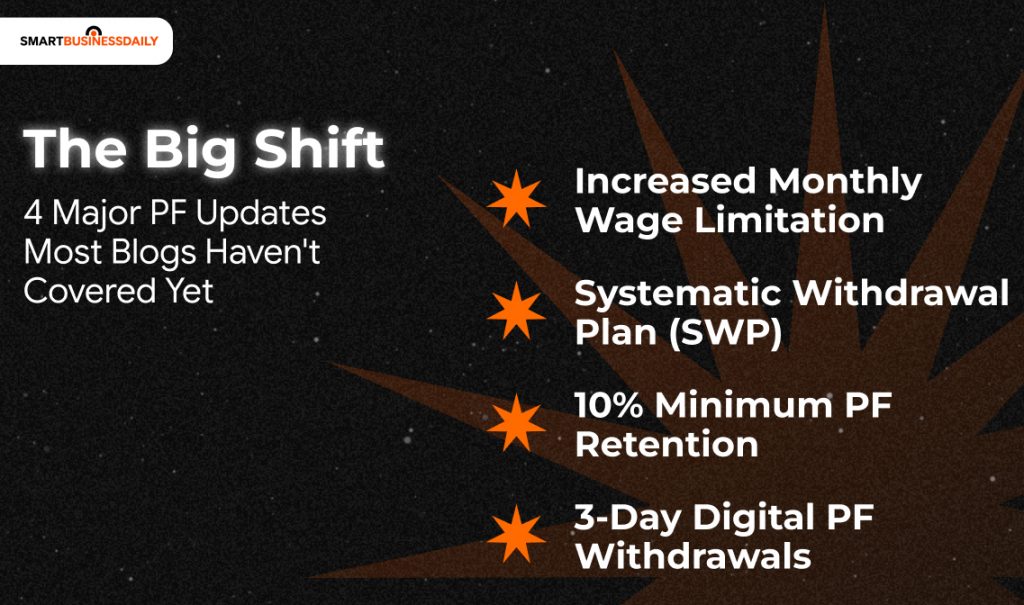
Although many financial blogs continue to cite previous 2014 legislation, India has recently implemented 4 key new PF updates that all new income earners should be aware of:
1. Increased Monthly Wage Limitation
After 12 years of a ₹15,000 wage cap, the mandatory EPF Basic Salary upper limit increased to ₹25,000. Consequently, in excess of 51 lakh additional workers are now compulsorily covered by PF, pension, and insurance provisions.
2. Systematic Withdrawal Plan (SWP)
Rather than having to liquidate your complete PF fund and then risking overspending, you can now continue to allow your money to accrue ~8.25% tax free interest within the EPFO. At the same time, you can receive a regular, set monthly income.
3. 10% Minimum PF Retention
To prevent employees from depleting their PF when moving between companies, a 10% minimum PF fund retention rule has been introduced.
This secures a core part of your PF and lets it continue compounding for your retirement.
4. 3-Day Digital PF Withdrawals
Urgent PF fund withdrawals of up to ₹5 lakh (for medical, educational, marriage, and housing requirements) are now automatically digitally processed within 72 hours using advanced banking and UPI infrastructure.
Understanding Hiring Laws: Why Your Job Type Changes Everything
Given that PF is so advantageous, you may be wondering whether all Indians automatically receive PF provision.
Unfortunately, this is not the case. Your entitlement to PF depends on your understanding of Indian labor laws and how a company engages your services.
Under India’s unified Code on Social Security, all businesses, offices, and factories with 20 or more employees are legally obligated to register for PF.
However, if you work for a small local agency or a newly established startup containing just 8 staff members, then it is not legally mandatory for the startup founder to register for and therefore provide you with EPF.
Nevertheless, many quality startups do so voluntarily as it helps them to attract superior staff.
Within a large enterprise of 5,000 employees, your particular labor contract will additionally dictate your entitlements. Below are the key distinctions between on-roll and contracted/freelance roles:
| Feature | Full-Time Employee (On-Roll) | Contract / Freelance Worker |
| Who hires and pays you? | The company hires you directly on its permanent payroll. | Either a third-party staffing agency pays you, or you bill as an independent freelancer. |
| Provident Fund (EPF) | 100% Mandatory (if the company has 20+ staff and Basic pay is up to ₹25,000). | Independent Freelancers: No EPF. Agency Contract Staff: The staffing agency (not the client company) must pay your PF. |
| Job Security & Perks | Paid sick/casual leave, gratuity after 5 years, company health insurance, formal notice period. | Fixed end date (e.g., 6 or 12 months); usually slightly higher cash-in-hand, but zero long-term benefits. |
| Income Tax Rules | Taxed under “Income from Salary”; company deducts TDS automatically. | Freelancers are taxed under “Business/Profession” (can claim tax deductions on laptops, internet, etc.). |
A Crucial Warning For College Graduates & Freshers
Often, businesses engage new graduates as ‘Trainees’, ‘Consultants,’ and/or ‘Fixed Term Contractors’ for the initial 6-12 months of their employment.
This is done so that the company does not have to incur the expense of providing EPF, health insurance, and leave entitlements. This is what it would be obliged to do if the graduate were a full-time employee.
Be sure to scrutinize your appointment documentation thoroughly. Determine whether you have been issued with an ‘Appointment Letter’ (for full-time roles) or a ‘Consultancy Agreement’ (for contractor roles).
Minimum Wage In India & How It Protects Your PF
Before calculating your PF deduction (12% of your salary), a business must comply with India’s minimum wage laws.
The minimum wage is the lowest amount a company can legally pay an individual. Indian labor law even prescribes penalties for businesses that underpay their workforce.
Unlike the United States, which has one nationwide minimum wage, India’s minimum wage differs depending on:
Which State or Union Territory you reside in. Because the cost of living in cities such as Mumbai or Bengaluru is substantially higher than in more modest towns, these states set much higher minimum wages than smaller states.
Your level of skill. The government classifies people into 4 skill categories:
- Unskilled (for example, laborers and cleaners);
- Semi-skilled (such as assistant operators);
- Skilled (for instance, accountants, technicians and data input staff); and
- Highly Skilled (such as engineers and senior management).
Your industry. Different sectors – construction, IT, retail outlets, hotels and manufacturing – all have differing minimum wage notifications.
How Minimum Wage Laws Stop Companies From Cheating Your PF
In previous years, some unscrupulous businesses exploited a gap in the law to unlawfully reduce individuals’ PF entitlements.
For example, if your total monthly salary was ₹24,000, a company might list on your payslip:
- Basic Salary = ₹5,000
- Special Allowance = ₹19,000
As PF is calculated solely from your Basic Salary, by restricting this to just ₹5,000 rather than the true figure of ₹12,000, the business only needed to pay 12% of ₹5,000 (i.e. ₹600) in PF contributions.
In comparison, it would have had to contribute 12% of ₹12,000 (i.e., ₹1,440). Therefore, this method allowed the business to save ₹840 per month!
India’s contemporary Labor Codes have forever sealed this loophole. Now:
- Your Basic Salary plus DA must constitute at least 50% of your total salary.
- Your Basic Salary cannot be less than your state’s minimum legal wage.
Thanks to these minimum wage and 50% salary stipulations, employers are prevented from falsifying your payslip in order to exploit your PF.
What Is ESI? (PF’s Medical Twin)
Alongside PF, HR personnel nearly always mention another 3-letter acronym when informing new recruits of their salary deductions: ESI.
Simply put, ESI is to PF as healthcare is to money – it is PF’s health counterpart.
Whilst PF looks after you in your retirement years (aged 60 and above), ESI (Employees’ State Insurance) supports you in the here and now.
If you, or a family member, becomes ill or suffers an injury, ESI will assist. The Employees’ State Insurance Corporation (ESIC) administers it, and it is one of the world’s largest state-sponsored health insurance programs for employees.
How ESI Works In Everyday Life
So, who is entitled? All companies, shops, hotels, and factories with 10 or more staff members (in the majority of Indian states) must register for ESI.
It also applies to employees with gross monthly salaries of ₹21,000 or less (or ₹25,000 for disabled individuals).
And what is the cost? Remarkably, only 0.75% of your gross salary is automatically deducted each month. Your employer also contributes 3.25%. So, if your monthly gross salary is ₹18,000, you will only be charged a mere ₹135!
What Benefits Are Provided?
100% Free Healthcare: You, your partner, children, and dependent parents can all receive free healthcare from ESIC hospitals and clinics nationwide.
This encompasses everything from basic temperature taking to highly specialized heart surgery. There is no maximum limit on expenditure.
Cash Sick Pay: If a doctor advises you to stay home because of poor health, ESIC will pay you 70% of your daily salary in cash. This can be done for up to 91 days a year.
Maternity Leave Pay: Female employees can take 26 weeks of fully paid maternity leave. ESIC funds this.
PF vs. ESI: Side-by-Side Comparison
| Feature | Provident Fund (EPF) | Employees’ State Insurance (ESI) |
| Core Purpose | Long-term retirement savings & monthly pension. | Immediate medical care, hospital bills & sickness pay. |
| Company Size Trigger | 20 or more employees. | 10 or more employees. |
| Salary Ceiling | Mandatory up to ₹25,000/month (Basic + DA). | Mandatory up to ₹21,000/month (Gross Salary). |
| Employee Contribution | 12% of Basic + DA. | 0.75% of Gross Wages. |
| Employer Contribution | 12% of Basic + DA (+0.5% insurance). | 3.25% of Gross Wages. |
| Who is Covered? | The employee (plus family nominee for insurance). | Employee + spouse + children + dependent parents. |
How To Track And Manage Your PF: The Magic Of UAN
Two decades ago, relocating within India was highly inconvenient for employees when it came to their PF.
Paper forms had to be completed, stamped by your previous employer and then presented to a state office. It could then take several months to transfer your PF to your new company.
Today, the system runs completely online. A unique 12-digit Universal Account Number (UAN) makes the entire process fast and paperless.
One Number For Life
When you start work with your first employer, your company creates your UAN.
No matter how many times you change employment (for example, 12 different companies in 5 different cities), your UAN will remain the same.
At each new company, you simply provide your existing UAN. Your new employer will then attach a new Member ID to it.
How To Instantly View PF Information
You don’t need to consult your HR team to find your PF fund value. As soon as your UAN is activated, you can at all times conveniently check your PF passbook using:
- The UMANG Mobile App (the Official Government of India application).
- The EPFO Unified Member Portal (unifiedportal-mem.epfindia.gov.in).
- Typing the following text – EPFOHO UAN ENG – and sending it as an SMS to 7738299899 using your registered mobile phone number.
- Making a free missed telephone call to 9966044425.
The #1 Golden Rule When Switching Jobs
When you resign from your initial position for another, better role, you will see an EPFO website button that lets you withdraw your PF money.
Avoid pressing this. Unless you are in genuine, dire financial straits, consistently select the ‘One Member-One EPF Account (Transfer Request)’ option.
You can transfer your PF from your previous Member ID to your new Member ID online in under 5 minutes.
This ensures your PF’s 8.25% compounded interest (which is tax-free) is never interrupted.