







When Should You Hire A Public Adjuster? Timing, Benefits And What To Know
13 Mins Read
Published on: 17 April 2025
Last Updated on: 17 August 2026
- What Is A Public Adjuster?
- What Does A Public Adjuster Actually Do?
- 1. Inspecting And Documenting The Damage:
- 2. Reviewing The Insurance Policy:
- 3. Preparing A Detailed Claim:
- 4. Estimating Repair And Replacement Costs:
- 5. Communicating With The Insurance Company:
- 6. Negotiating The Claim:
- 7. Helping With Complex Losses:
- When Their Help May Be Most Valuable?
- Public Adjuster vs. Insurance Company Adjuster:
- When Should You Hire A Public Adjuster?
- 1. The First 72 Hours: Where Details Make A Difference
- 2. Is Damage Assessment Always Obvious At First?
- Why Hiring A Public Adjuster Early Can Help?
- How A Public Adjuster Can Help You Build A Stronger Claim?
- Is Hiring A Public Adjuster Truly Worth It?
- How Much Does A Public Adjuster Cost?
- Questions To Ask Before Hiring A Public Adjuster:
- What Not To Do After A Property Loss?
- 1. Don’t Enter Unsafe Areas:
- 2. Don’t Delay Reporting The Loss:
- 3. Don’t Throw Away Damaged Items Too Soon:
- 4. Don’t Skip Documentation:
- 5. Don’t Start Major Repairs Without Approval:
- 6. Don’t Underestimate Small Damages:
- 7. Don’t Rely On Verbal Agreements:
- Frequently Asked Questions:
- 1. When should I hire a public adjuster?
- 2. Can I hire a public adjuster after filing an insurance claim?
- 3. Is a public adjuster worth it?
- 4. How much does a public adjuster charge?
- 5. What is the difference between a public adjuster and an insurance adjuster?
- 6. Can a public adjuster guarantee a higher settlement?
- 7. What does a public adjuster do?
- 8. Do I need a public adjuster for a small claim?
- 9. What should I look for when hiring a public adjuster?
- 10. Can I change my mind after hiring a public adjuster?
After a major storm, fire, flood, or other disaster, dealing with the damage is only the beginning.
You also have to document your losses, understand your insurance policy, communicate with the insurer, and build a claim that accurately reflects the cost of recovery.
This is where a public adjuster may help.
A public adjuster works for the policyholder rather than the insurance company. They can inspect and document property damage, prepare estimates, review relevant policy provisions, and handle communication with the insurer during the claims process.
So, when should you hire a public adjuster?
In many cases, it makes sense to consider one early, before important evidence disappears, repairs change the condition of the property, or you accept an insurance estimate without fully understanding what it covers.
Early involvement can be particularly useful when the damage is extensive, difficult to assess, or involves business interruption and other complicated losses.
That does not mean every insurance claim requires a public adjuster. A small and straightforward claim may be manageable on your own.
The right choice depends on the extent of the damage, the complexity of your policy, and how comfortable you are handling the claim yourself.
This guide explains when to hire a public adjuster, what they actually do, how they differ from an insurance company adjuster, and what to consider before deciding whether professional help is right for your claim.
Stay tuned.
What Is A Public Adjuster?

A public adjuster is a licensed professional who works on behalf of a property owner during an insurance claim. Unlike an adjuster hired by the insurance company, a public adjuster represents the policyholder’s interests.
Their job is to help document the damage, determine the value of the loss, interpret relevant parts of the insurance policy, and prepare the claim for submission and negotiation.
As a result, depending on the claim, a public adjuster may:
- Inspect the property and document visible damage.
- Look for damage that may not be immediately obvious.
- Prepare a detailed inventory of damaged or lost property.
- Estimate the cost of repairs or replacement.
- Review the insurance policy for potentially applicable coverage.
- Organize receipts, photographs, reports, and other supporting documents.
- Communicate with the insurance company and its adjusters.
- Help prepare and submit required claim documentation.
- Negotiate with the insurer regarding the value of the covered loss.
A public adjuster does not work for the insurance company. Moreover, their role is to represent the policyholder throughout the claim process.
However, hiring one does not guarantee a larger settlement or ensure that every claimed loss will be covered. Coverage depends on the terms, exclusions, limits, and conditions of the insurance policy.
Also, for that reason, a public adjuster can be most useful when a claim is large, complicated, difficult to document, or involves disagreements about the extent or value of the damage.
What Does A Public Adjuster Actually Do?
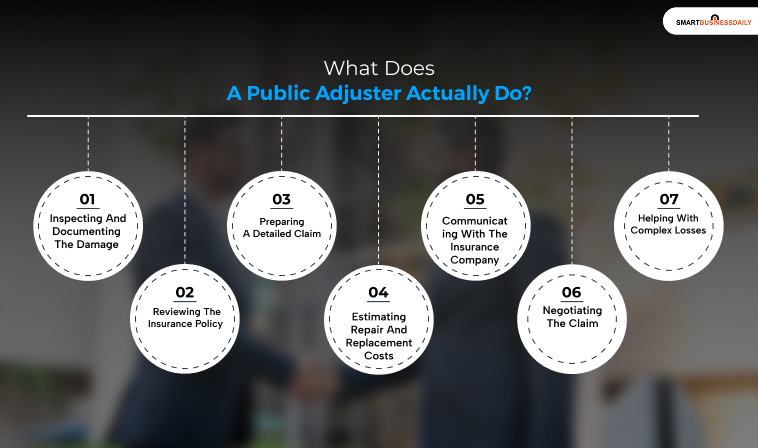
A public adjuster does more than inspect a damaged property. Their role is to help the policyholder document the loss, understand the claim, prepare supporting evidence, and communicate with the insurance company throughout the process.
The exact services vary by adjuster and claim, but the work typically includes the following.
1. Inspecting And Documenting The Damage:
A public adjuster examines the property to identify visible and potential damage. They may take photographs, record measurements, document damaged belongings, and create a detailed inventory of losses.
This documentation can become especially important when damage is extensive or difficult to assess during an initial inspection.
2. Reviewing The Insurance Policy:
Insurance policies can contain complicated coverage limits, exclusions, conditions, and endorsements. A public adjuster reviews the policy to identify provisions that may apply to the loss.
This does not mean every loss will be covered. The policy ultimately determines what the insurer is required to pay.
3. Preparing A Detailed Claim:
A strong claim requires more than a list of damaged items. It may include repair estimates, replacement costs, photographs, receipts, inventories, contractor reports, and other supporting documents.
A public adjuster can organize this information and help prepare the claim based on the documented losses and applicable policy coverage.
4. Estimating Repair And Replacement Costs:
The initial estimate from an insurance company may not always reflect every cost involved in restoring a property. A public adjuster can prepare or coordinate a more detailed estimate based on the damage identified during the inspection.
For complex losses, they may also work with contractors, engineers, restoration specialists, or other professionals when additional expertise is needed.
5. Communicating With The Insurance Company:
Managing an insurance claim can involve repeated calls, emails, inspections, forms, and requests for additional documentation.
A public adjuster can communicate with the insurer and its adjusters on the policyholder’s behalf. This can make the process easier to manage, particularly when the claim involves extensive property damage or multiple types of loss.
6. Negotiating The Claim:
After the claim has been documented and submitted, a public adjuster may negotiate with the insurance company regarding the value of covered losses.
Their goal is to make sure the documented claim is properly considered under the terms of the policy. However, a public adjuster cannot guarantee a particular settlement amount.
7. Helping With Complex Losses:
Some claims involve issues that go beyond straightforward property repairs. For example, a business may also experience lost income or additional expenses while its property is being restored.
Depending on the policy and the adjuster’s services, a public adjuster may help document these losses and include applicable coverage in the claim.
When Their Help May Be Most Valuable?
A public adjuster may be particularly useful when:
- The property has extensive damage.
- The cause or extent of the damage is complicated.
- Hidden damage may be involved.
- The insurance estimate appears incomplete.
- You have difficulty understanding your policy.
- The claim involves business interruption or lost income.
- You are uncomfortable negotiating with the insurance company.
- The amount of documentation required is difficult to manage.
Moreover, a public adjuster is not a replacement for the insurance company, contractor, engineer, or attorney. Their role is specifically focused on helping the policyholder manage and document the insurance claim.
Also, before hiring one, check their licensing requirements, experience, fees, and written agreement – understanding exactly what they will handle can help you decide whether their services are appropriate for your situation.
Public Adjuster vs. Insurance Company Adjuster:
| Public Adjuster | Insurance Company Adjuster |
|---|---|
| Works for the policyholder | Works for the insurance company |
| Helps document the policyholder’s losses | Investigates the claim for the insurer |
| Reviews the policy and claim | Reviews coverage and damage |
| Helps prepare the claim | Evaluates the claim |
| May charge a fee or percentage | Paid by the insurance company |
A public adjuster represents the policyholder, while an insurance company adjuster represents the insurer’s interests.
The exact services, fees, and licensing requirements vary by state, so homeowners should check the rules that apply where the property is located.
When Should You Hire A Public Adjuster?

Once disaster hits, people tend to make hasty decisions or try to be careful and act too late. This article will guide you comprehensively, providing detailed insights into the right time to hire a public adjuster and how to proceed.
1. The First 72 Hours: Where Details Make A Difference
People tend to panic right after a disaster. Property owners may rush to remove debris, begin temporary repairs, or agree to quick settlements without fully understanding what’s covered.
Furthermore, insurance companies often assign their adjusters promptly, but it’s important to remember that they design their evaluations to protect the company’s bottom line.
That’s why many policyholders bring in a public adjuster early—to establish their documentation before evidence disappears or people make premature decisions.
Having an advocate review the policy, walk through the property, and prepare an independent estimate can significantly improve the claim’s progress.
Expert advice from a public adjuster in Los Angeles can be invaluable in navigating large or complex urban claims, where certain issues can influence reimbursement, like-
- Zoning
- Temporary housing
- Code upgrades
The sooner you incorporate this insight into the equation, the easier it will be to manage expectations and avoid miscommunication with the insurer.
2. Is Damage Assessment Always Obvious At First?
Some of the most significant losses after a property disaster are not immediately visible but can be immensely impactful.
Some of the common losses are-
- Water can seep into unseen areas behind walls, leading to long-term mold growth.
- Fire damage may impact structural integrity even in spaces that look intact.
- Wind events can dislodge roofing or siding in ways that allow slow leaks to develop weeks later.
Public adjusters understand that what’s initially visible often only scratches the surface. Their thorough assessments typically go beyond what’s listed in the insurance company’s initial report.
This also includes hidden damage, which may be missed in a rushed evaluation. Therefore, a thorough check-up is very important.
They work with engineers, contractors, or restoration professionals to present a clearer picture of the overall restoration cost to return the property to its pre-loss condition.
Furthermore, waiting too long to start this process increases the risk of deterioration, which may be excluded from coverage based on neglect or delayed reporting.
When you act quickly, you preserve the evidence, maximize whatever you consider, and protect your claim from later disputes.
Why Hiring A Public Adjuster Early Can Help?
Without early involvement from a public adjuster, many property owners fall into a reactive mode—some common drastic reactions might include-
- Responding to insurer requests.
- Fielding unfamiliar forms.
- Second-guessing whether estimates are fair.
These reactions place the insurer in the driver’s seat, often leading to smaller settlements or incomplete repairs.
Public adjusters bring structure and clarity to an overwhelming process. They help define what you need to do and what you should document.
Moreover, policyholders can focus on recovery by setting the pace early. This proactive approach is particularly valuable in –
- Business interruption
- Loss of income
- Relocation expenses
The faster a strategy is in place, the more control the policyholder maintains over the financial and emotional toll of the recovery.
How A Public Adjuster Can Help You Build A Stronger Claim?
You can build a successful insurance claim on records, receipts, and a clear timeline that supports the loss’s value. As a result, it becomes easier to gather these details and build a comprehensive claim file if you involve a public adjuster early.
Many insurers set deadlines for submitting information or proof of loss. Public adjusters help meet these deadlines and go further.
Naturally, it makes the case for policy provisions that may not be obvious to the average person. Furthermore, this could include
- Code compliance coverage.
- Business income extensions.
- Content replacement at the current market value.
Also, by structuring the claim early, adjusters improve the odds of negotiating for the full amount that the policy entitles you to.
Is Hiring A Public Adjuster Truly Worth It?
Hiring a public adjuster can be worthwhile when an insurance claim is large, complicated, or difficult to document.
However, not every property loss requires professional help. The right choice depends on the extent of the damage, the complexity of your claim, and how comfortable you are handling the process yourself.
It may be worth considering when:
- The property has extensive damage from a fire, flood, storm, or other disaster.
- The full extent of the damage is difficult to document.
- Your claim involves business interruption, lost income, or additional living expenses.
- The insurance company’s estimate appears incomplete or does not reflect the cost of necessary repairs.
- Multiple types of damage or several areas of your property are involved.
- You are having difficulty understanding your policy or preparing the required documentation.
- You are uncomfortable negotiating with the insurance company on your own.
Also, you may not need a public adjuster when:
- The damage is minor and straightforward.
- The cause of the loss and the covered damage are easy to establish.
- You understand your policy and its coverage limits.
- The insurer’s assessment appears reasonable and complete.
- You are comfortable documenting your losses, communicating with the insurer, and negotiating the claim yourself.
How Much Does A Public Adjuster Cost?
Public adjusters typically charge a fee for their services, and the fee structure can vary by state, claim, and individual agreement. In some cases, the fee is based on a percentage of the insurance settlement.
Before hiring one, ask for a written agreement that clearly explains the fee, when it is payable, what services are included, and whether any additional costs may apply. You should also check the licensing requirements and fee restrictions that apply in your state.
The potential value of a public adjuster should therefore be weighed against the cost of their services.
For a small claim, handling the process yourself may make more sense. But for a large or complicated claim, professional assistance may provide enough value to justify the expense.
Questions To Ask Before Hiring A Public Adjuster:
Before hiring a public adjuster, take time to understand their experience, fees, services, and responsibilities. A few questions can help you determine whether they are the right fit for your claim.
- Are you licensed to work in my state?
- How do you charge for your services?
- What services are included in your fee?
- Will you handle communication with my insurance company?
- Do you have experience handling claims similar to mine?
- Can I review the contract before signing it?
- Are there any additional fees or expenses I should expect?
- How long do you expect the claims process to take?
- Who will be my main point of contact throughout the claim?
- Are there circumstances where you would recommend that I handle the claim myself?
Ask for clear answers before signing an agreement. Pay particular attention to the fee structure, included services, cancellation terms, and any expenses that may be charged separately.
A reputable public adjuster should be willing to explain the process without pressuring you to sign immediately. If you do not understand a contract or fee arrangement, consider having it reviewed before you commit.
What Not To Do After A Property Loss?
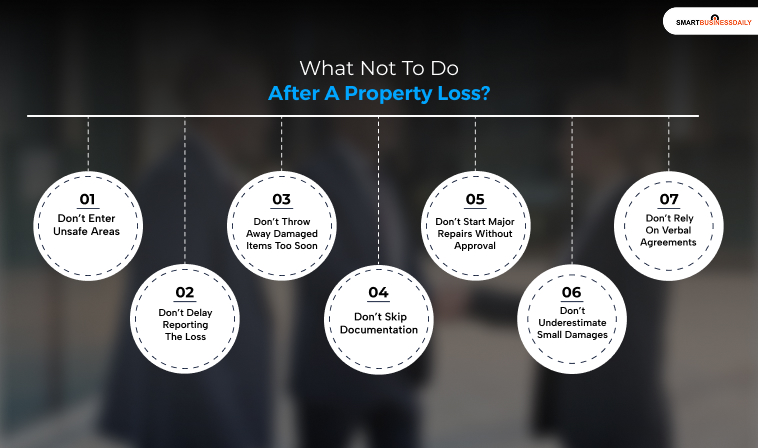
After experiencing a property loss, it’s easy to act quickly out of stress or urgency. However, certain missteps can worsen the situation, delay your recovery, or even reduce your insurance payout.
On that note, here are the most important things to avoid:
1. Don’t Enter Unsafe Areas:
Never re-enter a damaged property until it has been declared safe by professionals. Structural damage, gas leaks, electrical hazards, or contaminated water can pose serious risks.
2. Don’t Delay Reporting The Loss:
Notify your insurance company as soon as possible. Delays can complicate your claim or give the impression that the damage was not serious or well-documented.
3. Don’t Throw Away Damaged Items Too Soon:
Even if items are ruined, keep them until your insurer or adjuster has documented them. These items may serve as important evidence for your claim.
4. Don’t Skip Documentation:
Take photos and videos of all damage before any cleanup begins. A lack of visual evidence can make it harder to prove the extent of your loss.
5. Don’t Start Major Repairs Without Approval:
While temporary fixes to prevent further damage are usually encouraged, avoid permanent repairs until your insurance company has assessed the situation.
6. Don’t Underestimate Small Damages:
Minor issues can sometimes indicate larger hidden problems. Always report and document everything, no matter how insignificant it may seem.
7. Don’t Rely On Verbal Agreements:
Always get instructions, approvals, and agreements from your insurer or contractors in writing to avoid misunderstandings later.
By avoiding these common mistakes, you can protect your safety, strengthen your insurance claim, and speed up your recovery process.
Frequently Asked Questions:
1. When should I hire a public adjuster?
In many cases, it is worth considering a public adjuster early in the claims process, especially after significant property damage. Early involvement can help with documentation, damage assessment, and claim preparation before important evidence is lost or repairs begin.
2. Can I hire a public adjuster after filing an insurance claim?
In many situations, yes. Filing a claim with your insurance company does not necessarily prevent you from hiring a public adjuster later. However, the best time to involve one depends on the stage and complexity of your claim.
3. Is a public adjuster worth it?
A public adjuster may be worthwhile when a claim is large, complicated, or difficult to document. For a small and straightforward claim, you may decide that handling the process yourself is more practical.
4. How much does a public adjuster charge?
Fees vary depending on the adjuster, claim, location, and applicable state rules. Some public adjusters charge a percentage of the settlement, while other fee arrangements may apply. Always review the written agreement carefully before hiring one.
5. What is the difference between a public adjuster and an insurance adjuster?
A public adjuster represents the policyholder, while an insurance company adjuster works for the insurer. Both may inspect damage and evaluate a claim, but they represent different parties in the claims process.
6. Can a public adjuster guarantee a higher settlement?
No. A public adjuster cannot guarantee a particular settlement amount. The final payment depends on the insurance policy, covered damage, applicable limits and exclusions, and the evidence supporting the claim.
7. What does a public adjuster do?
A public adjuster can inspect and document damage, prepare estimates, organize claim documentation, review relevant policy provisions, communicate with the insurer, and negotiate on behalf of the policyholder.
8. Do I need a public adjuster for a small claim?
Not necessarily. If the damage is limited, easy to document, and the insurance company’s assessment appears reasonable, you may be able to manage the claim yourself. For more complicated losses, professional assistance may be more useful.
9. What should I look for when hiring a public adjuster?
Check that the adjuster is properly licensed where required, has experience with similar claims, clearly explains their fees, provides a written agreement, and can explain exactly what services they will provide.
10. Can I change my mind after hiring a public adjuster?
That depends on the agreement you signed and the laws that apply in your state. Before signing, review cancellation provisions and ask what happens if you decide to end the relationship later.
Read Also:
- 5 Reasons To Get Into Real Estate Business
- Things To Consider Before Buying A Second Property
- The Most Important Factors For Buying Your Dream Home




Related Articles



Comments Are Closed For This Article