







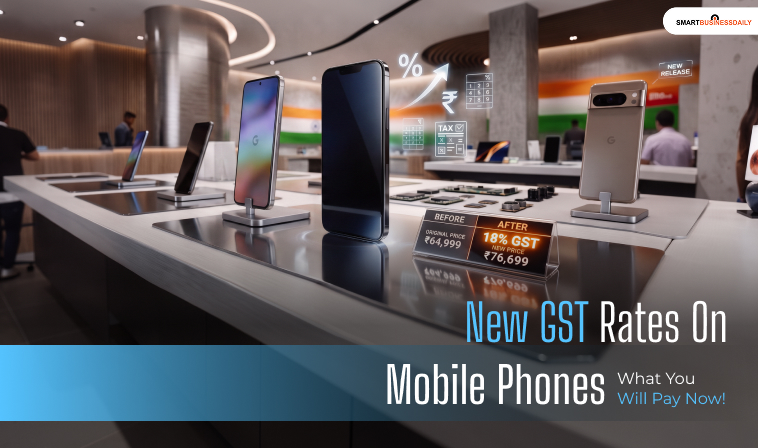
New GST Rates On Mobile Phones: What You Will Pay Now!
24 August 2026
7 Mins Read
- The Big Picture: Understanding The 18% Uniform GST Rate
- The Breakdown: GST Rates And HSN Codes For Mobile Accessories
- Doing The Math: How To Calculate GST On Your Invoice
- How The Tax Is Split On Your Receipt
- Intra-State Purchase (Local Retailer)
- Inter-State Purchase (E-commerce Warehouse)
- 1. The Spare Parts (Goods)
- 2. The Labor Charge (Services)
- 3. Insurance Claims And Theft Recovery
- Tax Savings For Businesses: The Input Tax Credit (ITC) Blueprint
- Global Tech: Understanding GST On Imported Mobile Phones
- Pro Tips: Common Billing Mistakes To Watch Out For
| Quick Summary: New GST Rates On Mobile Phones What is the current GST rate on mobile phones in India? A uniform 18% GST applies to all mobile phones under HSN code 8517. What is the tax rate on mobile accessories? Standard accessories like chargers, power banks, earphones, and screen protectors carry a flat 18% GST rate. Can businesses claim tax credit on smartphones? Yes, GST-registered businesses can claim 18% Input Tax Credit (ITC) if you are using the device for commercial purposes. What is the tax on mobile repairs? Both spare parts (screens, batteries) and technician labor charges attract a separate 18% GST. |
Buying a new smartphone is always exciting, but what if you have to update your device in India? Do you know how much you are actually paying for your phone?
Well, it’s time to learn how much tax applies to your device so you can get a clear picture of your tech budget.
In this article, we will discuss the new GST rates on mobile phones, understand what taxes apply to your accessories, analyze how repair services charge for damages, and see how business owners can claim credit on their phone purchases.
So let’s begin our journey to decode modern mobile phone taxation!
The Big Picture: Understanding The 18% Uniform GST Rate
Before the Goods and Services Tax (GST) system arrived, buying a phone in India was a chaotic experience.
Different states levied three specific things:
Their own mix of Value Added Tax (VAT),
Central excise duties, l
Local entry taxes.
This meant a smartphone could cost significantly less in Delhi than it did in Mumbai, leading to massive price confusion.
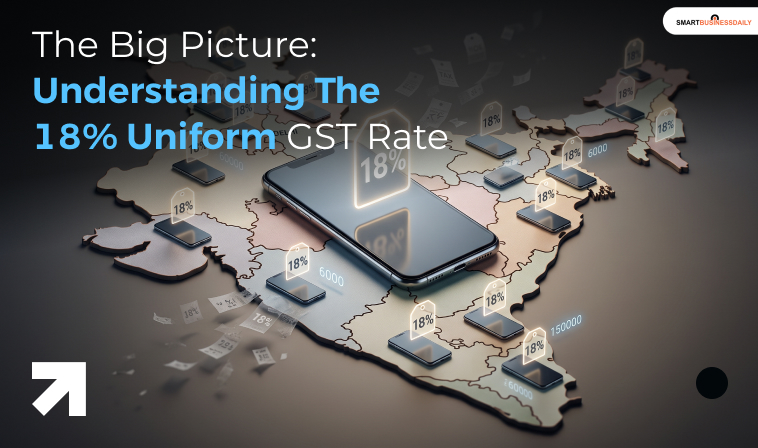
Today, those confusing state-by-state variations are completely over. Under the unified GST framework, all mobile phones attract a flat, nationwide 18% GST rate.
Whether you are purchasing a basic ₹6,000 entry-level feature phone or splurging on a premium flagship smartphone worth ₹1,50,000, the exact same percentage applies.
For tax filing and tracking purposes, all mobile handsets are uniformly classified under HSN Code 8517.
While this single tax rate caused a slight price increase compared to the pre-GST era (when average state taxes sat around 12%), it brought total transparency to the electronics market.
Now, consumers enjoy completely uniform pricing across every single state and Union Territory in India.
The Breakdown: GST Rates And HSN Codes For Mobile Accessories
When you buy a new smartphone, you always need to purchase accessories along with it.
For tax accounting, mobile accessories are placed in the same bracket as the main device.
That means that all phone accessories are subject to the same 18% GST rate.
Below is a list of the most common phone accessories along with their tax codes:
Mobile Phone Chargers – 8504
Batteries – 8507
Power Banks – 8507
Earphones & Headphones – 8518
Memory Cards – 8523
Tempered Glass & Screen Protectors – 7007, 3919
Phone Cases, Back Covers – 4202
The only accessories that are exempt from the 18% tax rate are the manufacturing raw materials used in phone fabrication that fall under the concession tax code 8517.
Doing The Math: How To Calculate GST On Your Invoice
As mentioned above, you can easily calculate the applicable GST for mobile accessories.
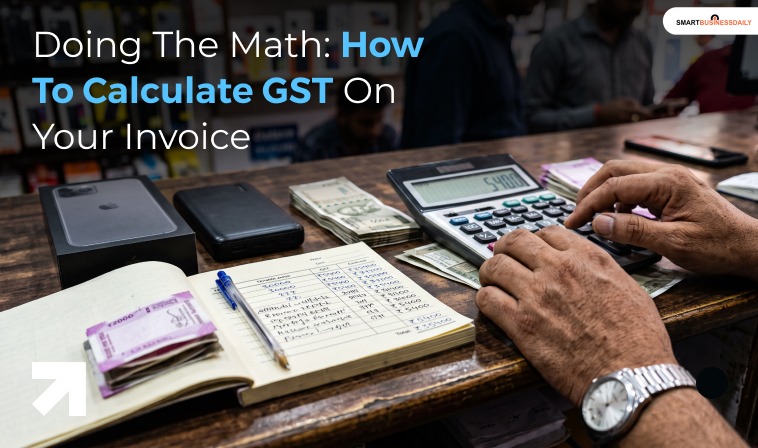
First, remember that you always calculate GST based on the actual selling price and not on the printed MRP.
In other words, if a retailer sells a particular product (say, a mobile phone charger) to you with a discount, authorities will use the discounted price for taxation purposes.
The calculations are mostly straightforward:
GST Amount = Taxable Value x GST Rate
Final Price = Taxable Value + GST Amount
Let’s take a couple of examples to see how GST calculations actually work.
Example 1
Let’s say you bought a mobile phone at a discounted price of ₹30000. The GST amount will be 30000 x 0.18 = ₹5400.
This means that you will have to pay ₹35400 in total (₹30000 + ₹5400).
Example 2
Similarly, if you bought a power bank with a discounted value of ₹2000, the GST amount would be 2000 x 0.18 = ₹360.
This means that you will have to pay ₹2360 in total (₹2000 + ₹360).
How The Tax Is Split On Your Receipt

When you look closely at your physical receipt or digital invoice, you will see the 18% tax divided based on where the seller is located:
Intra-State Purchase (Local Retailer)
If you buy from a brick-and-mortar store or an online seller located inside your home state, the tax splits evenly.
You will see 9% CGST (Central GST going to the union government) and 9% SGST (State GST going to your local state government).
Inter-State Purchase (E-commerce Warehouse)
Let’s say you ordered a phone online and a warehouse located in a completely different state ships it.
In that case, the retailer charges a single line item of 18% IGST (Integrated GST) instead.
No matter how the invoice splits the tax on paper, you pull the identical total amount of money out of your wallet!
Hidden Costs: GST On Mobile Phone Repair Services & Spare Parts
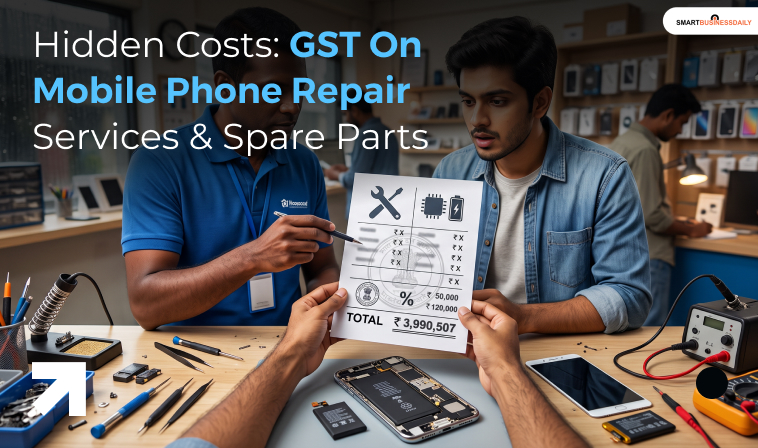
Accidents happen to the best of us, and dealing with a cracked screen or a degraded battery is a normal part of owning technology.
However, if you need to visit a service center for an out-of-warranty repair, you should prepare for how tax affects your maintenance bill.
The Indian tax system treats mobile repairs as a combination of goods and services, meaning mobile repair work attracts a flat 18% GST rate.
When you receive your final breakdown bill from the repair shop, the 18% tax will be applied separately to two distinct categories based on new GST rates on mobile phones:
1. The Spare Parts (Goods)
Physical components like brand-new display assemblies, replacement batteries, internal speakers, and charging ports are taxed at 18% under HSN Chapter 85.
2. The Labor Charge (Services)
The professional service fee charged by the technician for diagnosing, opening, and physically repairing your device also carries a separate 18% GST charge.
For smart consumers, using an authorized and registered repair shop is vital.
While unauthorized roadside shops might offer lower cash prices without a bill, registered repair networks can safely claim Input Tax Credit on the spare parts they purchase.
This is what allows them to provide genuine components with official brand warranties.
3. Insurance Claims And Theft Recovery
If you are wondering what to do if phone stolen or lost, your original tax invoice plays a critical role.
Insurance providers require this official GST bill to verify the device’s HSN code, serial number, and exact purchase value before processing your claim or approving a replacement handset.
Tax Savings For Businesses: The Input Tax Credit (ITC) Blueprint
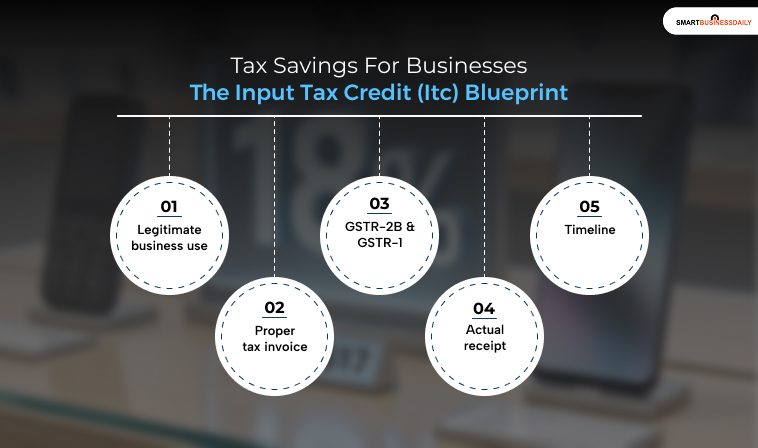
If you are a registered business owner, you can actually save money on the GST amount by claiming Input Tax Credit.
According to the Central Goods and Services Tax Act (CGST Act) 2017, businesses can claim credit on the 18% GST paid on mobile phone purchases.
In other words, you will be able to reduce your company’s tax liability by offsetting the GST amount.
Below are the eligibility criteria that need to be met in order to claim the ITC on your business phone:
1. Legitimate business use: The smartphone should be used for business purposes.
2. Proper tax invoice: You should possess a valid tax invoice that features your company’s name, your company’s GSTIN, the seller’s GSTIN, and the relevant HSN code.
3. GSTR-2B & GSTR-1: The seller should have filed the GSTR-1 return for the month of your phone purchase. After that, the invoice will automatically show in your GSTR-2B on the government portal.
4. Actual receipt: Your company should have physically received the phone.
5. Timeline: You should claim ITC within the timelines specified by the government (normally, the ITC claim should be filed before the October filing).
You Can Also Check: What Happens If You File GST Late In Canada?
Global Tech: Understanding GST On Imported Mobile Phones
When it comes to high-end flagship smartphones, some of them are only available internationally.
If you are willing to consider foreign options, it’s important to understand how GST works for imported mobile phones.
Authorities subject imported smartphones to a customs duty and an Integrated Goods and Services Tax (IGST) at 18%.
Customs authorities calculate the applicable customs duty based on the specific value of the phone.
Then, they combine the duty amount and the phone’s value to tax everything at 18% IGST.
It’s important to note that the imported phone price with GST will virtually always be higher than the price of a comparable local model.
Pro Tips: Common Billing Mistakes To Watch Out For
While understanding the new GST rates on mobile phones, it is also necessary to take a look at the common mistakes that you need to avoid!
When you receive the tax invoice for your phone accessory or smartphone, double-check the following items to make sure that you are not being charged extra:
- MRP taxation: Phones and accessories should be billed at a discounted rate.
- Missing HSN Code: Double-check that the phone’s HSN code 8517 is visible on the invoice.
- Wrong tax division: Make sure that an e-commerce portal did not mistakenly charge CGST & SGST for an outstation delivery. The IGST should be visible for inter-state sales.
After going through this mobile phone taxation guide, you should have a thorough understanding of the applicable indirect taxes.




Related Articles