








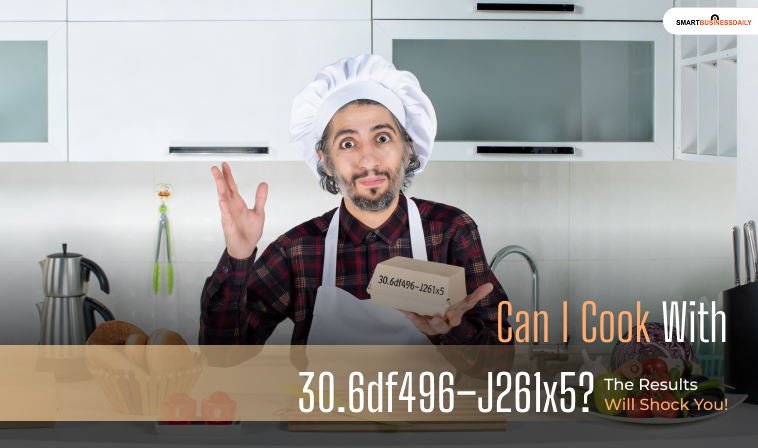
Can I Cook With 30.6df496–J261x5? The Results Will Shock You!
01 June 2026
6 Mins Read
- What Is 30.6df496–J261x5 In Reality?
- Why People Are Searching This In Connection To Small Businesses
- A Real Scenario: The Catering Supplier Who Nearly Got It Wrong
- How Real Food Safety Codes Work: A Quick Reference
- Why Small Businesses Should Be Concerned About 30.6df496–J261x5?
- What You Should Actually Do If You Find A Mystery Code
- Final Verdict
No business nitty-gritties today. Let me honestly share something that I recently came upon. It’s no business hack, but just a weird search term.
When I first came across the search query “can I cook with 30.6df496–J261x5,” my first thought was: someone is very confused. My second thought was: no, this is actually a business hack.
But I really suffered from the lack of a genuine answer to what 30.6df496–j261x5 is and what I can cook with it. That’s why I dug deep, and do you know what I found?
If you were running out of disruptive business marketing ideas, this one could be a game-changer! How?
What Is 30.6df496–J261x5 In Reality?
No, it is not a cryptic Morse code. In simple terms, 30.6df496–J261x5 is an alphanumeric technical code.
In other words, this is a kind of identifier you find in:
- software build systems
- hardware part catalogs, or
- engineering documentation.
Think of it like a serial number for a machine component. But what does it do?
In the same vein, let me break down what the structure tells us:
| Segment | Type | What It Likely Means |
| 30.6 | Numeric decimal prefix | Version number or batch/revision series |
| df496 | Hexadecimal-style string | Database or component identifier, common in software and hardware |
| – | Dash separator | Standard in part numbers and technical spec codes |
| J261x5 | Alphanumeric suffix | Sub-type, model variant, or catalog class indicator |
Some people are confusing it with the codes of acidity regulators and stabilizers that we use in food. However, research says that cooking does not have even a distant relation with 30.6df496–j261x5. But let’s just verify that it is actually unrelated to food.
Firstly, in the EU, food additives are assigned E-numbers, such as E330 (citric acid) and E471 (emulsifiers in bread). Globally, the INS system, managed by the WHO and FAO, assigns numbers such as INS 412 to guar gum.
At the same time, in the US, the FDA maintains a GRAS (Generally Recognized As Safe) list using chemical or common names. However, none of these resemble 30.6df496–J261x5.
As a result, it is safe to state that you cannot and should not cook with it. But here is where the interesting part starts.
Why People Are Searching This In Connection To Small Businesses
I talked to a friend who runs a small food packaging supply company out of a rented warehouse. She has three employees, runs on a tight margins, and his life is all about constant hustle.
To clarify, she told me something that I really want to discuss in this connection.
“People call us all the time asking if a component code on our machinery is food-safe,” she said. “They see a label, they Google it, and then they panic.”
To sum up, that is exactly what is happening with this search query. People encounter a code in a food-adjacent context. For example:
- on industrial equipment,
- a cleaning product stored near the kitchen
- inside a product manual
After that, their brain connects it to cooking. To sum up, it is actually a reasonable protective instinct.
Simply put, the problem is information scarcity. When someone searches for a strange code and finds nothing trustworthy, they keep clicking. They end up on low-quality sites. Sometimes they end up making bad decisions.
For small business owners operating in food service, food packaging, catering supply, or commercial kitchens, this is a matter of grave concern.
Check Also: Is Xevotellos Model Good For You Or Is It Just A Big Tech Bluff? Read The Entire Article To Know!
A Real Scenario: The Catering Supplier Who Nearly Got It Wrong

A small catering supply business I know was sourcing new food-grade containers from an overseas supplier. To sum up, they were just four people, operating out of a mid-sized city.
The shipment came with a technical spec sheet. Again, the spec sheet had component codes for the sealing compound used inside the lids.
Meanwhile, the code looked much different from a standard food safety identifier. The owner, understandably, got nervous. In the same vein, the main issue was: Is it food-safe? Could residue from that seal contaminate food?
After that, she Googled variations of the code for two days. But she found nothing useful.
In the same vein, do you know what she should have done? She should have gone straight to two sources.
- First, the supplier’s NSF International certification documents (NSF certifies equipment and materials for food safety use).
- Second, the FDA’s food contact substance database.
Within an hour of checking those two places, she had her answer:
“the compound was fully approved for food contact use. The code on the spec sheet was simply the manufacturer’s internal part identifier.”
You May Also Like: Last Mile Delivery: The Final 50 Feet That Make or Break Your Business
How Real Food Safety Codes Work: A Quick Reference
If you work in any food-related business, you need to know this. Here is the basic framework:
| Code System | Who Manages It | What It Covers | Example |
| E-Numbers | European Food Safety Authority (EFSA) | Food additives approved in the EU | E100 (curcumin), E330 (citric acid) |
| INS Numbers | WHO/FAO Codex Alimentarius | International food additive numbering | INS 621 (MSG), INS 412 (guar gum) |
| CAS Numbers | Chemical Abstracts Service | Pure chemical compounds | 57-50-1 (sucrose/table sugar) |
| GRAS List | US FDA | Substances recognized as safe in the US | Listed by name, not numeric code |
| NSF Certification | NSF International | Equipment and materials in food contact | Listed by product, not code string |
When a code does not fit any of these systems, it is almost certainly not a food ingredient identifier. On the contrary, it belongs to the technical or industrial world.
Why Small Businesses Should Be Concerned About 30.6df496–J261x5?
Here is what actually frustrates me about how food safety information is distributed.
Big companies like your restaurant chains have compliance teams. In addition, they have food scientists on staff.
Therefore, when a weird code shows up on a material spec sheet, someone in the building knows what it means. Or knows who to call. Meanwhile, small businesses don’t have that.
A catering company run by two people usually reads spec sheets at 11 PM, Googling codes, and hoping for the best. That’s why it is easier for small businesses to get confused.
According to the FDA, food safety violations disproportionately affect smaller food businesses. However, it is not because small operators care less. Rather, the reason is that they have fewer resources to verify materials and processes. To sum up, there is a critical knowledge gap here.
This is why search queries like “can I cook with 30.6df496–J261x5” exist in the first place. The person asking is probably not incompetent.
They are probably a small business owner or kitchen worker who found a code somewhere and has no easy way to decipher it.
What You Should Actually Do If You Find A Mystery Code
I have been in rooms where someone pulled out a container with an unfamiliar code and asked: Is this safe? So let me tell you about the princess we actually used to follow.
Start with the label itself. Look for a common ingredient name, an E-number, or an INS number. If the product is food-related, these must be there by law in most countries.
If the code appears on equipment or packaging materials, not the food itself, check for NSF International certification. Their database is searchable at nsf.org.
If the equipment is NSF-certified for food use, the components used in it are approved. For US businesses, the FDA maintains a food contact substance notification database. It is searchable and free.
For EU operations, EFSA’s food additives database at efsa.europa.eu covers everything approved under European law.
If none of that gives you an answer, call the manufacturer directly. Ask them to provide food safety documentation for the specific component.
If they cannot produce it, that itself is an answer. However, you must never rely on a Google search alone. At least don’t do that for physical safety questions.
Final Verdict
Can I cook with 30.6df496–J261x5? No. It is a technical identifier, not a food ingredient, not a cooking compound, not a food additive.
If you found this code in a food context, the right move is to trace it back to its source and verify it against an official food safety database. Do not guess.
Again, do not assume proximity to food means something is food-safe. And if you run a small food business, build a short checklist for when unfamiliar codes appear on anything that enters your kitchen or touches your product.
It takes thirty minutes to build. However, it could save you weeks of pain. That is the kind of practical, boots-on-the-ground knowledge that no big publication is going to share with you.
References: WHO/FAO Codex Alimentarius, US FDA Food Contact Substance Database, NSF International, EFSA Food Additives Database
Related Resource: How Does the Software RCSDASSK Redefine the Industry Standards? (2026 Expert Analysis)



Related Articles



Comments Are Closed For This Article