








Is Digital Real Estate The Ultimate Passive Income Hack Or A Massive Scam? The Honest Truth
19 August 2026
8 Mins Read
- Is Digital Real Estate Legit?
- What Exactly Is Digital Real Estate?
- Category 1: Traditional Online Properties (Web 2.0)
- 1. Websites And Blogs
- 2. Domain names
- 3. E-commerce Stores
- 4. Mobile Applications
- 5. Online Products / Membership Sites
- Category 2: Metaverse And Virtual Land (Web3)
- 1. Plots Of Virtual Land
- 2. Virtual Commercial Spaces
- Physical vs. Digital Real Estate: How Do They Compare?
- The Beginner’s Blueprint: A Step-By-Step Guide To Investing
- First Step: Set Your Budget And Risk Tolerance
- Second Step: Secure The Virtual Tools You Need
- Third Step: Choose The Right Domain For You
- Fourth Step: Do Your Homework
- The Big Risks: Look Before You Leap
- No Regulatory Protections
- Platform Dependency
- Search Engine Volatility
Imagine purchasing a type of real estate that you cannot physically touch, but can make you money nonetheless. Welcome to the world of digital real estate.
Similar to traditional real estate, which involves buying and selling land, houses, and buildings, digital real estate involves buying and selling virtual space on the internet.
In this article, you will discover what digital real estate is as well as the different forms it takes on and how people are profiting off of it.
Is Digital Real Estate Legit?

Yes, digital real estate is a real and valid asset.
However, it is crucial that you understand the nature of your purchase and how to properly research your acquisition.
Digital real estate in the form of domains, blogs, online stores, and apps is a multi-billion-dollar global business.
This is a well-developed market with reputable companies such as Google, GoDaddy, and Flippa.
So, as you buy and sell digital real estate, you are entering real businesses that have legal agreements and intellectual property at their foundation.
Nevertheless, digital real estate in Web3 is technically correct but very risky.
In fact, you have to be very cautious not to be deceived into thinking that virtual properties on metaverse platforms are just a new type of asset with almost non-existent regulations.
Although it is really hard to forge anything on the blockchain, quite a few projects will be dead.
While the others are likely to have their prices inflated to unreasonably high levels by their creators.
Hence, just as you would in any legitimate market, take your time, evaluate risks, and check every detail before investing. If something seems too good to be true, it usually is.
What Exactly Is Digital Real Estate?
At its core, digital real estate covers any piece of virtual property that exists exclusively online and has the potential to hold or increase in value.
Think of these assets exactly like physical plots of land. They can be bought, sold, developed, improved, and rented out to generate reliable passive income.
Moreover, the main appeal of digital property is its accessibility.
While buying a brick-and-mortar building requires massive capital, bank loans, and months of legal paperwork, you can purchase a piece of the internet from your laptop in a matter of minutes.
We must divide digital real estate into two main categories to truly understand this market: Web 2.0 assets (traditional online properties) and Web3 assets (the metaverse and virtual land).
Category 1: Traditional Online Properties (Web 2.0)
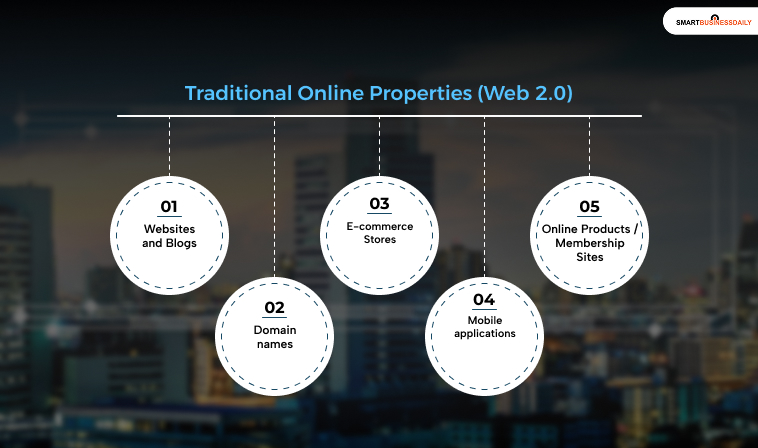
This is the safest, most secure, tested, and profitable segment of digital property.
The analogies to “real” estate would be buying someone’s local franchise or a shopping mall.
Moreover, you are purchasing digital property that makes money via traffic flowing through it.
1. Websites And Blogs
The most common way to invest in digital property is buying an existing blog or website.
Any blog or website with consistent traffic is a great candidate for purchase.
Moreover, monetization comes from ads via Google AdSense or affiliate marketing programs, which makes this a very attractive investment with a steady passive income stream.
2. Domain names
A domain name is simply a web address of any website, for example, Google.com or Amazon.com.
Domain names can be bought and sold like any other commodity. Some people call it flipping domains. Others compare it to purchasing gold or land.
Furthermore, you can get a domain name that is easy to guess or remember and sell it for a profit once someone needs it for their business.
Some domains have sold for millions of dollars as they are very simple and brandable.
3. E-commerce Stores
E-commerce stores such as Shopify websites or Amazon FBA accounts are another great way to diversify your investment portfolio.
You are buying a virtual shopping mall that sells physical products to customers worldwide.
Furthermore, these are mostly passive assets which can be automated with dropshipping or Fulfillment by Amazon services.
4. Mobile Applications
With billions of cellphones being used worldwide, an app stored on either Google Play or the Apple App Store is an incredible opportunity to make money online.
Moreover, unlike websites and blogs, a mobile application can generate revenue through subscriptions to premium content, in-app purchases, or Google AdMob ads.
5. Online Products / Membership Sites
The online products segment is the most diverse, as it can take many forms.
It can be a simple blog with a membership area where users pay \$10 per month to access.
Or, it can be an online course teaching a specific skill, or a forum with a list of online trainings.
All of these are usually built on a membership platform and generate recurring revenue from their members.
You May Also Love To Read: How Can Business Properties Aggr8Investing Change The Scenario For Businesses Out There?
Category 2: Metaverse And Virtual Land (Web3)
Merging blockchain, AI, and VR has enabled the virtual real estate concept to emerge as a groundbreaking idea.
1. Plots Of Virtual Land
On gaming platforms like Decentraland and The Sandbox, landowners can buy a plot.
Once a plot of land has been purchased, it will be identified by one or more cryptographic tokens (e.g., NFTs).
With that, blockchain technology can prove ownership without even being present in the real world.
So, this is because there will be an unchangeable, verifiable record of land ownership.
2. Virtual Commercial Spaces
Typically, the owner of a virtual land parcel can choose either to develop the land themselves or to sell it to a business entity interested in setting up a commercial outlet in the metaverse.
Moreover, some companies purchase virtual land parcels primarily to host exclusive concerts or art exhibitions.
It should be noted, however, that many firms have already sold off their digital properties to large multinational corporations eager to launch their advertising campaigns in the virtual world.
Physical vs. Digital Real Estate: How Do They Compare?
Investing in an online asset is not as different from buying a physical house as you might think.
Both models share the same core financial goals: capital appreciation and steady cash flow.
| Investment Feature | Physical Real Estate | Digital Real Estate |
| Barrier to Entry | Very high; requires large down payments, credit checks, and bank approvals. | Extremely low; anyone with an internet connection and a few dollars can participate. |
| Maintenance Costs | High; requires property taxes, physical repairs, roofing, plumbing, and insurance. | Low; limited to cheap monthly web hosting fees, domain renewals, or minor software updates. |
| Income Generation | Monthly rental checks paid by physical tenants. | Advertising revenue, affiliate commissions, product sales, or virtual rent. |
| Value Upgrades | Renovating kitchens, painting walls, or adding square footage to a building. | Improving site design, publishing high-quality articles, and boosting search engine traffic. |
| Market Liquidity | Low; selling a physical property can take weeks, months, or even years. | High; online marketplaces allow you to list and sell a digital asset within days. |
| Geographic Bounds | Limited to local economic conditions and physical location constraints. | Global reach; your property can attract visitors from all over the world simultaneously. |
Also Check: Best Short-Term Rental Property Management in Orlando: A Guide for Remote Owners
The Beginner’s Blueprint: A Step-By-Step Guide To Investing

The first step to becoming a billionaire with your own digital empire is to have a strategy. Take it seriously, as one would a real-world business’s development.
First Step: Set Your Budget And Risk Tolerance
Decide what risk and budget you are willing to take.
Never ever invest money you can’t afford to lose in a single asset. Content websites are a safer but lower-risk investment than metaverse real estate.
Moreover, the latter has the potential to yield exponentially higher returns but is also much riskier.
It’s essential to choose the track that best fits your financial goals. The choice depends on your attitude toward risk.
Second Step: Secure The Virtual Tools You Need
Next, if you have selected the Web2 option, open a web-hosting account and email accounts for your business.
If the crypto world is your thing, buy a hardware wallet and store your cryptocurrency there.
So, never store your website or metaverse plots in online wallets, as they can be hacked. Always use hardware devices to keep your earnings safe.
Third Step: Choose The Right Domain For You
Do not buy any website or domain from social media. Use escrow services to make all transactions secure.
Use Flippa, Empire Flippers, or Quiet Light as independent business brokers when buying or selling websites or apps.
When purchasing domains, use GoDaddy Auction, Namecheap, Sedo, or other domain-specific sites.
When buying metaverse land, use the platform’s escrow services or external NFT marketplaces (e.g., OpenSea).
Fourth Step: Do Your Homework
If you are buying a website, ask the owner to grant you access to Google Analytics and review their expenses and revenue.
At the same time, if you are buying metaverse land, study its traffic. How many users does it attract per day?
A plot in the middle of a busy street will bring exponentially more revenue than a lonely piece of land in the middle of nowhere.
| How much money do I need to start? You can start with as little as $10 to $15 to register a brand-new domain name. If you want to buy an established blog or e-commerce store that already generates reliable monthly profits, prices typically range from a few hundred dollars to hundreds of thousands of dollars depending on the monthly revenue. |
The Big Risks: Look Before You Leap

While the opportunities afforded by the digital world are enormous, it is important to recognize some of the particular dangers and limitations that come with such an environment:
No Regulatory Protections
Unlike real estate transactions, which are protected by local courts and government, deals in the digital space are completely unregulated.
If you lose money due to fraudulent contracts or phishing, you will have no recourse, as the banks will not help.
Platform Dependency
By building your project in the metaverse or on a third-party-controlled platform, you make that company your sole trustee.
If they go bankrupt or update their Terms of Service, you will lose your investment overnight.
Search Engine Volatility
For conventional web projects, the entire traffic and budget can be cut short by a shift in the ranking algorithm.
Moreover, it is essential to have additional promotional channels, such as email lists and social media accounts. This can help you to avoid such volatility.
| How do I know if an online property listing is a scam? Always rely on verified third-party data. Walk away immediately if a seller promises massive passive income. However, it refuses to share raw traffic reports, video walk-throughs of their accounts, or verified financial statements. Always use a trusted escrow platform to handle the transaction securely. |




Related Articles