








Why VC Funding Is A Trap: How To Scale Faster Using A Startup Booted Fundraising Strategy
12 August 2026
11 Mins Read

- The Concept Of Startup Booted Fundraising Strategy?
- Why Is This Gaining Popularity?
- Startup Booted Fundraising Strategy: Real-Life Case Studies
- Why It Works So Well?
- Your Step-By-Step Action Plan: Startup Booted Fundraising Strategy
- Step 1: Validate The Demand For Your Product
- Step 2: Begin To Get The Cash Flow Immediately
- Step 3: Focus On Monthly Recurring Income
- Step 4: Keep Everything As Lean As Can Be
- Step 5: Spend Money Wisely
- What Are The Practical Funding Models: Startup Booted Fundraising Strategy
- 1. Personal Funds Method
- 2. Revenues-As-A-Foundation Model
- 3. Part-Time Model
- 4. Coop Model
- Strategic Risks and Mitigation In Startup Bootstrapping
- 1. Enforce Aggressive Task Prioritization
- 2. Implement Low-Cost Automation Tools
- 3. Ship Imperfect MVPs Rapidly
- 4. Form Strategic Resource Alliances
- When Should You Raise External Capital?
- Core Financial Metrics vs. Valuation Myths
| Quick Summary: A startup booted fundraising strategy is a smart, revenue-first plan where you use early sales, lean operations, and personal savings to grow your business. You use real customer cash flow to build your product, instead of rushing to pitch rich venture capitalists on day one. This strategy works perfectly if you can: • First, you need to launch a simple, working version of your product quickly. • Secondly, you need to keep your daily setup costs as low as possible. • After that, you can reinvest your profits right back into the business. • Lastly, you need to use smart cash forecasting to see exactly when external capital will accelerate your growth. In short, a startup booted fundraising strategy ensures you never beg for money. Instead, you build a highly profitable company first. This is what gives you total power and leverage when you choose to talk to investors later. |
When you want to get financing, you will most likely have to pitch to wealthy investors who will ask for shares in exchange for their capital.
However, what if you just don’t want to give away the company or get involved in the boardroom politics?
That is why many founders are opting for a startup-bootstrapped fundraising strategy.
This intelligent approach is based solely on getting revenue from your sales. Hence, you create a business that generates enough revenue to run on its own, rather than begging investors for money.
The advantage of this method is that founders retain their independence and can grow the company gradually rather than in a rush, which can sometimes be quite dangerous.
Today, even most founding teams have realised the value of this down-to-earth method, as it focuses on freedom and real profits.
Thus, the question arising is: a startup booted fundraising strategy- what on earth is it?
Here is a step-by-step explanation presented through an example so the reader can figure it out easily.
The Concept Of Startup Booted Fundraising Strategy?
A startup booted fundraising strategy means you use your own sales to fund your dream.
Basically, you take the money customers pay you and pump it right back into the business.
Consequently, you get to keep full control of your decisions and your company stock.
It is the perfect mix of saving money, staying lean, and putting sales first.
Actually, you are not saying “no” to investors forever. Instead, you are building a strong business first so you can demand a much better deal later.
Why Is This Gaining Popularity?
Let’s be honest! The business world has undergone many changes lately. Founders are choosing a startup booted fundraising strategy for a few big reasons:
- Investor cash is expensive: When you are getting money from the outside, it means you are losing your freedom.
- Markets are unpredictable: Rapid economic ups and downs can dry up quickly.
- Real proof beats promises: When you are making money, it proves people actually want your product.
- Success leaves clues: Lastly, large companies like Mailchimp and Zoho have proven this path works.
Ultimately, making a real profit gives you the power to run your business your way.
Startup Booted Fundraising Strategy: Real-Life Case Studies
There are a few incredible business examples that completely bypassed the typical investor scenario yet still were highly successful:
- Mailchimp:
By merely keeping an ear to customers and relying on monthly sales, they managed to run a huge business.
This helped them evolve into a massive company, generating billions without ever taking a single penny from investors early on.
- Zoho Corporation:
This crew transformed into a world-class provider of software services from scratch. They concentrated on profit immediately.
Using such a business model, they demonstrated that investor- or angel-backed fundraising strategies are unnecessary when building a global business while maintaining absolute control over your company.
- Basecamp:
They preferred slow, steady growth rather than blowing the budget and chasing crazy ideas.
Consequently, they remained entirely independent and showed that a financially responsible attitude is definitely much better than a hectic startup lifestyle.
Why It Works So Well?
These businesses are proof that if you can do your business successfully, you don’t really need a huge amount of money to scale your product or services.
Absolutely true! Studies confirm that in their first three years, bootstrapped startups make a profit three times as often as investor-backed ones.
Moving to the core, this strategy demands that you be laser-focused on what really brings success:
- Happy customers: First of all, you create a product not for board meetings but for real users.
- Smart spending: On the second thought, you become very cost-conscious and waste very little.
- Strategic patience: On the third, you realise that the time you choose to get your venture growing is a reflection of your readiness.
Going the startup booted fundraising route would mean you are building a serious business with a long-run horizon from the day you start.
Your Step-By-Step Action Plan: Startup Booted Fundraising Strategy
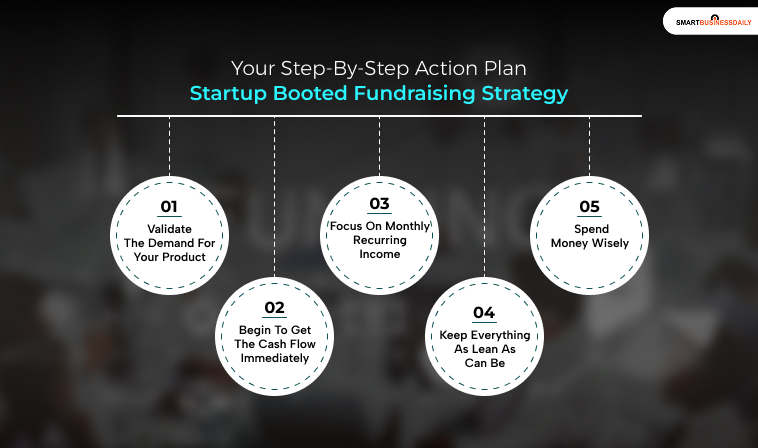
If you decide to build a business your way, the prospect is usually exciting. But you have to develop an adequate blueprint for this endeavour. That is the way you can succeed!
A winning startup booted fundraising strategy has a well-defined and step-by-step system that ensures a constant supply of money.
Below, you will find exactly how the application of this plan can serve as the basis for creating a highly successful company.
Step 1: Validate The Demand For Your Product
Before you waste time and resources building something nobody really needs, the key is to have customers wanting it first.
If you have the courage to take the risk, go ahead and run real-world validation of your business idea as a pilot project.
It is one of the great ways to not lose sleep over it while keeping it a secret. If people pay you first, they actually want it.
By doing it this way, you have totally minimised the risk of failure.
To prove your idea is viable in a fast, effective and cheap way, you can try: • Landing pages:
Create a landing page with a call to action that invites people to subscribe to your list; you want to collect email addresses.
- Early access: Provide your product or service to your most devoted and eager customers a little sooner than it is publicly introduced.
- Pre-orders: You can be so ahead of your game even if you start making money through selling the product to people who just know a tiny glimpse of it, like a concept or a sketch of what it would look like.
Step 2: Begin To Get The Cash Flow Immediately
Quite often, people don’t start making their business run for money until they have everything set for the perfect launch. But, startups booted can’t afford such luxury!
The reality is, cash money always wins hands down over the online buzz or excitement.
Furthermore, if you start selling at least the most promising features early, your customers can provide feedback as you work on improving the product for them.
The money generated from this will support only a limited number of expenses.
To help you find out the easiest methods that can be employed on the very first day, see the examples below:
- Paid betas: Charge your users a small amount to access an unfinished/early version of a product you are developing and get their feedback.
- Services: By offering consulting work here and there, a startup can support itself in developing the product over a longer period.
- Tiered pricing: Allow each consumer to buy the package that best suits their income level.
Also Check: How To Protect Your Business From Consumer Fraud? – Best Practices
Step 3: Focus On Monthly Recurring Income
A stable income helps to keep your mind at rest.
You should aim to create subscription-based models as your main source of income. Why? Startups have to depend largely on cash to raise funds.
In addition, the income you get at regular intervals provides great financial stability for you.
A regular income will enable you not only to plan but also to execute your growth strategy without the support of outside investors.
Strategies to generate monthly income:
- Subscription plans: Get monthly income by offering recurring services.
- User retention: Keep your existing clients happy so they stay your clients.
- Upselling: Provide premium features to people who already like your product.
- Membership: Create a community of paying individuals around your brand
Step 4: Keep Everything As Lean As Can Be
Since you are starting a business with a tiny bit of capital, you have to do everything you can to reduce your spending in the beginning so you have time and space to learn the business, grow, and earn.
Every dollar you save by reducing your expenses extends the time you have to achieve success.
Lean operations are a major part of this business model, as they help you use your resources in the smartest and most effective way.
As you have a limited budget, lean operations will help you to focus on what is really needed.
By keeping your fixed costs low, you have a firm grip on your financial situation.
Ways to minimise fixed expenses:
- Working from Home: Completely avoiding buying or renting an expensive office space.
- Intelligent software: Having software systems that will perform work such as scheduling, accounting and customer database management so that repetitive manual work is minimised.
- Contractors: Employing freelance workers to work only when you need them instead of hiring full-time workers who are not always needed.
- Minimal Expenses: Eliminate all nonessential costs for a month.
Step 5: Spend Money Wisely
It is time to put your money to work, and it has been earned from your company’s profits.
You shouldn’t be wasting it on new gadgets for a better office space or other unnecessary expenses.
Instead, put your hard-earned money to the areas that really need it, such as reinvesting a large portion of the profit back into your business.
This step will result in more sales because you are making your money work for you.
Ways to effectively use the profit:
- Acquiring: Allocate money for the types of marketing that bring good results.
- Upgrades: Improve your product based on your users’ suggestions.
- Productivity enhancement: Develop and optimise internal processes to save time and increase output.
- Customer Lifetime Value: Focus on the tools that help you retain customers as long as possible.
Over time, this strategic reinvestment creates a wonderful compounding growth effect.
Your profits continuously fuel your expansion without needing a single dime of external capital.
This is exactly what makes a startup booted fundraising strategy so scalable. Your own high performance entirely drives your growth.
What Are The Practical Funding Models: Startup Booted Fundraising Strategy
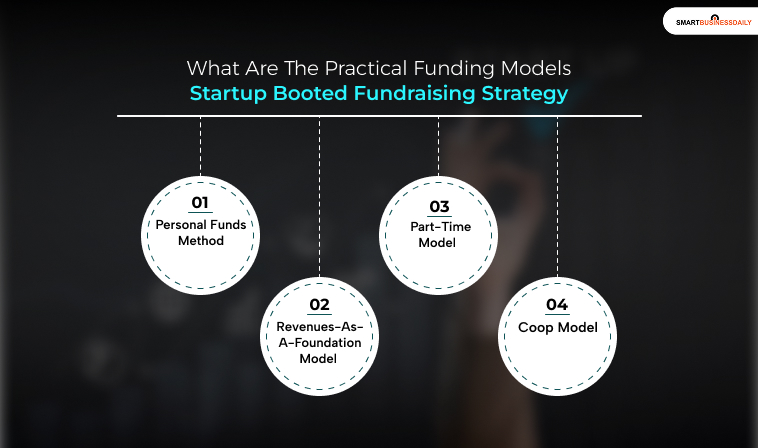
Bootstrapping is a way for investors to keep 100% of their company and remain fully in control of decision-making during the development of a profitable business.
Moreover, the funding structure depends on risk tolerance, the amount of personal capital, and the immediate cash flow need.
1. Personal Funds Method
Founders use their savings or income from their current jobs to fund the business’s initial operations.
- Ideal for: Solo founders who aim to bring the idea to life without outside influence and validation of the minimum viable product (MVP).
- Strategic Advantage: Allows you to bypass pitching and move straight into execution since you are the only decision-maker.
- Practical advice: Allocate a limited budget for the initial period to avoid financial problems on your side.
2. Revenues-As-A-Foundation Model
The business is designed to sell immediately and cover all operations with customer funds.
- Ideal for: SaaS or subscription boxes with regular billing schedules, or service-oriented agencies with regular billing.
- Strategic Advantage: Keeps monetary risk low because demand validation funds the company’s growth.
- Practical advice: Initially, concentrate on producing products or services that deliver the largest possible margins to build the company’s operating capital.
3. Part-Time Model
Founders conduct a job search or an independent side venture while building the startup in their spare time.
- Ideal for: Entrepreneurs cautious about the investment who cannot afford to rely only on the business income in the early development period.
- Strategic Advantage: Offers consistent financial support so that the pressure of the need to generate income is eased.
- Practical advice: Implement a highly efficient scheduling strategy to avoid becoming exhausted both professionally and personally while maintaining your product’s progress.
4. Coop Model
The startup and the established company form an alliance that will enable the exchange of knowledge and skills, provide access to a network of clients, and share common operational equipment.
- Ideal for: Entrepreneurs who have strong personal or professional networks but don’t have a lot of money at hand.
- Strategic Advantage: By leveraging the large corporation’s existing assets, costs are reduced, and the company can enter the market quickly.
- Practical advice: Always ensure that your contracts and legal documents with the company partner contain clear provisions on the scope, timeline, and delivery penalties.
Strategic Risks and Mitigation In Startup Bootstrapping
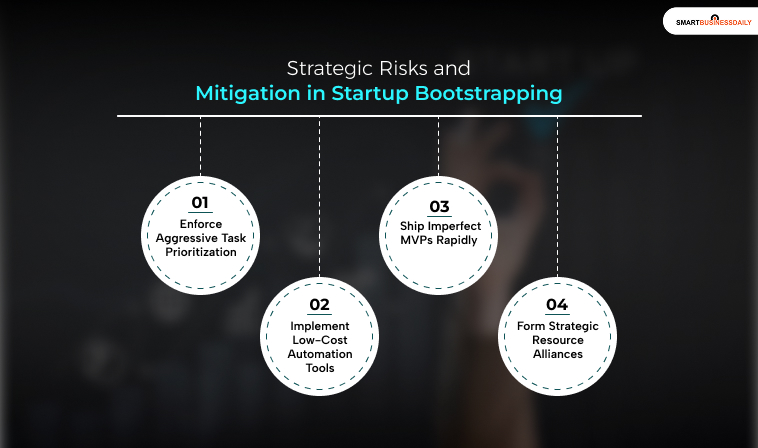
While self-funding secures absolute operational independence, founders must consciously navigate specific systemic trade-offs.
A successful bootstrapping strategy requires balancing slower growth velocity against the financial risks of personal liability.
Here are core risks of self-funded scaling:
- Velocity Caps: Growth is strictly limited by current monthly cash flow, slowing market expansion.
- R&D Constraints: Minimal upfront capital limits deep product innovation and the development of complex technical infrastructure.
- Liability Exposure: Founders face direct personal financial risk if the venture stalls.
- Market Outpacing: Well-funded competitors can quickly capture market share in high-barrier industries.
1. Enforce Aggressive Task Prioritization
Focus exclusive operational energy on high-impact, revenue-generating activities. Eliminate nonessential administrative overhead to protect your working-capital runway.
2. Implement Low-Cost Automation Tools
Leverage modern AI and automated software pipelines to replace expensive headcount.
Optimise your digital infrastructure early to scale operations without inflating fixed costs.
3. Ship Imperfect MVPs Rapidly
Launch minimum viable products directly to your target audience to establish an immediate feedback loop.
Early customer revenue validates market demand far better than prolonged, closed-door engineering.
4. Form Strategic Resource Alliances
Negotiate non-cash, mutually beneficial partnerships with complementary business entities.
Exchange specialized intellectual property or marketing access for necessary infrastructure and distribution channels.
When Should You Raise External Capital?
Bootstrapping is not a lifelong ban on outside investment; it is a tactical delay. Funding early stages independently builds immense operational leverage. When you finally invite venture capital or private equity to the table, you negotiate from a position of undeniable strength, radically reducing equity dilution.
Here are 4 triggers for raising external capital:
- Validated Product-Market Fit: Core products show consistent, predictable organic demand from a stable user base.
- Positive Unit Economics: Every new customer acquired generates clear, repeatable profit after accounting for variable costs.
- Capital-Locked Scaling: Internal cash flow can no longer keep up with verified, high-margin market expansion opportunities.
- Asymmetric Negotiation Power: Balance sheets provide the financial stability to walk away from predatory terms or toxic term sheets.
Core Financial Metrics vs. Valuation Myths
In a self-funded model, metrics act as your primary survival mechanism. Vanity metrics like estimated valuation mean nothing; execution efficiency means everything.
1. Revenue Growth Rate: Percentage increase in top-line revenue over a specific period.
- Why It Matters: Proves real market demand and verifies whether your business is expanding organically.
2. Gross Margins: Total revenue minus the Cost of Goods Sold (COGS), expressed as a percentage.
- Why It Matters: Reveals production efficiency and determines how much cash is left over to reinvest into operations.
3. Customer Retention Rate (CRR): Percentage of customers who continue paying for your product over a specific timeframe.
- Why It Matters: Proves actual product value and prevents burning cash on a leaky acquisition funnel.
4. Lifetime Value to Customer Acquisition Cost (LTV: CAC) Ratio: Total net revenue a customer generates compared to the marketing capital spent to acquire them.
- Why It Matters: Measures marketing efficiency. Healthy bootstrapped ratios typically sit at 3:1 or higher.
5. Cash Runway: Amount of time your business can survive before running out of money, calculated by dividing current cash reserves by monthly net burn. Why It Matters: Dictates your operational safety net and precisely how much time you have to iterate before reaching financial distress.
Additional Resource: How Can Business Properties Aggr8Investing Change The Scenario For Businesses Out There?




Related Articles



Comments Are Closed For This Article