








AI In Pharmaceutical Manufacturing: Benefits, Applications, And Future Trends
8 Mins Read
Published on: 24 December 2025
Last Updated on: 07 July 2026
- What Is AI In Pharmaceutical Manufacturing?
- AI In Pharmaceutical Manufacturing That Learns And Evolves:
- Benefits Of AI In Pharmaceutical Manufacturing:
- Supporting Innovation While Upholding Compliance:
- Examples Of AI Technologies In The Pharmaceutical Manufacturing Industry:
- 1. Real-time Quality Control And Inspection:
- 2. Predictive Maintenance:
- 3. Process Optimization & Orchestration:
- 4. Supply Chain & Inventory Intelligence:
- 5. Regulatory & Administrative Automation:
- How Does AI In Pharmaceutical Manufacturing Impact The Workforce?
- Challenges Of Implementing AI In Pharmaceutical Manufacturing
- Key Highlights:
- Frequently Asked Questions:
- 1. Can AI replace pharmaceutical manufacturing workers?
- 2. What AI technologies are used in pharmaceutical manufacturing?
- 3. How does AI improve quality control?
- 4. What are the biggest challenges of implementing AI?
Pharmaceutical manufacturing leaves almost no room for error.
A slight variation in temperature, contamination levels, or equipment performance can affect product quality, delay production, or even compromise patient safety.
Moreover, maintaining that level of precision across every batch is becoming increasingly difficult as manufacturing processes grow more complex.
This is where AI in pharmaceutical manufacturing is making a measurable difference.
Rather than replacing scientists, engineers, or production teams, artificial intelligence helps them make faster, more informed decisions.
It can analyze massive amounts of production data in real time, identify patterns that would otherwise go unnoticed, predict equipment failures before they occur, and optimize manufacturing processes to improve consistency.
Also, from quality control and predictive maintenance to regulatory compliance and supply chain planning, AI is quietly becoming one of the industry’s most valuable tools.
In this article, we’ll explore how AI in pharmaceutical manufacturing is transforming production, the technologies driving this change, and the benefits it offers manufacturers striving for greater efficiency, accuracy, and reliability.
Stay tuned.
What Is AI In Pharmaceutical Manufacturing?
Artificial intelligence in pharmaceutical manufacturing refers to the use of machine learning, computer vision, predictive analytics, and automation to improve:
- production efficiency,
- product quality,
- equipment maintenance, and
- regulatory compliance.
Instead of replacing human expertise, AI supports decision-making by analyzing large volumes of manufacturing data in real time.
AI In Pharmaceutical Manufacturing That Learns And Evolves:
What makes AI in pharmaceutical manufacturing so powerful is its ability to adapt over time. Traditional automation follows rigid instructions.
Machine-learning systems gain insights from each batch, sensor reading, and adjustment. As a result, facilities become more efficient and capable the longer these systems operate.
AI is especially valuable in predictive maintenance and process optimization. It can detect early indicators of equipment stress that a human would be unlikely to notice, such as
- Unusual vibration patterns,
- Temperature shifts,
- Minor drops in output.
These insights allow teams to schedule maintenance before problems interrupt production. When a parameter drifts outside its ideal range, AI can identify the change immediately. This way, they can help to correct it, preserving batch consistency and reducing waste.
AI also has a growing role in supply chain stability. By evaluating production patterns, market trends, and real-time logistical data, it can anticipate shortages or delivery delays and recommend proactive adjustments.
Benefits Of AI In Pharmaceutical Manufacturing:
Artificial intelligence is delivering measurable improvements across every stage of pharmaceutical manufacturing.
So, by combining real-time data analysis with predictive capabilities, AI helps manufacturers improve efficiency while maintaining the high quality and compliance standards the industry demands.
Some of the biggest benefits include:
- Improved product quality: AI continuously monitors manufacturing conditions to detect variations early, helping maintain consistent product quality across every batch.
- Reduced production waste: By identifying process inefficiencies and optimizing manufacturing parameters, AI minimizes material waste and lowers production costs.
- Less equipment downtime: Predictive maintenance systems identify potential equipment failures before they occur, reducing unexpected breakdowns and costly production interruptions.
- Faster quality inspections: Computer vision systems can inspect tablets, capsules, vials, and packaging in real time, identifying defects far more quickly than manual inspections.
- Stronger regulatory compliance: AI automates documentation, monitors production data, and creates detailed audit trails that simplify compliance with regulatory requirements.
- Smarter inventory and supply chain management: Predictive analytics helps manufacturers forecast demand, manage inventory levels, and anticipate supply chain disruptions before they impact production.
- Higher operational efficiency: By optimizing production schedules, equipment performance, and resource allocation, AI enables manufacturers to increase productivity without compromising quality.
As AI technologies continue to mature, these benefits will become even more significant, helping pharmaceutical manufacturers build safer, more efficient, and increasingly resilient production environments.
Supporting Innovation While Upholding Compliance:
Pharmaceutical manufacturing operates under strict regulatory scrutiny, and adopting advanced technologies can sometimes feel challenging.
AI in pharmaceutical manufacturing helps close the gap between innovation and compliance by making documentation clearer and strengthening transparency.
Natural language processing tools can interpret complex regulatory language and turn it into practical guidance, helping teams stay aligned with current standards.
Automated tracking systems monitor every step of the manufacturing process, creating detailed records that support internal quality programs and external audits.
As AI capabilities continue to evolve, its role in medical manufacturing will expand even further. This development is not about following trends.
It is about building processes that are more consistent, more efficient, and more dependable than ever before.
For additional insight into how AI in pharmaceutical manufacturing is redefining standards in pharmaceutical production, explore the visual guide accompanying this article from Advanced Technology Services, a provider of predictive maintenance sensors.
Examples Of AI Technologies In The Pharmaceutical Manufacturing Industry:
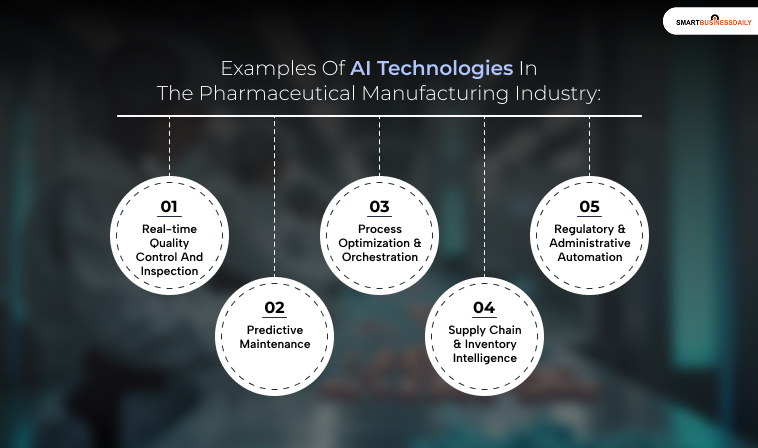
The pharmaceutical manufacturing industry is utilizing AI to transition from traditional “batch” processing to intelligent, self-optimizing “smart factories”.
As a result, the key AI technologies mainly include:
1. Real-time Quality Control And Inspection:
Computer vision (CV): AI-powered cameras and sensors mainly inspect products at “breakneck speed.” They can detect microscopic defects in tablets, capsules, and vials. This includes cracks, discoloration, or missing components.
Convolutional Neural Networks (CNN): This is a deep learning model that is specifically used for visual recognition tasks. This includes:
- Analyzing the size and shape of the particles in real time while the drugs are being formulated.
- Troubleshooting end product quality
Review by exception: Some of the AI in pharmaceutical manufacturing, such as Mareana, can help in several ways, such as:
- Scanning and digitizing handwritten batches. Records
- Flagging any form of anomalies for human reviews
This can drastically reduce the time you spend on manual quality assurance.
2. Predictive Maintenance:
Anomaly detection: The AI algorithms can easily analyze the real-time data from equipment sensors. This includes:
- Monitoring temperature
- Vibration
- Lubrication
These can help in forecasting failures even before they occur.
Uptime optimization: The features can predict maintenance needs up to 10 days in advance. Companies like J&J and Pfizer have secured millions in annual benefits per plant while reducing equipment downtime by 30-50%.
3. Process Optimization & Orchestration:
Digital Twins: The use of virtual representations of manufacturing processes enables companies to create simulations of “golden batch” conditions and test changes in production in the digital space before their execution.
Smart Scheduling: Job-shop scheduling, driven by AI, optimizes manufacturing processes and reduces changeover times.
For instance, a major pharmaceutical company, “Cipla,” reduced its changeover time by 22% using such models. Dynamic Control: The production parameters, such as heat, pressure, and mixing speeds, are managed in real-time by the RL and deep learning models to increase yield and reduce waste.
4. Supply Chain & Inventory Intelligence:
Demand Forecasting: ML models analyze seasonal trends, market ups and downs, and environmental data to reduce the risk of either drug shortages or overproduction.
Cold-Chain Monitoring: AI in pharmaceutical manufacturing for tracking and monitoring allows companies to see inside transportation routes.
It further alerts them to any temperature changes during transport, which could affect the quality of delicate medications.
5. Regulatory & Administrative Automation:
Natural Language Processing (NLP): NLP technology is applied to process technical documents, maintenance logs, and quality reports to identify the root cause of quality issues.
Automated Documentation: Generative AI models play a crucial role in drafting and formatting complex regulatory submissions (FDA, EMA), thereby reducing document preparation cycles by 20–30%.
How Does AI In Pharmaceutical Manufacturing Impact The Workforce?
The year 2026 marks a major technological advancement in integrating AI into the medical manufacturing industry.
This not only helps the sector address the 68% worker shortage but also prevents costly product recalls. The area of basic impacts consists of:
- Transfer of Skills: It is the coming of augmented jobs that the conventional occupations are turning to.
The workers need to be equipped with technical skills in data literacy and AI management to oversee automated quality control and robotic assembly gradually.
- Increased Productivity: The combination of AI and existing technologies is such that predictive maintenance is performed by AI and real-time detection of defects.
This reduces machine downtime and item defect rates significantly, from 50% to almost zero, that is, 1% in practical terms.
- Upskilling as a Strategy: Factories are investing in training to bridge the gap between aging staff with operational expertise and younger staff who are computer-savvy.
- New Positions: The demand for specialists in AI operations and engineers for predictive maintenance, who will be responsible for the smart factory ecosystem, is increasing significantly.
While AI automates repetitive monitoring tasks, it also creates new responsibilities for engineers, operators, and quality specialists.
Rather than replacing skilled professionals, most pharmaceutical manufacturers are using AI to augment decision-making while investing in workforce training and digital skills.
Challenges Of Implementing AI In Pharmaceutical Manufacturing
While AI offers significant advantages, implementing it successfully comes with its own set of challenges.
So, manufacturers must carefully address both technical and operational barriers to maximize the technology’s potential.
Some of the most common challenges include:
- High implementation costs: Deploying AI solutions often requires significant upfront investment in software, infrastructure, and specialized equipment.
- Data quality requirements: AI systems rely on accurate, consistent, and well-structured data. Poor-quality or incomplete data can reduce the effectiveness of AI models.
- Regulatory validation: Pharmaceutical manufacturers must ensure AI-driven processes comply with strict regulatory standards, which often requires extensive validation and documentation.
- Cybersecurity risks: As manufacturing systems become more connected, protecting sensitive production data and AI infrastructure from cyber threats becomes increasingly important.
- Integration with legacy systems: Many pharmaceutical facilities still operate with older manufacturing equipment and software, making AI integration more complex and time-consuming.
- Staff training and adoption: Successfully implementing AI requires employees to develop new technical skills and adapt to data-driven workflows, making ongoing training an essential part of digital transformation.
As a result, by understanding these challenges early, pharmaceutical manufacturers can develop implementation strategies that balance innovation with compliance, operational efficiency, and long-term sustainability.
Key Highlights:
Artificial intelligence is no longer a future concept in pharmaceutical manufacturing.
From predictive maintenance and automated inspections to smarter supply chains and regulatory compliance, AI is helping manufacturers produce safer medicines more efficiently.
Organizations that combine AI with skilled professionals and robust quality systems will be better positioned to meet growing industry demands in the years ahead.
Frequently Asked Questions:
Check out the frequently asked questions related to AI in pharmaceutical manufacturing.
1. Can AI replace pharmaceutical manufacturing workers?
No. AI supports decision-making and automates repetitive tasks, but skilled professionals remain essential for oversight, compliance, and quality assurance.
2. What AI technologies are used in pharmaceutical manufacturing?
Common technologies include machine learning, computer vision, natural language processing, predictive analytics, robotics, and digital twins.
3. How does AI improve quality control?
AI analyzes production data and visual inspections in real time to detect defects, monitor process variations, and reduce human error.
4. What are the biggest challenges of implementing AI?
High implementation costs, regulatory validation, data quality, cybersecurity, and employee training are among the most common challenges.
Read Also:




Related Articles



Comments Are Closed For This Article