








The Best Virtual Cards For Ad Payments: How To Choose The Right Setup For Marketers And Agencies?
8 Mins Read
Published on: 18 March 2026
Last Updated on: 19 March 2026

- Why High Limits Turned Into A Risk Flag In 2025?
- How Card Characteristics Affect Account Survival?
- How To Choose Best Virtual Cards For Ad Payments In 2026?
- When Unlimited Cards Actually Make Sense?
- The Best Virtual Cards For Ad Payments: Expert Review
- 1. Spend.net:
- Facts:
- 2. PSTNET:
- Facts:
- 3. Mybrocard:
- Facts:
- 4. Abcard (AnyBill):
- Facts:
- 5. Lamanche Payments:
- Facts:
- Safe Ad Payment Architecture:
- A Card Is Part Of Your Anti-Fraud System:
Anti-fraud systems on ad platforms changed completely in 2025. Instead of relying on static signals such as MCC, geo, or card type, risk checks now focus on analyzing user behavior patterns.
The core logic follows a ratio model where the key factor is the relationship between card limit, account age, and spending speed.
When this ratio looks unusual, the system assumes a threat such as stolen cards, rapid budget cycling, or aggressive network-style strategies.
In practice, the chain of card limit to account age, and spend velocity decides how long an ad account survives.
Even a clean BIN will not help if the card limit looks oversized for a young profile. Older signals like MCC or geo BIN now play a secondary role in scoring and rarely cause bans on their own.
Why High Limits Turned Into A Risk Flag In 2025?
One of the main issues of 2025 is the effect known as high-risk financial intent.
A card with an oversized limit resembles the pattern of toxic accounts common in grey networks, farmed profiles, or buyers of stolen cards.
On Meta, checks can start once a new account spends around 500 to 800 dollars. On TikTok, the range is about 1000 to 1500.
A limit above 2000 often triggers automatic suspicion because the system treats it as forced budget acceleration. Ad platforms interpret this as an attempt to burn through a card pool quickly.
Soft onboarding is not just a recommendation. It is a mathematically grounded way to lower risk.
For young accounts, safe limits fall within the range of about ten to twenty-five days of the expected daily spend.
If a card can push three thousand dollars while the account is only two days old, the system sees a harmful pattern and triggers behavioral anti-fraud.
How Card Characteristics Affect Account Survival?
Many engineering-level card traits influence payment stability. This includes BIN routing and hidden speed limits. Commercial BINs handle high budgets well but treat young accounts more strictly.
Prepaid cards work best in the early stage, while debit cards often mimic the natural behavior of small and mid-sized businesses.
Geographic patterns matter more than people assume. The same BIN can work smoothly on Meta and behave unpredictably on TikTok because each platform interprets MCC to BIN pairs differently through its ML models.
Hidden velocity thresholds are just as important. Daily, hourly, and session-based limits plus retry limits shape the survival rate.
Providers who smooth out velocity or automate transaction balancing usually deliver higher stability.
Another trigger is the 3DS flow. Hard challenges are poorly tolerated by Meta. Frequent 3DS checks act as a risk signal. The safest setup is frictionless or soft validation.
Card survival also depends on the issuer’s anti-fraud model, BIN quality, bank geography, and transparency of top-ups.
Even with identical limits, different providers can show very different stability levels.
How To Choose Best Virtual Cards For Ad Payments In 2026?
For new ad accounts, it is important to stay within safe limits. On Meta, this is about 100 to 250 dollars. On TikTok, it is 80 to 150. Also, on Google, it is 50 to 150.
Unlimited cards make sense only after the account passes initial billing consistently, showing stable velocity.
KYC levels remain a major factor. Weak verification leads to sudden restrictions, unstable top-ups, and extra checks.
The anti-fraud profile of the provider matters as well. Payment services built for e-commerce handle ad MCC codes poorly.
Providers optimized for ad transactions usually maintain low decline rates, predictable 3DS behavior, and stable BIN performance.
When Unlimited Cards Actually Make Sense?
You can justify unlimited cards when the monthly budget exceeds $ 50,000 and a team manages hundreds of accounts.
Even in these cases, it is safer to distribute limits across several card pools. For agencies, a sharded model works best.
This structure lowers risk several times and makes the infrastructure easier to manage.
The Best Virtual Cards For Ad Payments: Expert Review
So without wasting time, let’s check out the best virtual cards for ad payments.
1. Spend.net:
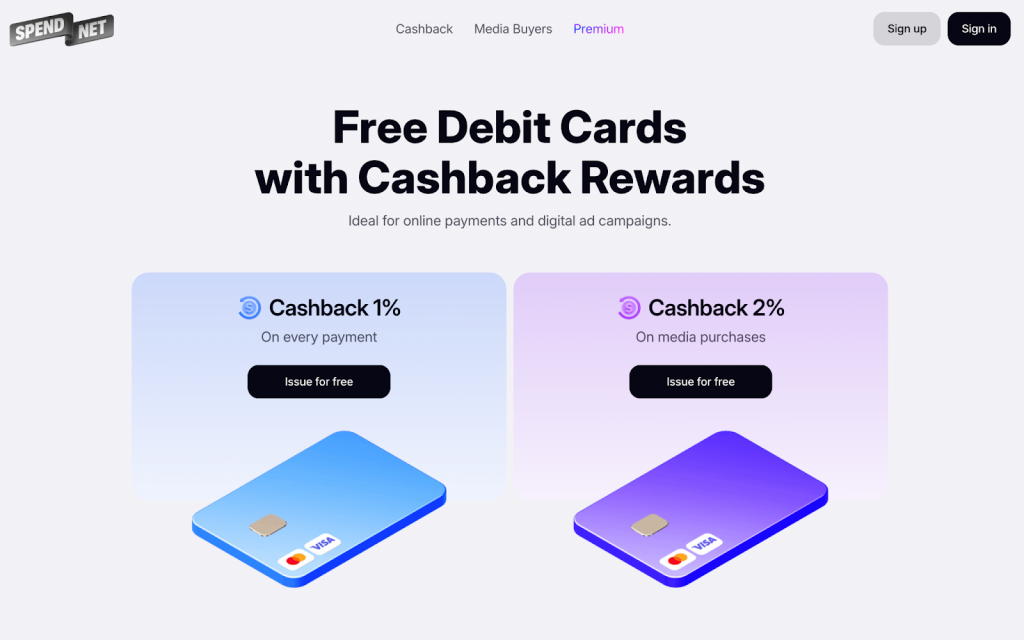
Spend.net is a strong option for early and mid-level budgets. Cards are free. The platform offers cards made specifically for media buying and universal cards for all types of online payments.
The system is built for media buying teams who rely on predictable expenses and low starting fees.
Free cards for advertising issuance and two percent cashback on ad spend help teams save money without losing payment stability.
Large BIN pools increase the chance of passing initial billing, which matters when launching new campaigns on Facebook or Google Ads. Zero transaction fees reduce operational costs, and flexible top-up options prevent delays.
These traits make Spend.net suitable for small teams and for those who want to scale without heavy infrastructure.
Facts:
- Two percent cashback on ad spend and one percent on all online payments.
- Cashback is added automatically with no need to confirm spend levels.
- The average top-up fee is two percent. Top-ups above fifty dollars have no fee.
- No fees on transactions, exchange, withdrawals, or refunds.
- Twenty BINs with six unique ones, which lowers the rate of declines.
- No limits on card issuance. Cards can be created in any quantity through the dashboard.
- 3D Secure supported.
- Top-ups in USDT and BTC.
- Team features include role management and CSV or XLS reporting for budget analytics, plus options for scaling card pools.
2. PSTNET:
PSTNET is one of the most flexible options for teams managing multiple accounts across different ad platforms.
The service provides separate BINs for each platform, which helps maintain payment patterns and lowers declines.
This matters when a team launches dozens of test campaigns and relies on stable initial billing. Zero transaction fees and multiple top-up methods allow for a predictable financial setup.
Built-in analytics, auto top-ups, and a mobile app make PSTNET not just a card issuer, but a tool to manage an entire ad infrastructure.
Facts:
- Issue virtual cards for media buying with separate BINs for Facebook, Instagram, Google, TikTok, Twitter, LinkedIn, Reddit, Quora, Taboola, Outbrain, Snapchat. Universal cards are available for any ad spend.
- Supports Visa and Mastercard via US and European banks.
- Over 25 unique BINs to minimize payment risk.
- Zero fee on first USDT deposit.
- PST Private program allows up to 100 credit cards per month for ad spend, with 3% cashback on ad expenses.
- No fees on transactions, withdrawals, or frozen card operations.
- Supports 3D Secure and two-factor authentication.
- Top-ups via 18 cryptocurrencies, SWIFT, SEPA, Visa/Mastercard.
- Subaccounts, auto top-up, and limit settings are available.
- Mobile app with detailed analytics and transaction history.
- BIN checker and cardholder tools for managing large card pools.
3. Mybrocard:
Mybrocard targets experienced teams that value both stability and manageability. Multi-currency support and agency account access make it ideal for complex campaigns across multiple niches.
Strict user verification creates a “cleaner” environment, lowering the risk of mass bans on payment patterns.
High minimum deposits suit teams already handling large budgets who need advanced capabilities. US, European, and Asian BINs provide flexibility for teams testing new traffic sources.
Facts:
- Offers debit and credit virtual cards, digital only.
- Supports ad spend, hosting, anti-detect tools, AI platforms, and other online expenses. The main currency is USD, but multi-currency support exists.
- 3D Secure and two-factor authentication implemented.
- Web-based interface; no mobile app yet.
- Agency dashboards for Google, TikTok, Reddit, and X (Twitter). API available.
- Accepts only thoroughly verified users. Registration often includes a live chat interview.
- Minimum starting balance $500. First 50 cards free.
- A subsequent card issuance fee of $2 is charged at the first transaction.
- Each card requires a minimum of $20 for activation.
- Crypto top-ups (USDT TRC20/ERC20) incur 3% fee; through the Capitalist partner, 6%.
- Withdrawal fee $5 for operations under $100, free above.
- The standard card transaction fee is $0.30. Additional Visa/Mastercard fees for foreign transactions.
- Works well with Facebook, Google Ads, TikTok, X, and Reddit. Provides agency accounts for both white hat and grey niches.
- BINs from the US, UK, Estonia, Latvia, Hong Kong, Denmark, and more. Three card types: ad spend, ad + operational expenses, and universal.
4. Abcard (AnyBill):
Abcard is designed for teams working almost exclusively with ad MCCs and aiming to minimize payment noise.
Cards are issued to match ad platform patterns as closely as possible, improving survival during initial billing.
The fee model linked to monthly turnover makes it cost-effective for steady spending. Overall balance for all cards simplifies management of large budgets.
Top-up and withdrawal limits may look strict, but they give the control agencies value. This service is not for mass use; it is made for teams needing predictable and clean BINs for Facebook and TikTok Ads.
Facts:
- Cards are for ad spend only (Facebook Ads, TikTok Ads). Other platforms like Google Ads, X Ads, and YouTube require a support request.
- Starts with five BINs; the sixth unique BIN unlocks after 25,000 euros in turnover.
- Debit and credit cards, digital only. Visa and Mastercard. Main currency: Euro. USD available with an extra fee.
- Cards issued only with a positive balance; no issuance or maintenance fees.
- Top-ups via crypto (USDT/USDC, TRC20/ERC20). Minimum deposit: 150 euros for the first card, 500 for subsequent cards.
- Top-up fee depends on monthly turnover: up to 25,000 euros — 4.5%, 25,000–100,000 — 4%, above 100,000 euros — 3.5%. Can drop further above 250,000.
- Currency conversion fee 2% when paying outside the euro.
- Shared balance across all cards; no card issuance with zero balance.
- Withdrawals are available after frozen cards and a three-week wait via crypto. Fee $10.
5. Lamanche Payments:
Lamanche Payments targets professional agencies needing stability on high-volume cards.
The service ensures reliable payment patterns via pre-selected BINs for ad platforms, and zero transaction fees make it cost-efficient for daily spend.
Telegram OTP support and fast hold returns create predictable workflows. Integrations with analytics, tracking, and anti-detect browsers make Lamanche a full-stack tool for media buyers.
This is ideal for teams building scalable ad infrastructure and requiring maximum payment stability.
Facts:
- Virtual cards only, no plastic; some BINs mimic plastic cards. Works with Visa and Mastercard. Supports ad platforms: Facebook, TikTok, Google, Bing, Taboola.
- No transaction, decline, or card issuance fees. Issuance free.
- Top-ups via JackWallet (USDT TRC20/ERC20). Minimum $500. Top-up fee scales: 4.5% → 4% → 3.5% → 3% based on turnover.
- Holds returned on day 10. 3D Secure optional; OTP codes via Telegram chat.
- Dashboard with multiple functions and Notion guides for common tasks.
- Cards are highly resistant to initial billing declines.
- Supports integration with Keitaro, MoreLogin, MangoProxy, Richads, and other platforms.
Safe Ad Payment Architecture:
Proper card pool management is key in anti-fraud architecture. Start with low-limit prepaid or debit BINs. Scale with mid-level cards. For high-volume scenarios, use high-limit corporate solutions with sharding.
Before scaling, test BIN behavior: initial billing with small amounts, analyze transactions under different MCCs, track velocity over 24 hours, and assess card resilience under load.
Early risk detection includes watching soft declines, delayed charges, payment method updates, frequent 3DS challenges, or drops in spending capacity. All of these are early anti-fraud signals.
A Card Is Part Of Your Anti-Fraud System:
In 2025, a virtual card stopped being just a payment tool. It became a component of the engineering architecture behind ad systems.
The right limit, proper BIN, verified KYC level, and balanced card pool distribution define not only payment success but also ad account survival.
The optimal strategy is a card matrix functioning as a risk-managed system. The better a card masks your behavior as natural, the longer your ad account lives.




Related Articles



Comments Are Closed For This Article