







Corporate Bonds: Meaning, Features, How They Work, Benefits, Risks, And Returns
9 Mins Read
Published on: 22 August 2024
Last Updated on: 20 August 2026

- What Are Corporate Bonds?
- How Do Corporate Bonds Work?
- 1. A Company Decides To Raise Capital:
- 2. The Company Issues Bonds:
- 3. Investors Receive Interest:
- 4. The Bond Reaches Maturity:
- What Are The Main Features Of Corporate Bonds?
- How Do Corporate Bonds Make Returns?
- Benefits Of Corporate Bonds:
- Drawbacks Of Corporate Bonds:
- Corporate Bonds vs. Stocks:
- Corporate Bonds vs. Government Bonds
- What Should You Check Before Buying A Corporate Bond?
- 1. Check The Credit Rating:
- 2. Understand The Issuer:
- 3. Check The Maturity:
- 4. Look At The Yield:
- 5. Check Liquidity:
- 6. Read The Terms:
- Are Corporate Bonds A Safe Investment?
- What Happens If A Company Cannot Repay A Corporate Bond?
- Corporate Bonds In India:
- Frequently Asked Questions:
- 1. What is a corporate bond in simple words?
- 2. How do corporate bonds work?
- 3. Are corporate bonds risky?
- 4. Do corporate bonds provide fixed returns?
- 5. Can you lose money in corporate bonds?
- 6. Are corporate bonds better than stocks?
- 7. Are corporate bonds better than fixed deposits?
- 8. What is a bond's coupon rate?
- 9. What is bond maturity?
When a company needs money to expand its operations, finance a new project, or refinance existing debt, it has several ways to raise capital.
One option is to issue shares and bring in new shareholders. Another is to borrow money by issuing corporate bonds.
When you buy a corporate bond, you are essentially lending money to the company. In return, the company agrees to pay you interest at specified intervals and to repay the principal when the bond matures.
For investors, corporate bonds can provide regular income and portfolio diversification.
However, they are not risk-free investments. The return you receive depends on factors such as the issuer’s creditworthiness, interest rates, the bond’s maturity, and market conditions.
This guide explains what corporate bonds are, how they work, how investors make money from them, and the key benefits and risks to consider before investing.
What Are Corporate Bonds?
A corporate bond is a debt security issued by a company to raise money from investors.
Instead of borrowing from a bank, a company can raise funds directly from investors by issuing bonds. Investors become creditors of the company, while the company becomes responsible for paying interest and returning the principal according to the terms of the bond.
For example, suppose CyberStark Industries wants to raise ₹10 crore to finance an expansion.
Instead of issuing additional shares, the company could issue ₹10 crore worth of corporate bonds. Investors who purchase those bonds lend money to CyberStark.
If the bonds carry an 8% annual coupon rate, investors would receive interest according to the payment schedule stated in the bond’s terms. At maturity, the company would generally repay the principal, subject to the issuer meeting its obligations.
Corporate bonds therefore create a relationship between:
Company → borrows money → pays interest → repays principal
Investor → lends money → receives interest → receives principal at maturity
The Indian corporate bond market is substantial. SEBI’s data shows that total outstanding corporate debt stood at about ₹47.29 lakh crore at the end of March 2024 across fixed-rate, floating-rate, structured-note, and other instruments.
How Do Corporate Bonds Work?
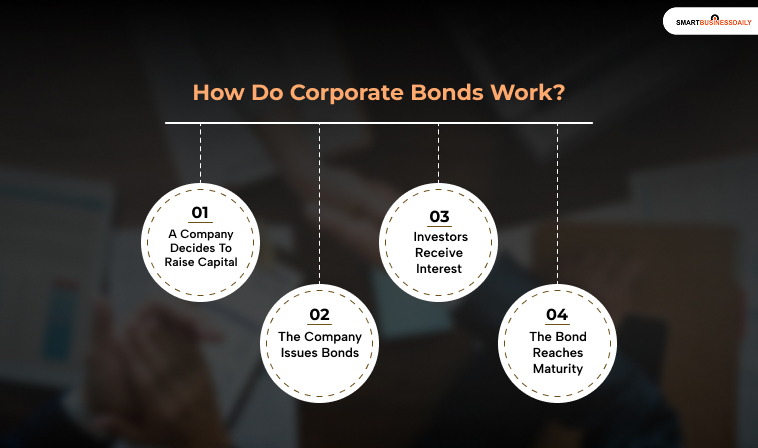
The process is relatively straightforward.
1. A Company Decides To Raise Capital:
A company may need funding for:
- Business expansion
- New infrastructure
- Working capital
- Acquisitions
- Refinancing existing debt
- Capital expenditure
- Other business requirements
Instead of raising all the money through equity, the company may issue debt securities.
2. The Company Issues Bonds:
The company sets the terms of the bond, including:
- Face value
- Coupon or interest rate
- Maturity date
- Payment frequency
- Credit rating
- Security or collateral, where applicable
- Other terms and conditions
Then investors can purchase the bonds in accordance with the applicable issuance and market structure.
3. Investors Receive Interest:
The company makes interest payments according to the bond’s terms.
For example, a ₹1,00,000 bond with an 8% annual coupon would generally provide ₹8,000 in annual coupon interest, assuming the stated coupon is applied to the face value.
In addition, the payment may be made annually, semi-annually, quarterly, or according to another schedule.
4. The Bond Reaches Maturity:
At maturity, the issuer is generally required to repay the principal amount to investors, subject to its ability to meet its obligations.
This is an important distinction:
Corporate bonds can offer contractual interest and principal repayment terms, but those payments are not guaranteed in the same way as a government obligation.
As a result, if the issuer faces financial trouble or defaults, investors can lose some or all of their expected returns.
What Are The Main Features Of Corporate Bonds?
Corporate bonds can be called debt securities that companies issue to raise capital. Here are some of the most notable features.
- Fixed Interest Payments – Corporate bonds provide regular interest payments semi-annually, annually, and annually, depending on the issuer and type of bond.
- Credit Ratings – These are ratings that rating agencies use to show issuers’ reliability in repaying their debt. Investors can use them to understand the risk of investing in certain products. Corporate bonds have specific maturity dates for when the principal is repaid.
- Marketability – These bonds are available on the secondary market and offer liquidity to investors. Bonds with higher ratings usually have lower yields. Bonds with lower ratings, however, may offer higher returns to compensate for the higher risk.
How Do Corporate Bonds Make Returns?

Investors can earn returns on corporate bonds in a myriad of different ways. Here are some of the most popular and reliable means of earning returns.
- Coupon Payments: These are regular interest payments by the issuer on a monthly, quarterly, or semi-annual basis.
- Capital Gains – An investor will profit if he sells a bond before its maturity date at a price higher than the original purchase price.
- Reinvestment – Interest can be reinvested to generate additional returns.
Benefits Of Corporate Bonds:
Corporate bonds are simply amazing. However, just saying that they are amazing is never enough. Therefore, in this section, we would like to list some of the most important and noticeable benefits of corporate bonds so that you can better approach the subject.
- Income is Relatively Stable – The regular coupon payments of corporate bonds ensure a steady income stream.
- Diversification – By adding corporate bonds to your investment portfolio, you can diversify and reduce the overall risk of your portfolio.
- ROI: Bonds issued by corporations can provide higher returns than savings accounts and government bonds.
- Credit Quality – Bonds with high ratings are low-risk investments.
- Liquidity – Most corporate bonds are traded on the major exchanges. This provides investors with high liquidity.
Drawbacks Of Corporate Bonds:

We have already studied the benefits and features of corporate bonds extensively. However, you cannot base your decision on the benefits. You need to study the drawbacks as well. Otherwise, you might make the wrong choice in the long run. Therefore, here are some of the most prominent drawbacks of corporate bonds:
- Fixed Payment: Unlike other bonds, corporate bonds come with a fixed interest rate. This is a double-edged sword. This means that the interest rate will never go below the initial rate. However, it also means that the interest rate will not grow.
- Riskier: Corporate companies are limited to major scaling. As a result, there is always the risk of stock tanking. Therefore, corporate bondholders always have latent anxiety about bonds tanking in the market.
- Low Capital Appreciation: Unlike stocks, bonds produce weaker maturity results. This means your bond’s worth will remain the same even if a company grows. This can frustrate people who want to use their bonds to grow financially.
Corporate Bonds vs. Stocks:
Corporate bonds and stocks both allow investors to participate in a company’s financial story, but they work very differently.
| Feature | Corporate Bonds | Stocks |
|---|---|---|
| Nature | Debt | Equity |
| Investor’s position | Creditor | Shareholder |
| Income | Interest/coupon | Dividends, if declared |
| Maturity | Usually has a maturity date | No fixed maturity |
| Voting rights | Generally none | Usually available |
| Return potential | Generally more limited | Potentially higher |
| Risk | Credit and market risk | Market and business risk |
| Repayment priority | Generally ahead of equity in liquidation | Behind creditors |
The choice between bonds and stocks depends on the investor’s objectives, risk tolerance, time horizon, and portfolio.
Corporate Bonds vs. Government Bonds
The key difference is the issuer.
Government bonds are issued by governments, while corporate bonds are issued by companies.
Moreover, corporate bonds generally carry greater credit risk because the issuer is a company rather than a sovereign government. Investors may therefore demand a higher yield for taking on that additional risk.
| Feature | Corporate Bonds | Government Bonds |
| Issuer | Companies | Government entities |
| Credit risk | Depends on issuer | Generally lower for sovereign obligations |
| Potential yield | May be higher | Often lower than comparable corporate debt |
| Default risk | Depends on issuer | Depends on the type of government security |
| Return | Interest + possible price gain/loss | Interest + possible price gain/loss |
The comparison should always be made between specific securities rather than assuming that every corporate or government bond carries the same risk.
What Should You Check Before Buying A Corporate Bond?
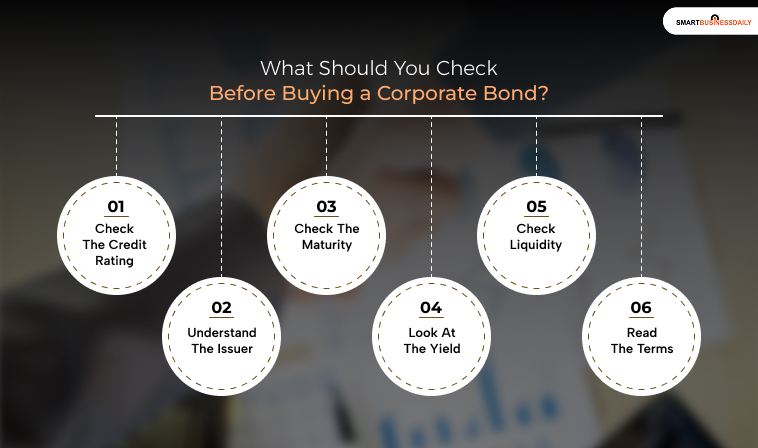
Before investing, do not focus only on the coupon rate. So, a bond offering 10% interest is not automatically better than one offering 8%. The higher coupon may reflect higher risk.
As a result, you need to consider these factors instead.
1. Check The Credit Rating:
Review the bond’s current credit rating and understand what the rating indicates – do not rely on the rating alone.
2. Understand The Issuer:
Look at the company’s financial position, debt levels, profitability, cash flows, and ability to service its existing obligations.
3. Check The Maturity:
Ask yourself how long you are comfortable keeping your money invested. Also, a longer maturity can expose you to greater interest-rate and market risks.
4. Look At The Yield:
The coupon rate is not necessarily the same as the actual yield you receive. Moreover, your purchase price, coupon payments, maturity value, and holding period all matter when evaluating a bond’s return.
5. Check Liquidity:
Find out whether the bond trades actively – this is because a bond that is difficult to sell may not suit someone who needs easy access to their money.
6. Read The Terms:
Review the information memorandum and other relevant issue documents.
Pay attention to:
- Interest payment dates
- Maturity
- Security
- Redemption terms
- Call or put options
- Covenants
- Credit rating
- Default provisions
Are Corporate Bonds A Safe Investment?
There is no single answer. Corporate bonds can be less volatile than equities in some situations, but they still carry meaningful risks.
Moreover, the most important question is not simply: What return does this bond offer? Instead, it is, ‘Why is this issuer offering this return, and what risks am I taking to earn it?’
A bond with a very high yield may be compensating investors for higher credit, liquidity, or other risks. Investors should assess the specific bond rather than treating all corporate bonds as safe or unsafe.
What Happens If A Company Cannot Repay A Corporate Bond?
If a company cannot meet its interest or principal obligations, it may default.
What happens next depends on the terms of the bond, the security attached to it, the issuer’s financial situation, and applicable insolvency and securities laws.
Moreover, secured and unsecured bonds can have different levels of protection.
In a default or insolvency situation, bondholders may have a claim against the issuer’s assets according to the applicable legal and contractual framework.
However, recovery is not guaranteed to equal the amount originally invested.
Corporate Bonds In India:
India has an established corporate bond market regulated within the country’s securities framework.
SEBI publishes data covering corporate bond issuance, outstanding debt, trading, private placements, and other market activity. Its data shows that corporate debt includes several categories of instruments and issuers.
Private placements have also been an important route for corporate bond issuance in India. SEBI’s published data records substantial private-placement activity across 2024 and 2025.
As a result, investors should therefore distinguish between the broad corporate bond market and the characteristics of any individual bond they are considering.
Frequently Asked Questions:
Check out the most frequently asked questions about corporate bonds.
1. What is a corporate bond in simple words?
A corporate bond is a loan from an investor to a company. The company agrees to pay interest according to the bond’s terms and repay the principal at maturity, subject to its ability to meet those obligations.
2. How do corporate bonds work?
A company issues bonds to raise money. Investors purchase the bonds and receive interest payments. At maturity, the company is expected to repay the principal.
3. Are corporate bonds risky?
Yes. Corporate bonds carry risks such as default risk, interest-rate risk, liquidity risk, inflation risk, and reinvestment risk.
4. Do corporate bonds provide fixed returns?
Many corporate bonds pay a fixed coupon, but the total return an investor receives can vary. If you sell a bond before maturity, its market price may be higher or lower than your purchase price.
5. Can you lose money in corporate bonds?
Yes. You can lose money if the issuer defaults, if you sell the bond below your purchase price, or if other risks affect the investment.
6. Are corporate bonds better than stocks?
Neither is universally better. Stocks offer ownership and potentially greater long-term growth, while corporate bonds provide debt-based income and generally have a defined maturity.
7. Are corporate bonds better than fixed deposits?
They serve different purposes and carry different risks. Corporate bonds may offer attractive yields, but they can expose investors to credit and market risks that differ from those of bank deposits.
8. What is a bond’s coupon rate?
The coupon rate is the stated annual interest rate applied to the bond’s face value. For example, an 8% coupon on a ₹1 lakh face-value bond generally represents ₹8,000 in annual coupon interest.
9. What is bond maturity?
Maturity is the date on which the bond reaches the end of its stated term and the issuer is generally required to repay the principal.
Read Also:




Related Articles



Comments Are Closed For This Article