








What Are Debt Certificates That Are Purchased by an Investor?
11 December 2025
9 Mins Read
- What Are Debt Certificates That Are Purchased By An Investor?
- What Are The Different Types of Debt Certificates Purchased by Investors?
- Bonds
- Notes
- Debentures
- Certificates Of Deposit (Cds)
- Commercial Paper
- Mortgage-Backed And Asset-Backed Securities
- Why Investors Purchase Debt Certificates?
- How Debt Certificates Work
- Accounting Perspective: Are Debt Certificates Assets
- Example 1. A company Issues Bonds to Raise Capital
- Example 2. An Individual Buys a Treasury Bill for Guaranteed Returns
- Example 3. Investors are Buying Corporate Commercial Paper
- Comparison Between Debt Certificates and Equity Investments
- Debt Instruments
- Equity Investments
- What Are The Pros and Cons of Investing in Debt Certificates?
- Pros
- Cons
- How to Start Investing in Debt Certificates?
- Frequently Asked Questions (FAQs)
- What Are Debt Certificates That An Invester Buy Explained
Many new investors often come across the term debt certificates and wonder what they really are.
The question sounds simple. What are debt certificates that are purchased by an investor?
But the answer carries real value for anyone who wants to understand how safe and steady investments work in the financial world.
Debt certificates play a major role in global markets. They support governments. They support banks.
Additionally, they support companies that need money to grow. When an investor buys a debt certificate, they are lending money to the issuer.
In return, the investor receives interest income and gets the principal amount back at maturity.
Understanding debt certificates is helpful for beginners who want low-risk options.
It is also useful for experienced investors who want to diversify and create a stable income.
Many trusted platforms like Investopedia describe debt instruments as formal contracts between lenders and borrowers with clear repayment terms.
These certificates are important because they offer predictability and safety for many people building long-term wealth.
In the following sections, this guide will explain how debt certificates work, why investors buy them, and how they are treated in accounting. All explanations are based on the outline and source references provided in .
What Are Debt Certificates That Are Purchased By An Investor?

Debt certificates are official documents that show a borrower owes money to an investor. They act as proof of a loan.
When an investor buys a debt certificate, they give money to an entity such as a company, a bank, or a government.
The issuer agrees to repay the principal at a set date and also pay interest on time.
According to Investopedia, debt instruments include any written promise to repay a borrowed amount with interest. This includes bonds, notes, and other fixed-income products.
These certificates share a few key features:
The first feature is fixed income. Investors know how much interest they will get.
The second feature is contractual repayment. The issuer commits to paying back the principal on the maturity date.
The third feature is the presence of interest payments. These payments can be monthly, quarterly, or yearly depending on the type of instrument.
The fourth feature is the maturity date. This date marks the time when the issuer returns the full amount that was borrowed.
Debt certificates are often considered safer than many market linked instruments. They give clarity.
Additionally, they give structure. They help investors plan their financial future with confidence.
What Are The Different Types of Debt Certificates Purchased by Investors?
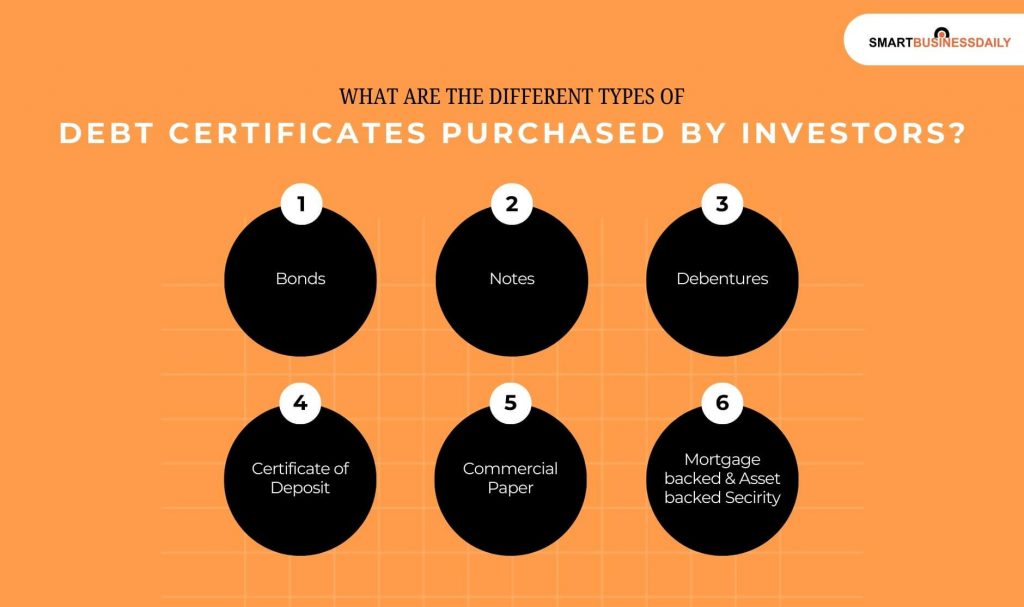
Debt certificates come in different forms. Each type serves a different purpose and fits a different investor need. lists the main categories clearly.
Bonds
Bonds are the most common form of debt certificates. Companies issue corporate bonds to raise funds for operations and expansion. Governments issue Treasury bills, Treasury notes, and municipal bonds to finance public projects.
Corporate bonds usually have higher interest rates than government bonds because companies carry more risk. Government bonds are known for stability and reliability. Many investors choose them for safety. Investors buy bonds because they offer steady interest and clear repayment terms.
Notes
Notes are debt instruments with shorter or medium term durations. They come from both corporations and governments. They function like bonds but often have shorter maturity periods. Some investors prefer notes because they tie up money for less time.
Debentures
Debentures are unsecured debt certificates. This means they are not backed by physical collateral. Instead, they rely on the creditworthiness and reputation of the issuer. Many large companies issue debentures because investors trust their ability to repay.
Certificates Of Deposit (Cds)
Certificates of Deposit are issued by banks. They come with fixed interest rates and fixed time periods. They are considered safe because they are backed by the bank and often insured by authorities depending on the region. CDs are ideal for investors who want guaranteed returns without market exposure.
Commercial Paper
Commercial paper is a short-term debt certificate issued by corporations. It is used for quick financing needs like payroll, inventory, or working capital. Investors choose commercial paper when they want short-term and low-risk returns.
Mortgage-Backed And Asset-Backed Securities
These securities pool different types of debts. Mortgage-backed securities combine several home loans.
Asset-backed securities combine debts like auto loans or credit card receivables.
Investors receive payments from the cash flow created by borrowers repaying those loans. These instruments give investors access to diversified debt pools.
Why Investors Purchase Debt Certificates?
Investors choose debt certificates for many reasons. These certificates offer benefits that suit conservative and balanced portfolios. lists these advantages in clear points.
One major reason is low risk. Debt certificates do not react sharply to market swings.
This gives investors a sense of stability. Another advantage is steady income. Interest payments arrive on predictable schedules which helps people plan their monthly or yearly finances.
Debt certificates also support diversification. When investors hold a mix of stocks and debt instruments, they reduce overall risk in their portfolio.
These certificates protect capital. They keep the original principal safe in most situations.
Some regions also offer tax benefits on certain types of government bonds. This makes them even more attractive for long term planning.
Many beginners start with debt certificates before they slowly explore other asset classes.
How Debt Certificates Work
Debt certificates follow a simple but strict process. The investor lends money to the issuer. The issuer uses the funds for operations, growth, or financial needs.
During the life of the certificate, the issuer pays interest. These payments may be fixed or variable, depending on the type of instrument. At maturity, the principal amount returns to the investor. This clear structure is what makes debt certificates reliable.
One risk is default risk. This happens when the issuer cannot repay. Another risk is interest rate risk.
When market rates rise, the fixed interest from older certificates becomes less attractive. Inflation risk reduces the real value of returns over time. Liquidity risk appears when an investor cannot sell the certificate easily before maturity.
Knowing these risks helps investors choose better options that match their comfort level.
Accounting Perspective: Are Debt Certificates Assets

From an accounting viewpoint, debt certificates are treated as assets. points to accounting explanations from Pearson and related forums to support this classification.
When an investor buys a debt certificate, it becomes an investment. It appears on the balance sheet as either a short term investment or a long term investment. Short term investments include certificates that mature within one year. Long term investments include those that mature after more than one year.
Companies also record interest income from these certificates. The interest received becomes part of the company’s revenue. This accounting method helps investors and firms understand the exact value and performance of their investments.
Real World Examples
Real examples make it easier to understand how debt certificates work in everyday financial situations. lists three clear examples.
Example 1. A company Issues Bonds to Raise Capital
Many companies issue bonds when they want to expand or improve their operations. They offer these bonds to investors who provide funds in return for interest. This helps the company get quick access to large amounts of money without giving away ownership. Investors benefit because they receive predictable interest payments and get their principal back at maturity.
Example 2. An Individual Buys a Treasury Bill for Guaranteed Returns
Treasury bills are short-term government-backed debt instruments. They are among the safest products available because governments rarely default.
When an individual buys a Treasury bill, they agree to lend money to the government for a short period.
In return, they receive a fixed return at maturity. Many beginners choose Treasury bills because they offer peace of mind.
Example 3. Investors are Buying Corporate Commercial Paper
Commercial paper helps companies manage short-term financial needs. Investors who want short-term, stable returns buy commercial paper.
These papers mature quickly and suit people who want to keep money safe for a short time without locking it away for years.
These examples show that debt certificates support both individuals and large institutions in many practical situations.
Comparison Between Debt Certificates and Equity Investments
Debt certificates and equity investments help investors grow their money. But they work in very different ways. Offers a clear comparison that highlights the major differences.
Debt Instruments
Debt instruments offer fixed income. They promise regular interest payments. They usually carry lower risk because the terms of repayment are written clearly. Investors do not gain ownership in the company. They simply lend money and receive interest.
Equity Investments
Equity investments provide ownership. When a person buys shares, they become part owners of the company.
Equity carries a higher risk because share prices move with the market. Returns can vary based on the performance of the company. Investors may receive dividends if the company decides to distribute profits.
What Are The Pros and Cons of Investing in Debt Certificates?
Debt certificates offer many advantages. They also have limitations. Lists the pros and cons clearly.
Pros
Debt certificates are considered low risk. They offer steady returns, which appeal to people who want a predictable income.
These certificates are ideal for retirement planning or conservative portfolios because they focus on safety.
Many debt instruments, such as government bonds, are highly liquid. Investors can sell them quickly if they need funds.
Cons
Debt certificates usually offer lower returns compared to stocks. They are sensitive to interest rate changes.
When interest rates rise in the market, the value of older certificates often falls. Inflation can reduce the real value of the interest earned.
Some instruments, like debentures, depend on the issuer’s credit strength and may carry credit risk.
How to Start Investing in Debt Certificates?

The first step is to understand your risk profile. Some people prefer very safe options. Others are comfortable with moderate risk. Knowing your comfort level helps you choose the right type of certificate.
The next step is to evaluate the credit rating of the issuer. Strong ratings show that the issuer is financially stable. Weak ratings show higher risk. Investors should always check ratings before buying.
You then choose between government issuances, corporate issuances, or bank-based options. Each category offers different interest rates and risk levels.
After that, you select a platform or broker. This could be a bank, a financial advisor, or a trusted online investment service.
also provides tips for safe investing. Always check bond ratings. Consider the maturity period so you know how long your money will be tied up. Diversify your investments so all your money is not in a single source.
These steps help new investors enter the market with clarity and confidence.
Frequently Asked Questions (FAQs)
The simplest form is usually a government bond or Treasury bill. These instruments are easy to understand and carry low risk.
Yes. Bonds are one of the most common types of debt instruments. They represent a loan made by an investor to a government or corporation.
Many debt certificates are safe. Government bonds and high-rated corporate bonds are usually reliable. Safety depends on the issuer’s credit rating and the type of certificate.
Some do. Others pay quarterly or yearly. The schedule depends on the type of instrument and the terms set by the issuer.
Investors can sell many certificates in the secondary market. The ease of selling depends on the type of instrument and market demand.
What Are Debt Certificates That An Invester Buy Explained
Debt certificates are important tools in the financial world. They help investors lend money to reliable issuers and receive predictable income.
They also support companies, banks, and governments that need funding. Understanding what these certificates are and how they work gives investors more control over their money.
They offer structure, stability, and clear repayment terms. While they carry some risks, they remain valuable for people who want safe and steady returns.
Investors should always research before buying. They should check credit ratings, compare options, and speak to financial advisors if needed. A clear understanding of debt certificates can help anyone build a stable and diversified portfolio.




Related Articles



Comments Are Closed For This Article