








Why Traditional Systems Fail And How droven.io Enterprise Tech Innovation Is Saving Modern Workflows!
31 August 2026
7 Mins Read
- What Is Droven.Io Enterprise Tech Innovation?
- What Is Droven.IO?
- What You Will Find Here: A Real-World Research Layer
- 1. Hype-Free Tech Breakdowns
- 2. Plain-Language Explanations
- 3. A Reliable Mental Framework
- Why Does This Platform Matter?
- What Tools Do They Cover?
- How Can Automation Help You To Automate Your Workflow?
- Exploring Free Resources For Tech Education
A few years ago, any conversation about AI felt highly experimental. Now, it’s completely unavoidable.
Modern businesses are building fully connected digital ecosystems, instead of focusing on individual apps.
This massive shift is exactly why the phrase “Droven.io Future Technology USA” is generating so much excitement across American industries.
This specifically highlights cloud infrastructure, smart automation and cybersecurity. They are all tied together.
Meanwhile, when you are navigating this evolution requires a clear framework.
A reliable knowledge resource can help you understand these complex shifts without getting bogged down by technical jargon.
Consequently, keeping up with droven.io enterprise tech innovation helps teams make data-driven decisions that fundamentally reshape how they operate every single day.
What Is Droven.Io Enterprise Tech Innovation?

Every business wants to grow. However, juggling separate digital tools usually leads to chaos.
That is where a joined-up approach changes the game. Smart companies are looking at them as one connected system instead of treating AI, cloud computing and cybersecurity.
This is exactly where the droven.io enterprise tech innovation model makes a massive difference.
Moreover, it focuses on practical productivity rather than tech hype. It helps you understand how all these digital pieces fit together before you even spend a single rupee.
As a result, this connected view aligns with where the global market is heading. McKinsey’s recent data shows that 88% of organizations now use AI in at least one business function.
Security and automation are no longer optional extras. They are the core of modern teamwork.
What Is Droven.IO?
This is where honesty matters the most. Especially since finding clear facts online can sometimes feel like a puzzle.
I noticed that several top results describe Droven.io as a powerful digital innovation platform designed to connect complex AI and smart data systems.
While looking into this tool, I noticed that several top results describe Droven.io as a powerful digital innovation platform designed to connect complex AI and smart data systems.
However, after digging deeper, there appears to be no public evidence to support that.
Meanwhile, there is no active login portal, official product demo, or setup documentation available anywhere.
Based on what’s visible, it reads less like a traditional software vendor and more like an educational hub that explains tech in plain language.
Because public details remain limited, separating real facts from assumptions is crucial. Consequently, here is a quick breakdown of what can genuinely be inferred right now:
| Is this a software company? | Limited public evidence |
| Is this any kind of SaaS automation tool? | Highly unclear |
| Can we count this as an educational tech hub? | This seems much more likely |
| Is this a direct AI platform? | Not from what is openly visible |
This guide flags what is verified versus what is just a guess, ensuring an honest look at the platform before anyone spends their valuable time.
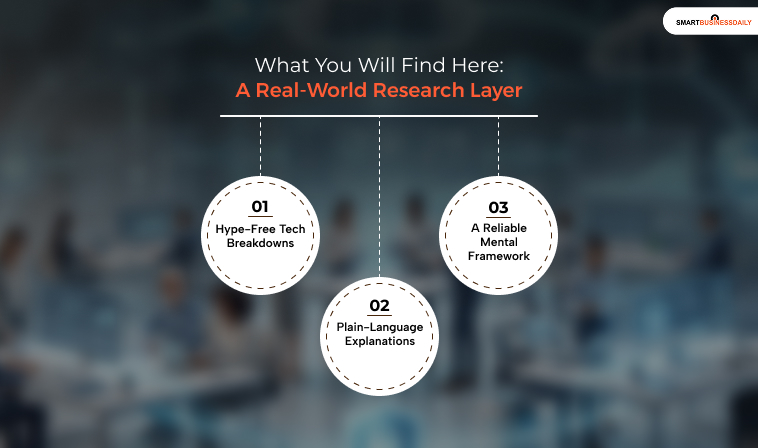
What You Will Find Here: A Real-World Research Layer
When you dive into the content on Droven.io, it quickly becomes clear that this space is built differently from standard tech blogs.
The focus is often on practical education and realistic frameworks, rather than pushing flashy software downloads or aggressive product sales.
If you explore the platform, here is exactly what you can expect to find:
1. Hype-Free Tech Breakdowns
The articles do not oversell artificial intelligence. Instead of ignoring the risks, the content openly acknowledges common enterprise failure points.
This includes messy data, unrealistic expectations, and unclear use cases.
2. Plain-Language Explanations
Complex digital concepts are broken down into simple, everyday vocabulary.
For instance, you will find clear explanations of how dynamic, AI-driven workflors different from static, rule-based automation.
You do not even need an engineering degree to understand them.
3. A Reliable Mental Framework
You will not find a magic, one-size-fits-all answer or a robotic decision-maker here.
Instead, the platform acts as a solid research layer designed to sharpen your critical thinking so you can make your own smart tech choices.
Ultimately, it is a space built to help you get smarter before spending a single rupee.
Moreover, it gives you the honest tools and context you need to evaluate modern technology on your own terms.
Why Does This Platform Matter?
A connected view of technology is no longer optional, and the reason is scale.
The money involved is now too large to ignore. Consequently, businesses that treat their tech tools as a single ecosystem are the ones pulling ahead.
The hard part is no longer finding software. Instead, the real challenge is understanding how AI, cloud networks, and cybersecurity actually connect across industries.
This is exactly where exploring Droven IO Future Technology USA becomes so valuable. It is not a product you buy, but a way to see how different tools fit together.
Meanwhile, the numbers behind this shift are massive. According to PwC research, AI is on track to inject a staggering $15.7 trillion into the global economy by 2030.
Your real competitive edge will come from integration and adaptability, not from buying more isolated apps, to capture that value.
What Tools Do They Cover?
If you are in a hurry, here is the quick answer: Droven.io covers broad categories of enterprise AI tools rather than acting as a software vendor itself.
From what is visible on the platform, the educational coverage spans a wide net to help businesses make sense of modern tech.
Specifically, you will find information on:
- Workflow Automation and RPA: Tools to cut down on repetitive manual tasks.
- Cloud and ML Infrastructure: The backend backbone that makes AI run at scale.
- Cybersecurity: Frameworks like Zero Trust to keep your business data safe.
Consequently, these categories align well with what real IT teams deal with every day.
The overall framing is highly practical, while I have not independently verified every single tool mentioned across their site.
It targets actual business operations like customer service and document processing instead of just hyping up a hypothetical future
How Can Automation Help You To Automate Your Workflow?
Traditional workflow automation follows fixed rules. If X happens, do Y. It is reliable. However, it is very rigid.
Consequently, the second a situation falls outside your rules, the system breaks completely.
AI-driven automation changes that equation completely. It adds a layer of smart interpretation on top of the rules.
For example, it allows document processing to read unstructured text instead of just fixed fields.
Meanwhile, customer service workflows can understand true intent rather than just matching keywords.
It also helps lead qualification score prospects based on patterns, and data routing can finally adapt based on context.
If you have ever fought with an old-school tool that broke when a customer typed something unexpected, you know this pain.
AI does not eliminate rules entirely. Instead, it makes them much smarter and more forgiving.
Traditional Automation vs. AI-Driven Automation
I get asked about the difference constantly. Let us look at this simple table to see how they compare side-by-side:
| Feature | Traditional Automation | AI-Driven Automation |
| Logic type | Fixed if/then rules | Adaptive, context-aware decisions |
| Handles unstructured data | Poorly or not at all | Yes-text, documents, natural language |
| Maintenance | Breaks when inputs change | More resilient to variation |
| Setup complexity | Usually simpler, faster to deploy | Higher upfront complexity, more data needed |
| Best for | Repetitive, predictable tasks | Tasks involving judgment or variability |
| Example | Auto-forwarding emails by subject line | Auto-categorizing support tickets by intent |
| Cost over time | Lower initial cost, higher manual patching | Higher initial investment, lower long-term friction |
Traditional automation still wins for dead-simple, predictable tasks. Do not let anyone convince you every workflow needs AI slapped on top of it. However, AI automation earns its keep when the task involves real ambiguity, language nuances, or data that does not fit neatly into fields.
Exploring Free Resources For Tech Education
If you want to study these automation systems, Droven.io operates as a completely free, publicly accessible content platform.
No paywall blocks articles, and you will not find any hidden subscription gates.
As a result, it’s an excellent starting point for your research. You do not need to commit any money before you understand the category.
However, I still recommend treating it as one input among many.
Always cross-reference what you read with official vendor documentation, industry reports, and insights from people who have actually implemented these tools.




Related Articles