








Indian Head Penny Value Chart (1859–1909): The Ultimate Collector’s Guide
01 April 2026
8 Mins Read
- What Is The History Behind The Indian Head Penny Value Chart?
- Minting Period and Mints
- How To Read The Indian Head Penny Value Chart?
- What Are The Factors That Affect The Value In The Indian Head Penny Value Chart?
- Indian Head Penny Value Chart By Year (1859–1909)
- The Indian Head Penny Value Chart
- What Are Some Rare Varieties To Watch For?
- What Are Some Key Dates and Varieties Worth Knowing?
- 1. 1877:
- 2. 1909-S:
- 3. 1869:
- 4. 1872:
- 5. 1888/7 Overdate:
- Current Market Trends And Price Drivers
- How To Grade And Sell Your Indian Head Penny?
- The Importance Of The Indian Head Penny Value Chart Explained
Have you ever found an old coin in a dusty jar or a forgotten drawer? Well, whenever I did, it often sparked a sense of mystery.
I have an uncle who is an avid coin collector. He always sparks in joy whenever he comes across an old coin.
And if that coin features a figure in a Native American headdress? I won’t be able to express the joy he feels in words.
If you are holding a piece of American history, you should know that it is known as the Indian Head Penny.
Basically, these are bronze and copper-nickel treasures.
So, guess what? They were the backbone of American commerce for half a century.
Also, today, they are among the most beloved items for numismatists and casual collectors alike.
I know many people search for an Indian Head Penny value chart. This is because pricing these coins is not as simple as looking at a single number.
Moreover, the value depends on a delicate balance of the year it was minted.
Additionally, another important factor is the specific mint mark. Also, the collectors pay a huge importance to its physical condition.
In this guide, I will break down everything you need to know to identify these coins.
In addition, you will also learn how to grade.
Finally, you will really know how to value your collection using the latest market data from trusted sources like PCGS, NGC, and J.M. Bullion.
What Is The History Behind The Indian Head Penny Value Chart?
The Indian Head Cent replaced the short-lived Flying Eagle cent in 1859.
It remained the standard small cent in the United States until it was replaced by the Lincoln Penny in 1909.
Furthermore, over these fifty years, the coin saw changes in its metal composition and survived the economic turmoil of the Civil War.
The design was the work of James Barton Longacre, who served as the Chief Engraver at the Philadelphia Mint.
While the coin is called the Indian Head, the figure is actually Lady Liberty.
Longacre chose to depict her wearing a feathered headdress to create a distinctly American symbol.
The series began with a copper-nickel composition, which gave the coins a pale, whitish appearance.
Because of this, they were often called White Cents. In 1864, the Mint switched to a thinner bronze alloy consisting of 95% copper.
This change was permanent and helped the Mint keep up with the high demand for small change during the war years.
Minting Period and Mints
Most Indian Head Pennies were struck at the main Philadelphia Mint. These coins do not have a mint mark.
However, toward the very end of the series in 1908 and 1909, the San Francisco Mint began producing them as well.
You can find the S mint mark on the reverse side of the coin, located under the wreath.
Identifying these marks is crucial because San Francisco minted far fewer coins than Philadelphia.
A 1909 Philadelphia penny might be worth a few dollars, while a 1909-S can be worth hundreds or even thousands, depending on its state.
How To Read The Indian Head Penny Value Chart?
Looking at a price table for the first time can feel overwhelming.
To use a value chart effectively, you must first understand that a coin’s price is a range rather than a fixed point.
The market fluctuates based on collector demand and the current price of copper.
Grading is the process of determining a coin’s level of wear. Professional services use a 1-to-70 scale, but most collectors use these general categories:
- Good (G): The coin is heavily worn. The design is visible but lacks detail.
- Fine (F): Moderate wear is present. Some details in the feathers and the word LIBERTY are visible.
- Very Fine (VF): The hair details and headdress tips are clear.
- Extremely Fine (XF): Only slight wear on the highest points. The letters in LIBERTY are sharp and bold.
- About Uncirculated (AU): Nearly perfect with just a trace of wear from brief handling.
- Mint State (MS): The coin looks exactly as it did the day it was minted, often with original mint luster or shine.
One pro tip I always share with new collectors is to look closely at the headband.
Now, let’s say you can clearly see all the letters in the word LIBERTY. Then, the coin is likely in XF condition or better. Additionally, this significantly increases its value.
What Are The Factors That Affect The Value In The Indian Head Penny Value Chart?
Now, this goes beyond the basic grade. Moreover, there are several other elements dictate what a buyer will pay.
- Firstly, it puts a certain importance on rarity and mintage. Additionally, you must know that some years saw millions of coins produced.
However, there are others who saw very few. Also, lower mintage numbers almost always lead to higher prices.
- Secondly, you must also pay attention to errors. Equally, you must also check on the varieties. Also, I want to address the possible mistakes. Specifically, these can be made during the minting process.
Moreover, it like a doubled die. In fact, it can also be a re-punched date. However, they can make a common year extremely valuable.
- Thirdly, demand trends are also very important. So, let’s say a specific segment of the hobby becomes popular. Then those prices for those specific coins can spike. Also, it can happen even if they aren’t technically rare.
- Finally, you should check the metal composition as well. So, as we know, the copper value is small. But it provides a floor for the price of common, heavily worn coins.
Indian Head Penny Value Chart By Year (1859–1909)
This section is the core of our guide. So, below is a summarized view of the values you can expect for common and semi-key dates.
Also, please note that these are estimated market averages for coins without major damage, like holes or heavy cleaning.
The Indian Head Penny Value Chart
| DATE | GOOD | FINE | EXTREMELY FINE | UNCIRCULATED |
|---|---|---|---|---|
| 1859 Indian Head Penny | $15 | $25 | $110 | $200 |
| 1860 Indian Head Penny | $10 | $20 | $65 | $100 |
| 1861 Indian Head Penny | $25 | $45 | $110 | $175 |
| 1862 Indian Head Penny | $10 | $20 | $50 | $75 |
| 1863 Indian Head Penny | $10 | $20 | $50 | $75 |
| 1864 Indian Head Penny | $20 | $40 | $100 | $150 |
| 1865 Indian Head Penny | $15 | $25 | $45 | $65 |
| 1866 Indian Head Penny | $50 | $80 | $190 | $250 |
| 1867 Indian Head Penny | $50 | $90 | $230 | $275 |
| 1868 Indian Head Penny | $40 | $70 | $170 | $220 |
| 1869 Indian Head Penny | $85 | $235 | $445 | $550 |
| 1870 Indian Head Penny | $80 | $220 | $400 | $500 |
| 1871 Indian Head Penny | $130 | $325 | $575 | $650 |
| 1872 Indian Head Penny | $100 | $370 | $575 | $700 |
| 1873 Indian Head Penny | $25 | $65 | $185 | $1235 |
| 1874 Indian Head Penny | $20 | $45 | $100 | $150 |
| 1875 Indian Head Penny | $20 | $60 | $120 | $160 |
| 1876 Indian Head Penny | $35 | $70 | $225 | $240 |
| 1877 Indian Head Penny | $900 | $1,550 | $2,500 | $3,000 |
| 1878 Indian Head Penny | $35 | $60 | $200 | $275 |
| 1879 Indian Head Penny | $8 | $20 | $70 | $80 |
| 1880 Indian Head Penny | $5 | $9 | $30 | $60 |
| 1881 Indian Head Penny | $5 | $8 | $25 | $35 |
| 1882 Indian Head Penny | $5 | $8 | $25 | $35 |
| 1883 Indian Head Penny | $5 | $8 | $25 | $35 |
| 1884 Indian Head Penny | $5 | $10 | $27 | $40 |
| 1885 Indian Head Penny | $8 | 15 | $65 | $80 |
| 1886 Indian Head Penny | $6 | $20 | $140 | $175 |
| 1887 Indian Head Penny | $3 | $5 | $18 | $28 |
| 1888 Indian Head Penny | $3 | $5 | $22 | $27 |
| 1889 Indian Head Penny | $3 | $5 | $18 | $30 |
| 1890 Indian Head Penny | $3 | $5 | $16 | $30 |
| 1891 Indian Head Penny | $3 | $5 | $15 | $30 |
| 1892 Indian Head Penny | $3 | $5 | $20 | $30 |
| 1893 Indian Head Penny | $3 | $5 | $20 | $30 |
| 1894 Indian Head Penny | $5 | $15 | $50 | $70 |
| 1895 Indian Head Penny | $3 | $5 | $15 | $25 |
| 1896 Indian Head Penny | $3 | $5 | $15 | $25 |
| 1897 Indian Head Penny | $3 | $5 | $15 | $25 |
| 1898 Indian Head Penny | $3 | $5 | $15 | $25 |
| 1899 Indian Head Penny | $3 | $5 | $15 | $25 |
| 1900 Indian Head Penny | $2 | $5 | $10 | $20 |
| 1901 Indian Head Penny | $2 | $5 | $10 | $20 |
| 1902 Indian Head Penny | $2 | $5 | $10 | $20 |
| 1903 Indian Head Penny | $2 | $5 | $10 | $20 |
| 1904 Indian Head Penny | $2 | $5 | $10 | $20 |
| 1905 Indian Head Penny | $2 | $5 | $10 | $20 |
| 1906 Indian Head Penny | $2 | $5 | $10 | $20 |
| 1907 Indian Head Penny | $2 | $5 | $10 | $20 |
| 1908 Indian Head Penny | $2 | $5 | $10 | $20 |
| 1908 Indian Head Penny (S) | $90 | $125 | $175 | $250 |
| 1909 Indian Head Penny | $12 | $17 | $25 | $30 |
| 1909 Indian Head Penny (S) | $450 | $600 | $750 | $850 |
What Are Some Rare Varieties To Watch For?
The 1864 L on Ribbon is a famous variety. Also, this is where the engraver’s initial was added to the design mid-year.
Additionally, you can find the small L on the ribbon behind Lady Liberty’s neck. Also, the 1877 cent remains the King of the series for many.
Specifically, I would like to mention that it has the lowest mintage of any regular-issue Indian Head Penny,. Therefore, this makes it the prize of any collection.
What Are Some Key Dates and Varieties Worth Knowing?
When I talk to fellow collectors, the conversation usually turns to The Big Five.
Also, these are the coins that every hunter dreams of finding in an old estate sale or a bulk lot.
1. 1877:
This is the undisputed key date. Moreover, with fewer than a million minted, even a heavily worn version can sell for hundreds of dollars.
2. 1909-S:
This is the final year of the series. Additionally, it is also the lowest mintage from the San Francisco Mint. Therefore, this coin is a must-have for completionists.
3. 1869:
It is known for having a lower survival rate than other years in the 1860s. Therefore, this makes it surprisingly difficult to find in high grades.
4. 1872:
Let me tell you, this is another low-mintage year from the tough 1870s. Additionally, this is also the time when the U.S. economy was struggling.
5. 1888/7 Overdate:
A rare error where the 8 was punched over a 7. Also, this is one of the most valuable varieties in the entire series.
Current Market Trends And Price Drivers
The value of an Indian Head Penny is not just about its age. Modern market trends also play a huge role.
Furthermore, in recent years, we have seen a surge in interest in toning.
Additionally, I would say that this is the natural oxidation. Also, it happens over decades.
Therefore, sometimes it turns a copper coin into beautiful shades of:
- Blue
- Purple
- And, Red
In addition, I have also met a lot of collectors who are often willing to pay a premium for Eye Appeal.
And guess what? It goes beyond the technical grade.
In fact, the price will also change based on whether the buyer is a collector or an investor.
Moreover, investors usually stick to coins certified by PCGS or NGC, as these are easier to resell at predictable prices.
If you are holding an uncertified coin, your price might be slightly lower because the buyer is taking a risk on the grade.
How To Grade And Sell Your Indian Head Penny?
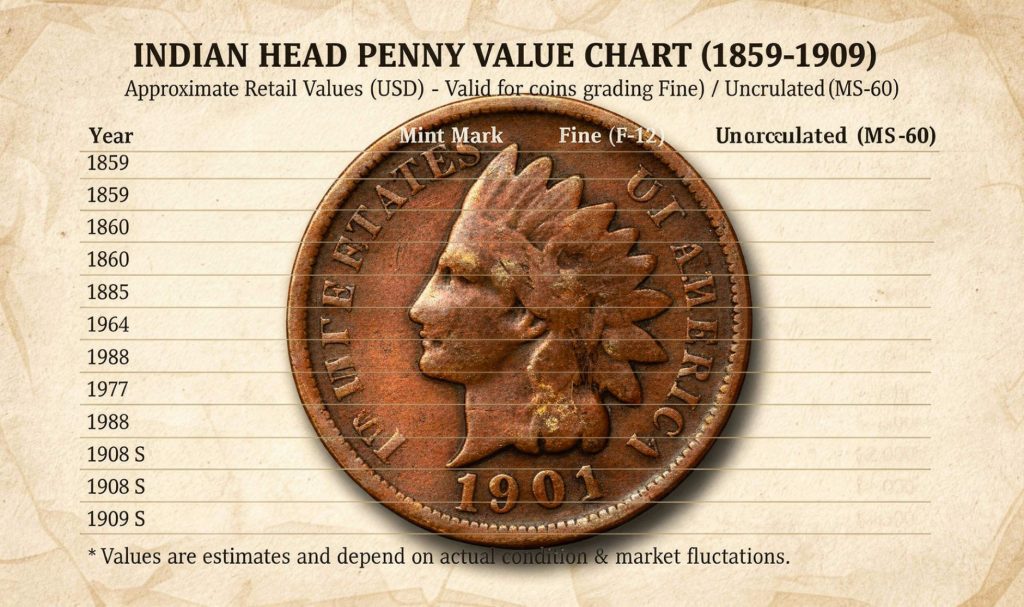
If you think you have a winner, your first step should be a careful visual inspection.
Additionally, I would suggest that you use a magnifying glass to check for the LIBERTY letters on the headband.
If the coin looks exceptionally clean or shiny, be careful.
I have seen many people who try to clean old coins to make them look better.
But this actually destroys their value in the eyes of professional collectors.
The Importance Of The Indian Head Penny Value Chart Explained
The Indian Head Penny is more than just a piece of copper. Moreover, it is a tiny canvas that tells the story of American expansion.
Also, it talks about the artistic evolution. In fact, when I was first studying about it, I got to know that these are more valuable to the collector.
So, let’s say you are a seasoned investor. Also, you might be someone who has just found a single coin. Then, I suggest that you use a value chart.
Honestly, this is the best way to appreciate its value.
Also, I recommend bookmarking this page. Therefore, you can refer back to the grading tips and price guides as your collection grows.




Related Articles



Comments Are Closed For This Article