






Why Your Small Business Needs A Last Mile Sorting And Distribution Center?
23 May 2026
7 Mins Read
- What Is A Last Mile Sorting And Distribution Center?
- Why The Last Mile Is So Expensive?
- How Does This Connect To Same-Day And Next-Day Delivery?
- What Happens Inside: The Sorting Steps
- The Small Business Reality
- Inventory Problems That Hurt Your Last Mile Performance
- A Small Business That Got It Right
- How To Decide Whether A Last Mile Partner Is Right For You?
My neighbor runs a small candle business out of her garage in Ohio. She started shipping orders herself, driving to the post office every afternoon with a laundry basket full of boxes.
For a while, it worked. Then she hit a wall. To clarify, her orders were taking 5 to 7 days to arrive. At the same time, the customers were leaving 1-star reviews. However, she had no idea where half her packages were after they left her hands.
What she needed was a better understanding of how the last mile of shipping actually works. Specifically, what happens inside a last mile sorting and distribution center. And how small businesses can use that knowledge to compete with the big players.
What Is A Last Mile Sorting And Distribution Center?
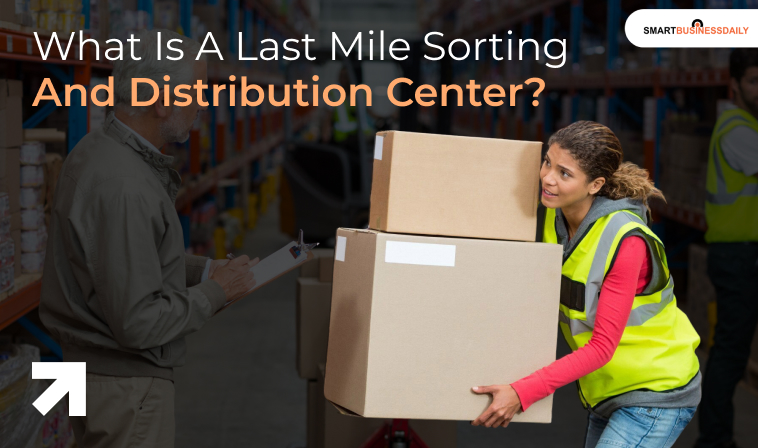
Think of it as a pit stop positioned close to your customer. Large fulfillment hubs handle bulk freight across long distances.
But a last mile sorting and distribution center sits at the edge of a delivery zone. Sometimes inside a city, and sometimes just outside it.
Most importantly, these centers handle the final stretch. Packages arrive from regional hubs, get scanned, sorted by route and address, and loaded onto local delivery vans in the most efficient order possible.
This is the step most people never see. But why? Because it is unglamorous. At the same time, it’s the reason why your package sometimes shows up by noon instead of 6 PM.
The sorting process often uses a system similar to the FIFO method. We also call it first in, first-out philosophy. It means packages that arrived first get dispatched first.
This ensures that older orders are released before newer ones. As a result, you can ensure optimal inventory management.
In high-volume centers, automated conveyors and barcode scanners handle hundreds of packages per hour. Their main role is routing each one to the correct outbound truck without a person touching it more than once.
Why The Last Mile Is So Expensive?
Here’s a stat worth knowing. The last mile delivery accounts for roughly 53% of total shipping costs, according to Wise Systems. But how will small businesses manage that cost?
You can negotiate rates on long-haul freight. But the final few miles cost too much and reduce your net profit margins too.
To clarify, I am talking about the costs involved in taking trips to the residential streets, apartment buzzers, and wrong addresses before reaching the exact location.
A delivery attempt failed notification is not just a customer service headache. Each failed attempt costs a carrier between $5 and $17 to reattempt.
When you’re shipping large volumes, those numbers add up fast. However, the well-run last-mile centers reduce this by pre-sorting, based on real-time address data and flagging known problematic addresses before the driver even leaves.
How Does This Connect To Same-Day And Next-Day Delivery?
If you’ve ever wondered how does same day delivery work from a logistics standpoint, this is the short answer. It only works if the inventory is already close to the buyer.
That’s the whole premise of a micro fulfillment center. It is a smaller, urban-focused storage and dispatch point that feeds directly into last mile operations.
Amazon has hundreds of these scattered across the US. Grocery chains like Albertsons have been building them inside existing stores.
For my candle-selling neighbor, the equivalent was signing up with a third-party ecommerce fulfillment service that stored a portion of her inventory in a Chicago-area facility.
Her customers in the Midwest started getting orders in two days instead of six. Her review scores went from 3.8 to 4.6 stars within three months.
However, she didn’t build a distribution center. Instead, she just plugged into one.
What Happens Inside: The Sorting Steps
| Stage | What Happens |
| Inbound Receiving | Packages are scanned and logged as they arrive from regional hubs |
| Sorting | Packages are grouped by delivery zone, route, and sequence |
| Route Assignment | AI route optimization software assigns each package to the most efficient driver path |
| Loading | Trucks are loaded in reverse delivery order, i.e., the last stop goes in first |
| Dispatch | Drivers leave with a sequenced manifest; tracking updates go live |
This flow is tightly timed. A delay in sorting cascades into late deliveries across dozens of routes.
That’s why centers invest heavily in AI route optimization tools. They are software that factors in traffic, delivery windows, package weight, and driver hours all at once.
It’s not just about saving fuel. Instead, it’s about maximum predictability. And small businesses have to master that in due course.
The Small Business Reality
Most small businesses don’t interact directly with a last mile center. They ship via carriers such as UPS, FedEx, and USPS, or regional alternatives like Sendle USA.
Meanwhile, those carriers handle the sorting internally. But understanding what’s happening behind the scenes helps you make smarter shipping decisions.
For example, if you’re comparing shipping options, you might be wondering, can you buy stamps at UPS for quick one-off shipments? The answer would be “Yes”.
All you need to do is set up a carrier account. In the same vein, another important question would be: Are you optimizing your shipping at scale, or just reacting to orders one at a time?
The businesses that win on shipping are the ones treating ecommerce fulfillment as their foundation. That means understanding your average order volume, your customers’ locations, and which carrier’s last mile network is densest in those zip codes.
Inventory Problems That Hurt Your Last Mile Performance
Two inventory issues silently impact small business shipping performance.
The first is being out of stock on your best sellers during a surge. Say, a holiday or a viral moment on social media.
If you don’t have a safety stock formula in place, you’ll either turn away orders or scramble to restock while customers wait.
In the same vein, safety stock is a buffer inventory level you maintain above your average demand. It is calculated based on lead time variability and service level targets.
It’s not complicated, but most small sellers skip it.
Is the second dealing with backorders? But what is a backorder situation? When a customer orders something you don’t have in stock yet, we call that a backorder in e-commerce terms.
Handled badly, it destroys trust. However, when handled well, with honest ecommerce tracking updates and realistic timelines, it can actually help build loyalty.
| Inventory Problem | Impact on Last Mile | Simple Fix |
| Out of stock during a demand spike | Orders are delayed or canceled before they even reach sorting | Safety stock buffer based on 2–3x average weekly demand |
| Backorder mismanaged | Customer receives no updates; assumes package is lost | Automated status emails tied to fulfillment milestones |
| No FIFO discipline | Older inventory ships last; quality or freshness issues | Clearly labeled shelving and first-in-first-out pick rules |
A Small Business That Got It Right
There’s a Shopify seller based in Austin. In simple words, she sells custom dog bandanas. Meanwhile, her business scaled from $3,000 a month to $40,000 a month in about eighteen months.
Her secret wasn’t paid ads. On the contrary, it was her fulfillment speed.
She partnered with a third-party logistics provider that had a last mile footprint in Texas, California, and the Northeast. When she started offering expedited shipping at checkout, conversions went up 22%.
In other words, customers who saw “arrives in 2 days” bought more readily than those who saw “5–7 business days.”
She now obsessively monitors ecommerce tracking data. Not just for customer inquiries, but to spot patterns.
However, order fulfillment remains challenging for some small businesses. In this case, the smaller parcel volume is the biggest crux. Compared to them, the larger vendors like Amazon take much less time to deliver. But if you ask me how long does Amazon takes to deliver and why can’t you do the same, that’s a genuine concern too.
But in Amazon’s case, two things stand out. These are infrastructure and technology. Still, Amazon uses expedited shipping for some orders. Now, you may ask whether they incur losses from the unplanned use of expedited shipping?
In that case, let me tell you that Amazon’s parcel volume is almost 100 to 200 times that of your small business. So, it scarcely matters.
But does that mean there is nothing left for small businesses? No, that’s not the case. All small businesses can tap into that same infrastructure incrementally. All they need to do is understand how last mile sorting works and choose partners that take it seriously.
How To Decide Whether A Last Mile Partner Is Right For You?
If you’re evaluating a 3PL or fulfillment service for your small business, ask these questions:
- Do they have sorting facilities or last mile hubs near your highest-volume customer zip codes?
- How do they handle failed delivery attempts? Do they reattempt automatically, or does it require manual intervention?
- What does their last mile delivery optimization process look like? To clarify, do they use route optimization software, or are drivers still working off paper manifests?
- Can they provide real-time tracking that integrates with your store platform?
You don’t need to understand every technical detail of how a distribution center operates. But you do need to know enough to ask the right questions.
My neighbor with the candle business figured this out the hard way. Now she ships about 400 orders a week through a 3PL.
Her average delivery time is 2.4 days. Plus, she hasn’t made an afternoon trip to the post office in over a year.
The packages still go through a last mile sorting and distribution center. She just finally understands what that means and why it matters! It’s your turn now!




Related Articles



Comments Are Closed For This Article