








Consumer Fraud: How To Protect Your Business From Scams
5 Mins Read
Published on: 25 January 2024
Last Updated on: 01 October 2026
- What Is Consumer Fraud?
- Types Of Consumer Fraud
- 1. Identity Theft
- 2. Mortgage Fraud
- 4. Deceptive Robocalls
- 5. Fake Charities
- Ways To Protect Your Business From Consumer Fraud
- Comprehensive Knowledge Of Your Business
- Exercise Caution With Phone Orders
- Verification Of Organization Legitimacy
- Enhanced Cybersecurity Measures
- Thorough Employee Background Checks
- Know Your Customers (KYC)
- Identify Vulnerable Areas
- Be Mindful Of Cyber Attacks
- Develop an Action Plan and Report!
One of the biggest risks of owning a business is being vulnerable to consumer fraud and scams.
You may face legal trouble, financial loss, a tarnished reputation, and a breach of trust among stakeholders.
Consumer fraud encompasses deceptive tactics like phishing scams, where fraudulent emails trick individuals into divulging personal information, leading to identity theft or unauthorized transactions.
The Consumer Sentinel Network received 2.4 million consumer fraud cases in 2022, causing $8.8 billion in losses.
In this article, we’ll cover how to protect your business from consumer fraud, so let’s dive in.
What Is Consumer Fraud?
Consumer fraud occurs when a consumer suffers financial or personal loss due to certain business practices.
Fraud can include deceptive, unfair, misleading, or false business practices that cause the consumer to lose money or suffer other harm.
With the increased use of online and digital media, the number of fraudsters has risen.
Almost every consumer is at risk of fraud. However, in most cases, fraudsters mostly target college students and senior citizens.
Identity theft is one of the major issues in online fraud today. In the process, cybercriminals steal your personal information.
Then, they assume your identity, open financial accounts in your name, and make purchases on your behalf.
Fraud also includes mortgage scams, which affect distressed homeowners as they lose money.
To combat fraud, the US government created the Consumer Financial Protection Bureau (CFPB), which protects consumers from financial scams and fraud.
The body also ensures that banks and financial institutions treat consumers properly and fairly.
It also develops new tools and information to promote best practices for consumers.
Types Of Consumer Fraud
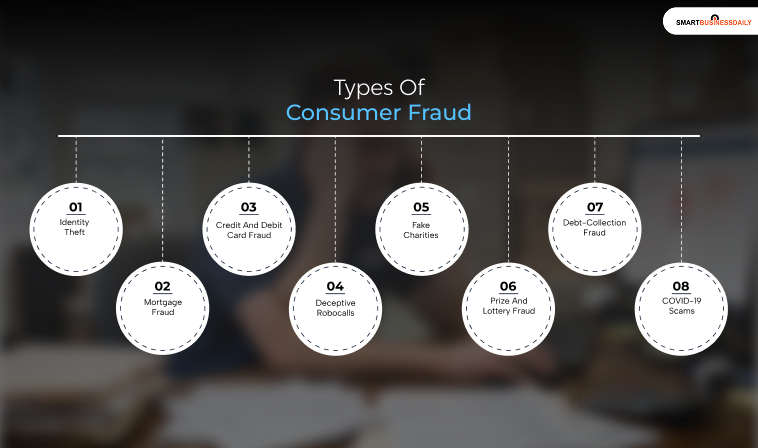
The following are some of the major frauds that you need to be aware of to protect yourself:
1. Identity Theft
It occurs when someone steals your personal information, including your name, SSN, phone number, bank account, credit card number, etc.
They do it through data mining. This lets them drain your finances and use your accounts.
2. Mortgage Fraud
These days, mortgage fraud occurs against distressed homeowners.
These include loan modification schemes, foreclosure rescue schemes, equity skimming, and many more.
In fact, many professionals misuse their knowledge of the real estate market.
3. Credit And Debit Card Fraud
Here, someone steals your card and uses it to purchase goods or for other fraudulent purposes.
4. Deceptive Robocalls
These robocalls promise a “guarantee to reduce your credit card interest rate.”
They then ask you for a fee. In most cases, these offers are scams, and they often ask for your personal information as well.
5. Fake Charities
As the name suggests, these are fake charities, and they use the same techniques to steal your money that legitimate charity institutions use to raise funds.
As a result, it becomes hard to know where your money is going.
6. Prize And Lottery Fraud
There are many types of prize and lottery fraud.
However, they often target aging adults and come mainly through a postcard or a phone call.
They often declare you a winner and then ask you to pay to cover taxes and other costs.
7. Debt-Collection Fraud
These scammers scam consumers as collection agencies and demand payment for outstanding debts.
People with unpaid debts are the main victims of this type of fraud.
8. COVID-19 Scams
After the COVID-19 pandemic, many scammers are using people’s fear and financial needs to take advantage of them.
These mainly come in the form of phone calls about COVID treatments or financial assistance.
Ways To Protect Your Business From Consumer Fraud
In today’s business landscape, safeguarding against consumer fraud is essential to maintain financial stability and protect your reputation.
Here are essential strategies to shield your business from fraudulent activities:
Comprehensive Knowledge Of Your Business
A fundamental defense against fraud is a thorough understanding of your business operations. Regularly review internal processes, financial records, and transactions.
This familiarity enables you to quickly identify irregularities or potentially fraudulent activities.
Exercise Caution With Phone Orders
Phone orders can be susceptible to fraud because verifying callers’ identities is difficult. Whenever feasible, encourage customers to use secure online platforms for transactions.
When phone orders are necessary, implement rigorous verification procedures to confirm the legitimacy of requests.
Verification Of Organization Legitimacy
Verify the authenticity of organizations you engage with, especially in collaborations, partnerships, or financial dealings.
Research potential partners, suppliers, or clients to ensure they possess a reputable track record and are not associated with fraudulent practices.
While the focus here is on protecting businesses from consumer fraud, it’s important to acknowledge the legal implications that might arise.
When consumer fraud escalates into legal disputes, organizations like ConsumerShield can be a resource. They specialize in navigating the legal complexities of consumer rights and class action lawsuits, supporting those affected by fraudulent practices.
Securing Bank Accounts: Strengthen measures to protect business bank accounts.
Regularly monitor account activities, set up alerts for suspicious transactions, and employ multi-factor authentication for online banking.
Educate your finance team about common fraud tactics and stress the importance of secure financial practices.
Enhanced Cybersecurity Measures
Bolster your business’s cybersecurity to prevent unauthorized access and data breaches.
Install reputable antivirus and anti-malware software, keep systems and software updated, and educate employees on the significance of robust passwords.
Consider implementing firewalls and encryption for an additional layer of protection.
Thorough Employee Background Checks
Employees with access to sensitive information pose potential risks.
Conduct extensive background checks before hiring, especially for roles involving financial responsibilities or data handling.
This includes checking references and criminal records and verifying educational and professional qualifications.
Know Your Customers (KYC)
Understanding your customers is crucial to preventing fraud. Implement rigorous identity verification during onboarding using tools like biometrics or two-factor authentication. Regularly monitor transactions, employing automated systems to flag potential fraud for immediate investigation.
Identify Vulnerable Areas
Conduct a thorough assessment of business processes to identify potential vulnerabilities. Evaluate payment processing system security, implement secure gateways, and update security measures regularly. Provide ongoing employee training to recognize and respond to fraud, fostering a culture of vigilance and awareness.
Be Mindful Of Cyber Attacks
In the digital age, safeguarding against cyber threats is essential. Install and update firewalls and antivirus software to protect against malware.
Train employees on cybersecurity best practices, including how to recognize phishing attempts.
Develop a comprehensive incident response plan to ensure a swift and coordinated response in case of a security breach.
These efforts can be supported by effective IT management solutions.
Develop an Action Plan and Report!
Protecting your business from consumer fraud can be a big undertaking!
While you’re at it, create a robust action plan with preventive strategies and clear response protocols.
Train your staff to spot potential fraud and establish clear procedures for promptly reporting suspicious incidents.
Additionals:
- Technological Environment – Factors & Effects On Business




Related Articles



Comments Are Closed For This Article