







Essential Skills For Financial Professionals In Today’s Market
5 Mins Read
Published on: 04 February 2025
Last Updated on: 03 April 2026

- 10 Essential Skills For Financial Professionals:
- 1. Technological Proficiency In Financial Tools:
- 2. Advanced Financial Analysis And Business Strategy:
- 3. Strategic Thinking For Business Acumen:
- 4. Regulatory Knowledge And Risk Management:
- 5. Effective Interpersonal And Communication Skills:
- 6. Adaptability And Continuous Learning:
- 7. Ethical Judgment And Integrity:
- 8. Global Perspective And Cultural Awareness:
- 9. Leadership And Team Management:
- 10. Financial Planning And Resource Management:
- Skills Will Set You Apart!
Today’s financial landscape is more dynamic than ever! This requires users and service providers to up their game and embrace relevant technology.
Professionals in this sector must stay up to date with the trends to ensure relevance and compliance. So, knowing the skills for financial professionals can help them thrive in the sector.
This is necessary for the complete (and ethical) integration of advanced technologies that evolve with regulatory frameworks.
Having the right set of skills also helps the professional adapt to the shifting market dynamics.
To help you stay continuously competent, we’re here with an article on skills that can help you stay relevant.
Read through to learn the essential skills that redefine financial professionals and help them thrive in a dynamic market.
10 Essential Skills For Financial Professionals:
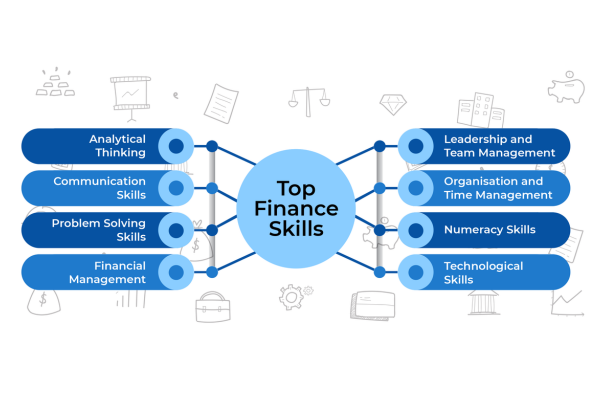
Being relevant in your sector takes a lot more than knowing the right opportunities – you need the right set of skills.
That is why it is so important to constantly keep evolving your skills – no matter the sector you are in.
Here’s a list of all the essential skills for financial professionals:
1. Technological Proficiency In Financial Tools:
The rapid technological advancements have been transformative for the finance sector.
It is amazing how professionals now must have the proficiency to run financial software and tools. Why?
Because technological advancements in the sector help improve efficiency and accuracy. Two things that the finance sector is always trying to improve.
With the help of technological integration, you’ll get hands-on experience with enterprise resource planning (ERP) systems, advanced analytics platforms, and data visualization tools.
These are some of the necessary tools for the current times.
In addition, comprehending emerging technologies such as blockchain and artificial intelligence will give you an edge against the competition.
The technological trends that emerge are important for the professional growth they bring.
With the rise in technological trends, you can leverage these tools to optimize performance and deliver exceptional value.
2. Advanced Financial Analysis And Business Strategy:
As a professional in this sector, it is important that you have strong analytical skills.
These are some of the most essential skills for financial professionals. However, the scope extends beyond traditional methods, bringing innovation to this sector.
The ability to interpret vast data, while applying insights to the strategy, is a need of the hour. Especially ever since there has been a dynamic integration of technology.
Consequently, companies expect professionals to move beyond smashing their targets and use their financial analysis to guide business decisions.
An online MBA in accounting can help you develop fundamental financial expertise, while also helping you hone strategic thinking.
The educational path is important to strengthen the knowledge in managerial accounting, financial reporting, and corporate finance. These are essential for effective decision-making.
In addition, professionals with a deeper understanding of such principles can contribute to risk mitigation strategies and profitability.
This makes them a valuable asset in any financial role.
3. Strategic Thinking For Business Acumen:
A financial professional does not just thrive on technical skills; strategic thinking helps them apply their knowledge in practice.
This is also essential for the professional to understand the business environment, analyze the market trends, and the factors that influence financial decisions.
Professionals should have a broader perspective to assess strategies and anticipate market shifts, helping them develop long-term plans. This helps support organizational objectives, too.
In addition, strategic thinking is essential for financial professionals to align their financial initiatives with the overall business goals.
It also helps facilitate informed decision-making, thereby fostering sustainable growth.
4. Regulatory Knowledge And Risk Management:

It is necessary that you navigate the complex regulatory landscape skillfully – this is one of the most critical skills for financial professionals.
This stems from a thorough understanding of the regulations and laws governing the sector. For example, International Financial Reporting Standards (IFRS) are essential across most countries.
As a financial professional, you must ensure your company or business complies with the relevant regulations.
This helps prevent legal risks and upholds organizational integrity.
In addition, effective risk management includes identifying, assessing, and implementing measures to mitigate potential financial risks.
This is an essential approach that safeguards organizations against unforeseen circumstances and builds resilience.
5. Effective Interpersonal And Communication Skills:
As a professional across sectors, it is important that you have effective communication skills.
For a financial professional, it is even more crucial given the client-facing models prevalent here.
Thus, communication skills for financial professionals are quite important due to the need to clearly communicate complex information.
This skill becomes particularly important given the high volume of interactions between stakeholders and professionals who may not always have a financial background.
Therefore, having interpersonal and communication skills is essential for translating complex data into easy-to-understand insights.
It also enables them to work efficiently, especially within a team – this is essential for building relationships, too.
As a manager or senior professional at your company, you must be able to convey information persuasively.
This influences decision-making and drives organizational success.
6. Adaptability And Continuous Learning:
The financial sector changes rapidly, probably more than any other sector. These technological advancements result from evolving market conditions.
Thus, professionals must exhibit adaptability through embracing new methodologies, such as adjusting to dynamic environments.
In addition, this shows a commitment to continuous learning, which is essential for staying on trend with developments.
In addition, you can attend workshops, pursue certifications, and engage in lifelong learning – thus, staying relevant and equipped with the latest knowledge.
7. Ethical Judgment And Integrity:
Upholding ethical standards is fundamental in finance. Professionals are entrusted with sensitive information and significant responsibilities.
Demonstrating integrity involves making decisions that are not only legally compliant but also morally sound.
Ethical judgment fosters trust with clients, colleagues, and stakeholders, which is crucial for long-term success.
Maintaining transparency and accountability reinforces the credibility of both the professional and the organization.
8. Global Perspective And Cultural Awareness:
In an increasingly globalized market, financial professionals benefit from a broad perspective that encompasses diverse economic environments and cultural contexts.
Understanding international markets, exchange rates, and global economic indicators enables professionals to make informed decisions in a global context.
Cultural awareness also enhances communication and negotiation with international clients and partners, facilitating successful cross-border collaborations.
9. Leadership And Team Management:
As professionals advance in their careers, leadership skills become increasingly important.
Effective team management involves guiding and motivating team members, delegating tasks appropriately, and fostering a collaborative work environment.
Strong leaders also mentor junior professionals, contributing to their development and the organization’s overall talent growth.
Leadership in finance requires decisiveness, empathy, and the ability to inspire others toward achieving common goals.
10. Financial Planning And Resource Management:
Expertise in financial planning is crucial for developing budgets, forecasting financial performance, and managing resources efficiently.
Professionals must be adept at creating comprehensive financial plans that align with strategic objectives.
This includes analyzing financial data to project future revenues and expenses, identifying cost-saving opportunities, and ensuring the optimal allocation of resources.
Effective financial planning supports organizational stability and facilitates informed decision-making.
Skills Will Set You Apart!
All in all, today’s financial landscape demands these skills in financial professionals.
By cultivating these essential competencies, financial professionals can navigate market complexities, drive strategic initiatives, and contribute significantly to their organizations’ success.
Continuous development in these areas will keep professionals competitive and effective in the dynamic world of finance.




Related Articles



Comments Are Closed For This Article