








What Percentage Of People Make Purchases Due To FOMO: An Honest Insight
03 April 2026
4 Mins Read
- What Percentage Of People Make Purchases Due To FOMO: General Population Statistics
- What Percentage Of People Make Purchases Due To FOMO: Dividing the Core Categories of Buyers
- 1. Gen Z (70% - 80%):
- 2. Millennials (67% - 69%)
- 3. Gen X (57%)
- 4. Baby Boomers (28%)
- What Are The High Conversion Triggers That Lead To FOMO Shopping?
- · Limited-Time Offers
- · Countdown Timers
- · Exclusive Drops
- The 2026 FOMO Paradox In Investing
- What Are The Potential Disadvantages And Safety Concerns Of FOMO Shopping?
- · Financial Strain
- · Buyer’s Remorse
- · Data Privacy
- What Percentage Of People Make Purchases Due To FOMO? Now You Know!
I have been studying a lot about the market trends for the last 6 months, and I have noticed a very subtle change in the statistics.
Guess what? I am not very happy about this change.
Firstly, I would like to say something about the impact psychological barriers have on our everyday lives.
Additionally, it also influences the market sphere as well.
Recently, I came across a certain psychological stance in the case of shopping. Let’s check this out.
In 2026, the Fear of Missing Out (FOMO) has evolved from a simple social anxiety.
Now, it is more of a primary engine for the global e-commerce economy.
I was going through the current data for what percentage of people make purchases due to FOMO. Guess what it reveals?
FOMO is no longer just a youth trend. Rather, it is a calculated marketing trigger.
Also, it influences a massive portion of the population.
So, I wanted to share a breakdown of the percentage of people making purchases due to FOMO.
Additionally, I have also talked about the categories influenced by the demographics and triggers.
What Percentage Of People Make Purchases Due To FOMO: General Population Statistics
So, I was going through the latest consumer sentiment reports. You know, as a part of my research for this article.
Guess what?
I saw that a significant majority of active internet users are influenced by FOMO in their purchasing journey:
Firstly, I was quite amazed that 52% to 62% of all consumers admit to making an impulse purchase specifically.
This is because of a FOMO-style advertisement or notification.
In addition, 56% of social media users report that seeing others enjoy products.
Also, I read something so shallow that the experiences on platforms like TikTok and Instagram directly drive their own exclusion anxiety.
Therefore, this leads to unplanned spending.
70% of mobile users say that push notifications, SMS alerts, and app-based limited stock warnings are the primary triggers for their mobile impulse buys.
What Percentage Of People Make Purchases Due To FOMO: Dividing the Core Categories of Buyers
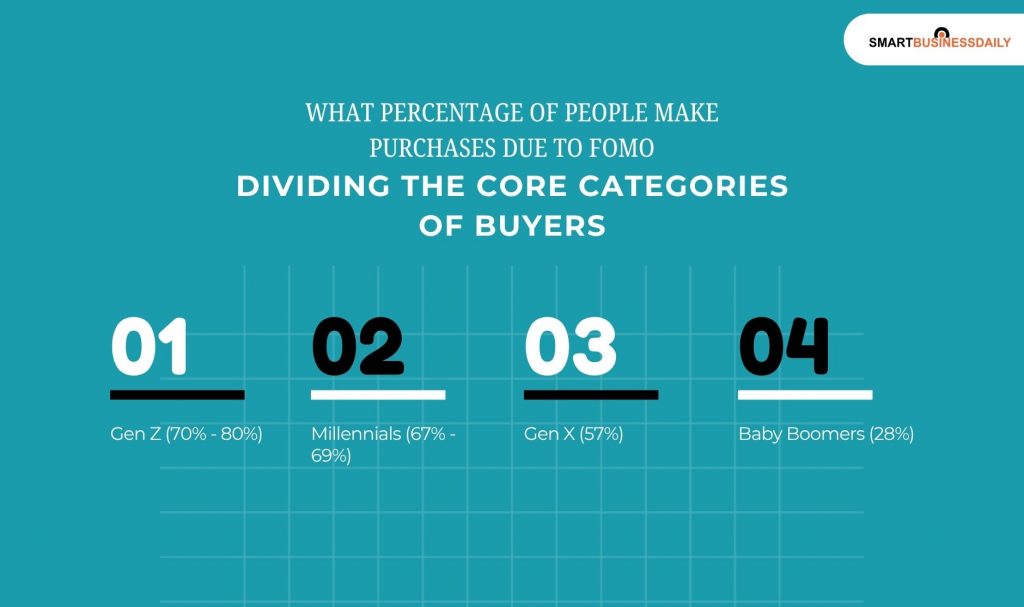
FOMO-driven spending is highly concentrated in younger demographics, though it is beginning to rise among older generations as they become more digitally integrated.
1. Gen Z (70% – 80%):
This group is the most reactive to peer social posts and influencer drops. They often view products as social currency.
Additionally, it leads to high-frequency impulse buys. Also, you stay relevant within their digital circles.
2. Millennials (67% – 69%)
Millennials are the most likely to buy within 12–24 hours of seeing a scarcity ad.
Recent 2026 data shows that 67% of this group completes an unplanned purchase in under half a day when encountering a low stock warning.
3. Gen X (57%)
I do agree that the Gen X people are more skeptical than younger cohorts..
However, I cannot help but agree that Gen X is increasingly influenced by FOMO regarding travel experiences.
Additionally, they are also triggered by limited-time health offers. Also, all the exclusive lifestyle upgrades have an immense impact.
4. Baby Boomers (28%)
This generation remains the least affected by FOMO triggers.
They typically prioritize long-form research. Also, they give a certain importance to planned purchases.
They place this over the high-pressure urgency of flash sales.
What Are The High Conversion Triggers That Lead To FOMO Shopping?
Marketing in 2026 relies heavily on psychological urgency tools. These specific tactics have a measurable impact on conversion rates:
· Limited-Time Offers
These can boost average conversion rates by 332% to 341% compared to standard evergreen promotions.
· Countdown Timers
Also, I would suggest that you start adding a visible timer to a checkout page.
It has been shown to reduce cart abandonment by 29%. This is because it forces the brain to bypass logical planning in favor of urgent action.
· Exclusive Drops
For 2026 fashion and tech trends, 55% of users report buying into an exclusive drop purely to avoid being the only one in their social circle without the item.
The 2026 FOMO Paradox In Investing
Interestingly, FOMO has moved beyond retail and into high-stakes finance. In 2026, the FOMO Paradox describes a market where:
- 46% of investors plan to increase their exposure to volatile equities despite fearing a market collapse.
- This is driven by a fear of missing out on The Bottom of the market or being left behind during a sudden gold or crypto surge.
What Are The Potential Disadvantages And Safety Concerns Of FOMO Shopping?
While FOMO is a powerful tool for brands, it carries significant risks for the consumer:
· Financial Strain
40% of Gen Z admit to overspending and going into debt just to keep up with the lifestyles they see on social media.
· Buyer’s Remorse
Approximately 48% of FOMO-driven purchases result in regret within the first 48 hours, as the emotional high of the purchase fades.
· Data Privacy
FOMO ads often collect intense behavioral data. Users are encouraged to click quickly, often bypassing security checks or fine print in the rush to secure a deal.
What Percentage Of People Make Purchases Due To FOMO? Now You Know!
By the year 2026, it is estimated that around 60% of individuals are likely to be influenced by FOMO, or the fear of missing out, particularly when it comes to marketing strategies.
This means that a significant portion of the population feels a strong urge to make impulse purchases fueled by the desire to be part of the latest trends or exclusive offers.
If you find yourself engaging in quick, impulsive buying decisions, know that you’re not alone.
This behavior reflects a broader global phenomenon, where digital platforms have been meticulously designed to exploit feelings of exclusion and anxiety.
These platforms create environments that heighten the sense of urgency and scarcity, compelling users to act swiftly in order to avoid missing out on valuable experiences or products.
As a result, more people are becoming increasingly sensitive to marketing tactics that play on these emotions.




Related Articles


Comments Are Closed For This Article