







How To Become A Freelancer In 2026 With 0 Clients At First?
29 May 2026
8 Mins Read

- Stop Believing The Freelancer Clichés Failed Entrepreneurs Say
- What You're Actually Giving Up?
- What Small Business Owners Should Really Take Note Of:
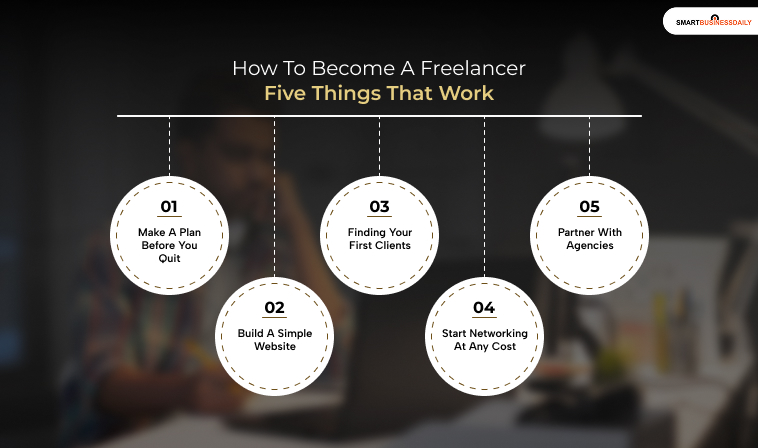
- How To Become A Freelancer: Five Things That Work
- 1. Make A Plan Before You Quit
- 2. Build A Simple Website
- 3. Finding Your First Clients
- What Tools Can You Use To Make New Contacts?
- 4. Start Networking At Any Cost
- 5. Partner With Agencies
- Figure It Out Gradually!
My cousin Stacey quit her HR job in 2023. At that time, she had no freelance projects, no good portfolio, and certainly no clear plan on what to do next.
She had savings for maybe three months. But still, she didn’t have a 100% breakthrough on how to become a freelancer.
Cut to 2025. Eighteen months later, she was billing more than her old salary. At the same time, she was working from home, choosing her own clients, and finally living her weekends too.
But the first 6 months of being a freelancer were never easy. Though I must tell you, freelancing is not as hard as the theory makes it sound.
But she did not receive any practical skills training before she jumped into her freelance venture. In 2026, when the landscape changes further, you don’t need to feel bootstrapped.
Rather, in 2026, you can easily launch your freelancing business to get the head start you actually dreamt of.
Stacey was also here some time back. But she saw the struggle. Her story may help a few of you to eliminate odds and have a smooth freelancing experience!
Stop Believing The Freelancer Clichés Failed Entrepreneurs Say
Before anything else, let’s expose a few myths at the start of this piece. People imagine freelancing as:
- Waking up at 10 AM
- Working from a café
- Doing passionate work all day.
So, how to become a freelancer? Stacey told me that the first thing that surprised her wasn’t finding work. Rather, it was doing it all alone. She went from a noisy open-plan office to sitting alone in her flat.
In other words, there was nobody to help, counter, or work hands-on with her. Some people thrive in that situation. While many others succumb to this pressure and prefer to return to their older ways.
The other myth is that freelancing means freedom from bad clients. In other words, you can cherry-pick whom you want to work with. But in most cases, it doesn’t.
You just get to choose how you approach the bad clients. But when things get dicey, you take charge and do what’s needed to give your business the necessary head start.
Go in with clear eyes. Freelancing is a real business you happen to run by yourself. Treat it like one from day one.
What You’re Actually Giving Up?

A lot of business coaches don’t want to talk about it. But why? Simple, because you can’t glorify it. When you quit, you give up the whole financial support system.
As a result, you are constantly under the threat of starting to shoot up your business revenues as soon as you can. That’s how to become a freelancer.
At the same time, the accountability is all yours. Moreover, it’s you who has to do all the work. So no more sick days or someone else handling your taxation and delivery. It’s all on you.
One of many friends left a marketing agency to freelance as a content strategist. He had clients lined up. Most importantly, he was prepared. What he didn’t account for was the February slump.
Simply put, two clients paused work simultaneously. At the same time, a third took six weeks to pay an invoice. As a result, he had nothing coming in for nearly a month.
He survived it, but only because he’d built a cash buffer beforehand. His advice now to everyone asking how to become a freelancer:
“Save more than you think you need. Then save a bit more.”
What Small Business Owners Should Really Take Note Of:
You are not only giving up your convenience. After all, convenience is an aesthetic asset. However, there are some really important things that you have to sacrifice:
- No guaranteed income: Some months will be great. Others will make you question everything. This is normal, but it takes adjustment.
- You handle tax now: We’re in the US. That means you have to bear quarterly advance tax payments once you cross the threshold. Get a CA early, or at least use proper accounting software. A tax surprise in March will cost you dearly.
- Sick days cost you money: When Stacey had a bad flu for a week in November 2023, she lost about $40,00 in billable time. You can factor this into your rates over time, but it still stings.
- Nobody is handing you work: In a job, tasks come to you. You just maintain your deliverables and your TAT. That’s it! Freelancing means constantly filling your own pipeline. That job doesn’t stop, even when you’re busy.
How To Become A Freelancer: Five Things That Work
Enough on the negatives. Now let’s discuss some things that really worked for Stacey. I assessed the odds, and it seems these 5 things will also work out for all freelancers in the US:
1. Make A Plan Before You Quit
How to become a freelancer hassle free? Don’t resign on a Tuesday because you had a bad Monday. Stacey spent four months moonlighting.
In other words, she was taking small freelance projects while still employed. Wait. She was doing that before she put in her notice.
By the time she left, she already had two paying clients, a basic website, and three months of savings. So, that means she wasn’t starting from zero.
Use your current job as a runway. Save hard and compromise on lifestyle if you have to. Build your basics. Most importantly, identify the type of clients you want.
At the same time, it is always better to know what service you’re selling and what you’ll charge for it. Writing down a rough plan.Even just a one-pager.
I believe that such planning forces clarity that most new freelancers don’t have at the beginning.
2. Build A Simple Website
You don’t need anything fancy. When that friend of mine started out, he built a three-page site on Wix in a weekend.
That was only:
- Home page
- Services page,
- A few work samples
- Contact form.
That was it. His first three agency clients found him through that site. Remember, not through cold outreach, just Google. So that’s enough clue for you about how your initial proceedings should be.
If you don’t have client work to show yet, make your own samples. Write a sample article. Maybe design a sample logo. Or build a sample social media plan for a fictional brand.
Stacey wrote three full HR policy documents as sample work and uploaded them as PDFs. The best part is that nobody ever asked if they were for real clients.
The point isn’t to pretend you have experience you don’t. Instead, it’s to show you can do the work.
💡Bonus Points: Get a professional email address while you’re freelancing. Sending proposals from Gmail leaves a weak impression.
3. Finding Your First Clients
This is where most people get stuck and give up. So, here’s the honest truth that I want you to know about clients.
Your first clients are almost never strangers. Simply put, they are the ones who already know you, or people who know people who know you.
Stacey’s first freelance client was a startup founder she’d worked with two jobs earlier. She sent him a message saying she’d gone independent and asked if he needed HR consulting.
He said yes. That single conversation paid her rent for two months.
Start with your existing network. At first, tell people you’re freelancing. Post about it on LinkedIn. At the same time, you should also send personal messages, not mass emails, to former colleagues, managers, and classmates.
Be specific about what you do. Here’s a sample from Stacey’s deck that may help you:
“I help small businesses set up HR processes from scratch” is far more useful than “I’m a freelance HR consultant.”
Once you’ve exhausted warm contacts, cold outreach is your best option. However, what I learned from Stacey’s case is that it needs to be personalized.
What Tools Can You Use To Make New Contacts?
Platforms like Upwork, Toptal, or LinkedIn ProFinder can help here. But these tools shouldn’t be your only strategy.
Competition on those platforms is fierce. As a result, the rates are often pushed down. Meanwhile, you can use them to build early credibility and reviews. But eventually, you have to rely on them less as you grow.
According to Upwork’s Freelance Forward report, over 76.4 million Americans freelanced in the last year. That is almost 38% of the US workforce.
But what’s interesting is that the number has grown since. The market isn’t shrinking. But neither is the competition. As a result, differentiation matters more than ever.
4. Start Networking At Any Cost
Networking has a bad reputation because most people do it wrong. But what are the common errors that people make:
- They walk into an event, hand out business cards
- Some of them talk about themselves for five minutes, and leave disappointed
- They think it immediately converts to work.
- They might call that network. However, that is actually an example of canvassing.
Real networking is slower and more human. Here are some things you cannot miss if you are serious about networking:
- Going to an industry meetup
- Having a genuine conversation with two or three people,
- Following up afterward
- Staying in touch for months before any work materializes.
My friend got one of his biggest retainer clients in the form of a digital agency that now sends him three to four briefs a month.
To put it simply, he started showing efforts much earlier. He was in talking terms with them since he met them at a LinkedIn event.
Pro Tip: Don’t go in looking to sell. Rather, go in looking to meet people.
5. Partner With Agencies
This isn’t a suggestion many professionals share.
Start looking out for agencies from day 1. I’m talking about agencies. For example, digital marketing agencies, design studios, web development shops, and PR firms.
Remember that almost all of them use freelancers. They have fluctuating workloads. As a result, they can’t hire full-time staff for every skill. So, they need reliable people they can call at short notice.
Stacey cold-emailed eight HR consultancies and HR-tech companies in her city, introducing herself as a freelance HR policy writer. Three replied.
Out of them, two became regular clients. One of those has now referred her to four other companies.
The approach is simple: research agencies relevant to your skill, email them directly, explain what you do, and make it clear you’re available for project or overflow work. So don’t hard sell, but stay in the loop.
If you do good work for one agency, they talk to other agencies. The referral network that builds up over one or two years can become your most reliable source of work. And the best part, no pitching required.
You Can Also Check: What Do You Need To Know About React?
Figure It Out Gradually!
Six months into freelancing, Stacey called me and said she was thinking of going back to a regular job. She was tired, her income was uneven, and she missed having colleagues.
How to become a freelancer without such pullbacks? That’s not possible. You just need to be mentally resolved.
I asked her one question: “Is the work itself better?” She thought about it and said yes. So, she didn’t go back. By month nine, things had stabilized. Again, by month twelve, she was turning down projects.
The early phase of freelancing is hard, not because the work is hard, but because everything is uncertain at once. I am talking about the most serious stakes like income, clients, routine, and identity. That uncertainty will go away slowly.
The freelancers who make it aren’t usually the most talented ones. They’re the ones who didn’t quit during the uncomfortable middle part. That’s the actual advice nobody gives you at first.
Thinking about making the jump? Start with a plan, not a resignation letter.



Related Articles


Comments Are Closed For This Article