







UPS Vs USPS: An Exhaustive Logistical, Pricing, And Delivery Network Comparison
5 Mins Read
Published on: 31 July 2026
Last Updated on: 03 August 2026
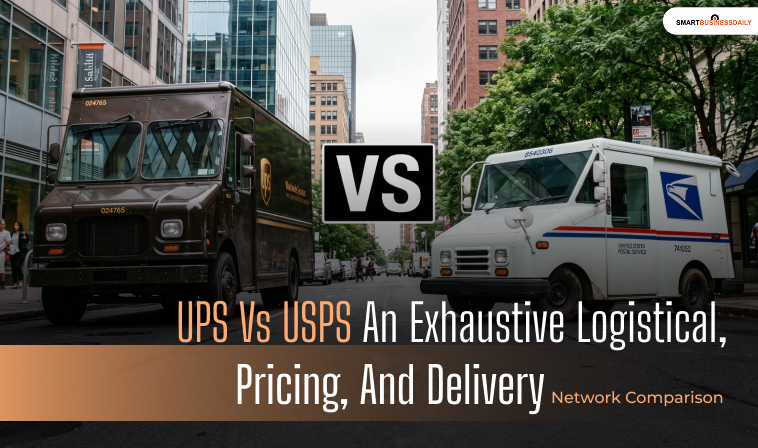
- UPS Vs USPS: High-Density Logistical Framework Matrix
- Pricing Dynamics And Weight-Based Value Boundaries
- USPS: The Lightweight Champion
- UPS: The Heavy Volume Powerhouse
- Shipping Speed, Transit Guarantees, And Network Reliability
- · UPS Transit Accountability
- · USPS Priority Processing
- UPS Vs USPS: Comparing The Pros And Cons
- Strategic Audience Fit: Which Carrier To Choose?
- UPS Vs USPS: Which One Wins?
The global supply chain and e-commerce ecosystems rely heavily on domestic shipping infrastructure to move inventory between businesses and consumers.
In the United States, two shipping networks dominate this marketplace: United Parcel Service (UPS) and the United States Postal Service (USPS).
While both entities handle millions of packages every single day, they operate under completely different:
- Corporate Structures
- Pricing Models
- Logistical Delivery Pipelines
Furthermore, it is very important that you choose between UPS vs USPS involves looking far past basic drop-off boxes.
Moreover, this works best if your work profile matches with either of the following:
- E-commerce entrepreneurs
- Logistics managers
- Corporate procurement officers
- Everyday consumers
This independent, data-driven analysis breaks down their financial models, shipping speeds, tracking networks, and surcharge structures to help you select the optimal carrier for your shipping needs
UPS Vs USPS: High-Density Logistical Framework Matrix
To evaluate how these two delivery networks stack up, it helps to examine their foundational structural differences, target package weights, and unique system strengths:
| Performance Parameter | United Parcel Service (UPS) | United States Postal Service (USPS) |
| Primary Institutional Structure | A publicly traded, investor-owned global logistics corporation. | An independent agency of the US federal government with universal service mandates. |
| Optimal Package Weight Tier | Heavy parcels, valuable items, and large enterprise freight shipments (up to 68 kg). | Ultra-lightweight envelopes, flats, and small e-commerce boxes under 2 kg. |
| Core Delivery Strengths | Highly accurate point-to-point tracking and guaranteed time-bound express shipping. | Unmatched local mailbox access and exceptional domestic affordability for light packages. |
| Weekend Delivery Footprint | Regular Saturday delivery incurs a premium surcharge; Sunday delivery is limited to specific store loops. | Standard Saturday shipping is built in; Sunday delivery is available for priority mail categories. |
| Pricing Architecture Focus | Dynamic dimension-weight (DIM) metrics and destination zone surcharges. | Flat-rate sizing options and highly uniform weight-based pricing structures. |
Pricing Dynamics And Weight-Based Value Boundaries

The primary cost differences between UPS and USPS are determined by the package’s final physical dimensions, total weight, and travel distance.
USPS: The Lightweight Champion
The Postal Service offers a highly competitive tier, USPS Ground Advantage, alongside its classic Priority Mail Flat Rate program.
If you want to know more about the USPS Ground Advantage vs priority mail, read the attached document.
If you are shipping items under 2–3 kilograms, USPS consistently delivers the lowest rates.
Because they operate under a universal mandate to visit every residential address in the country daily, adding a lightweight parcel to their existing route incurs very little additional cost, allowing them to keep consumer rates low.
Furthermore, USPS does not charge hidden residential delivery or fuel surcharges.
UPS: The Heavy Volume Powerhouse
UPS uses a Dimensional Weight (DIM) Pricing model. Therefore, it calculates shipping costs based on a package’s total size volume.
This is a much better format rather than just its raw scale on a balance sheet.
While single retail shipments through UPS can be expensive due to added fuel and residential delivery surcharges, the company excels at high-volume business-to-business (B2B) shipping.
By setting up a corporate account, businesses can secure steep volume discounts that make heavy, bulk, or long-distance shipments incredibly cost-effective.
Related Article For You: UPS Label Created? What Does It Mean in 2026?
Shipping Speed, Transit Guarantees, And Network Reliability

When your business or personal projects rely on strict, time-bound delivery windows, the structural differences between these two networks become critical.
· UPS Transit Accountability
Services like UPS Next Day Air and UPS 2-Day come with strict, ironclad financial delivery guarantees.
If a premium package arrives even a few minutes past its promised deadline, the company issues a full refund.
Moreover, this high level of accountability makes UPS the preferred carrier for legal documents.
Additionally, it applies to sensitive medical supplies and high-value tech inventory.
· USPS Priority Processing
Services like USPS Priority Mail Express offer overnight delivery options.
But their standard Priority and Ground Advantage services only provide estimated delivery windows (usually 2 to 5 business days).
While these lines are highly reliable, they lack the legal and financial performance guarantees that enterprise businesses require to protect their supply chains.
UPS Vs USPS: Comparing The Pros And Cons
| Carrier Service | Core Strengths | Core Vulnerabilities |
| United Parcel Service (UPS) | Unmatched point-to-point tracking precision.Guaranteed time-bound delivery windows.High weight capacities for heavy freight.Massive volume discounts for corporate accounts. | Baseline retail shipping costs are higher. Residential deliveries incur extra convenience surcharges. Fuel tracking metrics can make monthly billing unpredictable. |
| United States Postal Service (USPS) | Lowest available pricing for small, lightweight parcels.Free flat-rate boxes and home pickup services.Zero hidden fuel or residential surcharges.Seamless access to PO Boxes and military mail drop-offs. | Customer service issue resolution can feel slow and institutional. Tracking updates sometimes lag between sorting facilities. Time-bound delivery windows are rarely backed by financial refunds. |
You Can Also Check: How To Fix GPS Not Working: Quick Ways To Restore Your Location Services
Strategic Audience Fit: Which Carrier To Choose?
To protect your shipping budget and ensure your inventory arrives safely, align your specific parcel profiles with the correct delivery network:
| Shipping Requirement Scenario | Recommended Carrier | Strategic Rationale & Operational Fit |
| Parcels Under 2 kg | USPS | Ground Advantage and Priority Mail offer unmatched cost-per-gram values without any added residential fees. |
| Valuable High-End Tech | UPS | Strict barcode tracing and time-stamped transit signatures protect valuable assets against theft. |
| Heavy Bulk Freight (>15 kg) | UPS | Built-in industrial distribution networks handle large, heavy boxes smoothly without triggering extreme weight penalties. |
| PO Box & Remote Delivery | USPS | Federal access laws ensure safe delivery into secure government mailboxes that private couriers cannot touch. |
UPS Vs USPS: Which One Wins?
In the battle of UPS vs USPS, there is no absolute winner; instead, success relies on using each carrier’s specific strengths to fit your budget and timing needs.
USPS is the ultimate cost-efficiency tool for lightweight, everyday shipping.
Its flat-rate boxes and surcharge-free pricing make it perfect for independent sellers, small e-commerce startups, and standard household mail.
On the other side, UPS is the premier choice for technical security, bulk volume, and strict deadlines.
Its guaranteed air networks and precise end-to-end tracking give enterprise businesses the security and predictability they need to scale.
For optimal results, smart shippers adopt a hybrid approach: route small, low-value items through USPS to maximize your profit margins, and protect your heavy, time-sensitive, and high-value orders by locking them into the UPS network.




Related Articles



Comments Are Closed For This Article