







How To Get SEO Clients In 2026: The Ultimate Client Acquisition Blueprint That Actually Works!
14 August 2026
9 Mins Read

- The Death Of Volume: Why Traditional SEO Pitching Fails In 2026
- The Sharp Decline of Cold Email Response Rates
- The Shift From "Traffic Volume" To "Generative Search Footprint"
- How To Get SEO Clients: Monetizing Immediate Buyer Intent (Inbound Systems)
- Way 1: Hijacking High-Budget Retainers On Freelance Marketplaces (Upwork & Toptal)
- Way 2: The 60-Second Video Proposal Audit
- Way 3: Partnering with Complementary Web Design & Development Agencies
- How To Get SEO Clients: Precision Outbound via Visual Data (Outbound Systems)
- Way 1: Visualizing Competitor Theft Via Local Proximity Geo-Grids
- Way 2: The "Asymmetry" Loom Pitch For E-commerce Brands
- Way 3: The "Unattended Keyword" Outreach Strategy
- How To Get SEO Clients: Leveraging The Paradigm Shift (Modern AI Systems)
- Way 1: The AI Visibility Audit (GEO Audit Pitch)
- Way 2: White-Labeling Your Services Into Niche Enterprise Audits
- How To Get SEO Clients: Building A High-Authority Inbound Engine (Organic Systems)
- Way 1: Shifting LinkedIn Strategy To Counterintuitive Teardowns
- Way 2: "Micro-Consulting" In High-Value Digital Communities
- Guarding Agency Margins: How To Qualify Inbound Leads
Quick Answer: The 10 fastest ways of how to get SEO clients in 2026 are:
- Filter high-budget Upwork/Toptal leads,
- Send 60-second video proposals,
- Partner with web design agencies,
- Show local geo-grid rankings,
- Send Loom teardown pitches,
- Target “page 2” keywords,
- Run AI Visibility (GEO) audits,
- White-label enterprise audits,
- Post client teardowns on LinkedIn,
- Do free micro-consulting in niche communities.
Getting SEO clients used to be simple. You sent 200 cold emails, you got a few replies, and you booked a few calls. That system is breaking down. Inboxes are full. Buyers are tired. And search itself has changed,
which means the way you prove your value has to change too.
This guide gives you 10 real, working ways to find and close SEO clients in 2026.
Every method below is built around one idea: find people who are already looking to buy, or show them proof so clear they can’t say no.
The Death Of Volume: Why Traditional SEO Pitching Fails In 2026

The fact is that mass outreach still works a bit. However, the effectiveness is not what it used to be, and you may waste more time on the same for smaller gains. Two major changes are responsible for this state.
The Sharp Decline of Cold Email Response Rates
Cold email response rates have been decreasing sharply, particularly for how to get SEO clients. An average reply rate in 2019 was about 8.5%.
Industry data indicated that the average was already dropping by close to 5% by 2025.
The Instantly Benchmark Report of 2026 analysed millions of delivered cold emails, yielding a platform-wide average of just 3.43%.
That means approximately 19 out of every 20 such emails go unseen.
Even newer findings, though, paint the worst possible picture. When Belkins did over 7.5 million cold emails in 2025, they measured the number of responses against the total number of emails sent, i.e., including those that went unanswered.
This was their actual result, with an average reply rate of 0.45%, and it only worsened even into the second half of the year.
The conclusion is straightforward. When all your clients are from mass emailing, you should know it will just not work out in the end.
What is more, you will probably get the fewest clients from one email, and that too only from those who are already looking to make a purchase.
The Shift From “Traffic Volume” To “Generative Search Footprint”
The bigger shift is in search itself. Google is no longer just a list of blue links.
AI Overviews now answer a huge share of queries directly on the results page, so users never click through at all.
Here’s what the data shows:
- In the US, about 58–65% of Google searches now end with zero clicks to any website (SparkToro/Datos data).
- When an AI Overview appears on the page, that zero-click rate jumps to around 83%.
- In Google’s newer AI Mode, the zero-click rate can reach 93% (Semrush).
- Only about 1% of AI Overview views lead to a click on a cited source (Pew Research).
At the same time, AI search tools are seeing explosive growth in use. ChatGPT alone had reached about 900 million weekly active users by early to mid 2026, more than double its user count a year earlier.
This changes what a client is paying for. They no longer just want to “rank” and get traffic.
They want to be the brand that AI tools mention by name when someone asks for a recommendation.
How To Get SEO Clients: Monetizing Immediate Buyer Intent (Inbound Systems)
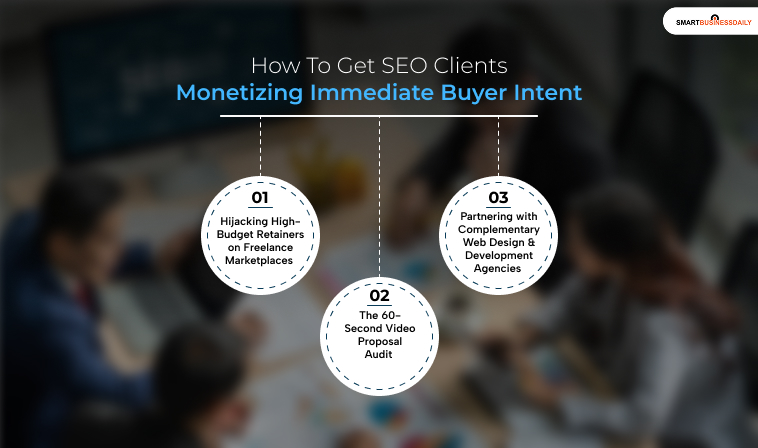
These three approaches work very well with individuals who are actively hunting for an experienced SEO expert right now.
Way 1: Hijacking High-Budget Retainers On Freelance Marketplaces (Upwork & Toptal)
Freelancers often open every job listing they see on Upwork and apply to them all.
This method is time-consuming and inefficient, as freelancers spend precious work time on cheap, low-quality leads. A better idea filter your search aggressively.
Here are the main factors you should look for before even considering putting forward a proposal:
- Payment method verified
- Total client spending more than $10, 000
- Employment of freelancers rate more than 1 time out of 2
- Job published within the last few hours (new posts usually garner fewer serious bids)
Clients with a history of spending money are not just “shopping around.”They have engaged freelancers, paid them, and now understand what a high-quality SEO service costs.
You’re likely to get a good retainer deal when targeting this clientele than from a fresh account listing a $ 50-budget job.
Way 2: The 60-Second Video Proposal Audit
There is a pattern to most proposals on Upwork: just a standard introduction, a couple of selling points, and a proposed payment.
Therefore, clients quickly skip over these proposals. To differentiate and grab attention, you should, in fact, film a short video lasting just 1 minute.
Start the video by opening the client’s website in a browser window.
Indicate one issue that is real and that can be immediately resolved by a skilled SEO expert:
- A missing title tag,
- Slow page speed,
- Broken schema
Then say, in plain words, what you’d fix and why it matters. Attach the video link to your proposal.
You just need to include a video link with your proposal.
The effectiveness of the approach is that it demonstrates two things at once: that you analysed their website as your first step, and that you are really in this to fix things.
A written document alone will not convince customers of these things as effectively as a short video can.
Way 3: Partnering with Complementary Web Design & Development Agencies
Web design and development agencies build beautiful sites all day. Most of them don’t offer SEO, and many don’t want to. That’s your opening.
Reach out to 10–15 small agencies. Offer a simple referral or white-label deal: they finish the site, you handle the SEO setup and ongoing optimisation, and
you split revenue or pay a referral fee. This gives you a steady stream of warm leads, brand-new sites that need SEO from day one, without you spending a dollar on ads or outreach tools.
How To Get SEO Clients: Precision Outbound via Visual Data (Outbound Systems)
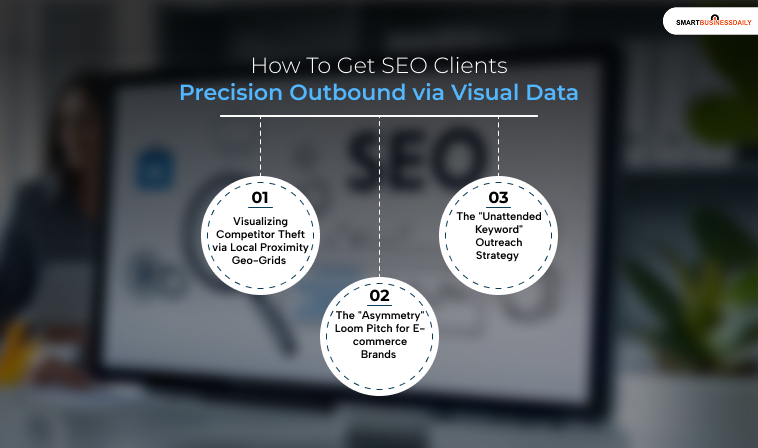
Outbound still works, but only when you lead with proof, not a pitch.
Way 1: Visualizing Competitor Theft Via Local Proximity Geo-Grids
A geo-grid report is a map of dots showing where a business ranks for a keyword across a city or neighbourhood. Local businesses are shocked when they see it.
Here’s the pitch: pull a geo-grid for a local business’s top keyword. Show them they rank #1 right at their storefront.
But drop to page 3 just 2 miles away, meaning they’re invisible to most customers actually near them.
Send this as a simple image, not a wall of text. A local business owner instantly understands a map. They don’t always understand “keyword rankings.”
Way 2: The “Asymmetry” Loom Pitch For E-commerce Brands
E-commerce brands usually have technical problems they don’t know about:
- Broken schema markup,
- Orphaned pages,
- Duplicate product URLs,
- Thin category pages.
These issues quietly cost them real revenue.
Record a 3-minute Loom video walking through their site.
Show the exact broken schema or dead internal links using their screen, not a slide deck. Keep it specific to them, no generic tips.
This method is called “asymmetry” because you’re giving away real, useful value for free before they have paid you anything. That imbalance is what makes people trust you enough to reply.
Way 3: The “Unattended Keyword” Outreach Strategy
Find a business that already ranks on page 2 for a keyword tied to real revenue — close, but not close enough to get clicks.
Page 2 rankings get almost no traffic, so the business is losing money it doesn’t even realize it’s losing.
Send them a short outreach message showing the exact keyword, their current position, and the specific content change needed to push it to page 1, maybe a new section, an updated word count, or a missing
FAQ block. This works because you’re not selling a vague promise. You’re showing a fixable gap with a dollar amount attached.
How To Get SEO Clients: Leveraging The Paradigm Shift (Modern AI Systems)

This is the newest and highest-leverage pillar, because most SEO sellers haven’t caught up to it yet.
Way 1: The AI Visibility Audit (GEO Audit Pitch)
Ask ChatGPT, Claude, and Gemini a question a customer might ask: “best project management software for small teams,” or “best plumber in [city].”
Screenshot the answer. If the prospect’s brand doesn’t appear, that’s your entire pitch — no explanation needed.
This method lands because it’s visual and undeniable. A business owner might not fully understand backlinks or crawl budgets, but they instantly understand “AI recommends your competitor by name, and not you.”
Given how fast AI tools have grown, hundreds of millions of weekly users across ChatGPT, Gemini, and Perplexity combined. This gap will only matter more, not less.
Way 2: White-Labeling Your Services Into Niche Enterprise Audits
Mid-market software companies (CMOs at $10M–$100M in revenue) have budgets, but they don’t always have an in-house technical or programmatic SEO expert.
Build a tight, professional audit template: technical health, content gaps, competitor comparison, AI visibility, and pitch it directly to CMOs as a paid diagnostic, not a free sample.
Price the audit itself as a real deliverable (say $1,500– $5,000 depending on company size).
This filters out tire-kickers immediately and turns your sales process into a paid engagement rather than free work you hope will convert later.
How To Get SEO Clients: Building A High-Authority Inbound Engine (Organic Systems)
These methods build a pipeline that keeps working even when you’re not actively pitching.
Way 1: Shifting LinkedIn Strategy To Counterintuitive Teardowns
Generic tips posts (“5 SEO tips for 2026!”) barely move anymore — everyone posts them, so nobody remembers who wrote which one.
Instead, post real teardown-style breakdowns of your own client wins: the exact indexing problem you found, the traffic number before and after, the revenue impact.
Specific numbers build trust that advice-only posts never will.
A post that says “we fixed a crawl budget issue and organic revenue rose 34% in 90 days” earns more profile visits and DMs than ten generic tip lists.
Way 2: “Micro-Consulting” In High-Value Digital Communities
Founders and marketers ask for SEO help constantly in places like relevant Reddit communities, niche Slack groups, and Skool communities.
Most people who answer give a one-line, vague reply.
Instead, write a real, detailed, step-by-step answer — as if the person paid you for it. Do this consistently in the same three or four communities.
Over time, people start recognizing your name and DM you directly because you’ve already proven you know what you’re doing.
This costs time, not money, and it builds trust faster than almost any paid ad ever will.
Guarding Agency Margins: How To Qualify Inbound Leads
Acquiring leads is but one side of the job coin. Not screening them afterwards and continuing to do it means you have wasted a lot of time talking to people who were never in the position to pay you properly.
Three Filters to Screen the Quality of Leads: Budget, Decider Contact Availability, and Reasonable Timeframes
Before making a sales call, confirm three filters:
- Budget: Can they afford ongoing SEO work, and not a cheap one-time fix?
- Can you talk to someone who is in charge and signs the paper, or is it that guy who needs to “check with the team” after each call?
- Realistic Timelines: Do they think they’ll get #1 results in 14 days? Well, you better watch your back.
It takes SEO a couple of months, and a prospect who doesn’t understand that will be the type of client who gives you sleepless nights.
When a potential customer meets none or only one of these three filters, there is a very high probability they are a low-quality lead.
Setting up an intake funnel through the use of a Friction-Based Application
Replace the typical “book a call” button with a short application that asks for budget, current traffic, main goal, and time-frame expectations.
This small amount of friction filters out low-intent browsers before they ever reach your calendar. Serious buyers don’t mind filling out a form. Tire kickers usually drop off right there and save you from wasting a 30-minute call on someone who was never going to sign.




Related Articles