







Crisis Management: Types, Strategies, And Best Practices For Businesses
9 Mins Read
Published on: 30 July 2024
Last Updated on: 03 July 2026

- What Is Crisis Management?
- 1. Threat:
- 2. Uncertainty:
- 3. Time Pressure:
- Crisis Management vs. Risk Management:
- Types Of Crises:
- 1. Natural Disasters:
- 2. Cybersecurity And Technological Crisis:
- 3. Confrontational Crisis:
- 4. Crisis Of Malevolence:
- 5. Organizational Misdeed Crisis:
- 6. Workplace Violence:
- 7. Public Relations and Communication Crises
- Why Understanding Crisis Types Matters?
- Role Of Leadership During Crisis:
- 1. Signal Detection:
- 2. Prep And Prevention:
- 3. Containment:
- 4. Recovery:
- 5. Learning:
- 6. Communication:
- 7. Review, Learn, And Improve
- Leadership Sets The Tone During A Crisis:
Every business will face a crisis at some point. It may be a cybersecurity breach, a product recall, a public relations issue, a natural disaster, or even an internal leadership failure.
While the nature of the crisis may differ, one thing remains constant: how an organization responds often determines how quickly it recovers.
History is filled with companies that emerged stronger after handling a crisis with transparency and decisive action.
Also, it’s full of businesses that suffered lasting financial and reputational damage due to unpreparedness. The difference rarely lies in the crisis itself – it lies in the response.
That’s why crisis management has become an essential part of modern business strategy.
Instead of reacting under pressure, organizations develop crisis management plans that help them respond quickly, protect stakeholders, minimize operational disruption, and preserve customer trust.
In this guide, we’ll explore what crisis management is, how it differs from risk management, the most common types of business crises, and the leadership strategies that help organizations successfully navigate challenging situations.
Stay tuned.
What Is Crisis Management?

Crisis management is the process of preparing for, responding to, and recovering from unexpected events that threaten an organization’s operations, finances, reputation, or people.
Its objective is not only to limit immediate damage but also to restore normal business operations as efficiently as possible.
A crisis can take many forms, and it needs a tough set of crisis management skills to manage a crisis situation.
It may be caused by internal failures, such as data breaches, workplace misconduct, or operational disruptions, or by external events like natural disasters, economic downturns, or regulatory changes.
Also, regardless of the source, every crisis requires timely decision-making, clear communication, and coordinated action.
Effective crisis management is built on three fundamental elements:
1. Threat:
Every crisis presents a genuine threat to the organization. This may involve financial losses, operational downtime, legal liability, reputational damage, or risks to employee and customer safety.
Understanding the scope of the threat helps leaders prioritize their response.
2. Uncertainty:
Crises often unfold with incomplete or rapidly changing information.
Leaders rarely have all the facts when making critical decisions, which is why flexibility and continuous assessment are essential throughout the response process.
3. Time Pressure:
Most crises require immediate action. Delayed decisions can allow a problem to escalate, increasing both financial costs and reputational damage.
Organizations with established crisis response plans are generally able to act faster and more confidently than those responding without preparation.
So, successful crisis management is not about eliminating every possible problem.
Instead, it focuses on reducing the impact of unexpected events while maintaining business continuity and protecting stakeholder confidence.
Crisis Management vs. Risk Management:

Before heading deeper into the abyss and learning more about crisis management, we must understand one clear difference between crisis management and risk management.
Young entrepreneurs often think risk management and crisis management are two sides of the same coin. However, that is not the case. Both have some fundamental differences between themselves.
Risk management refers to planning and putting things simply. In other words, risk management is when an organization prepares for events that might happen. Think of it as a means of prevention.
Crisis management, on the other hand, is the act of containing a crisis. This is fixing the situation and moving on with the business operations. This fundamental difference sets these two concepts apart from each other.
| Risk Management | Crisis Management |
| Focuses on preventing potential problems | Focuses on responding to events that have already occurred |
| Conducted before a crisis develops | Activated once a crisis begins |
| Identifies and evaluates risks | Contains damage and restores operations |
| Reduces the likelihood of disruption | Reduces the impact of disruption |
| Supports long-term resilience | Supports immediate recovery and business continuity |
Types Of Crises:
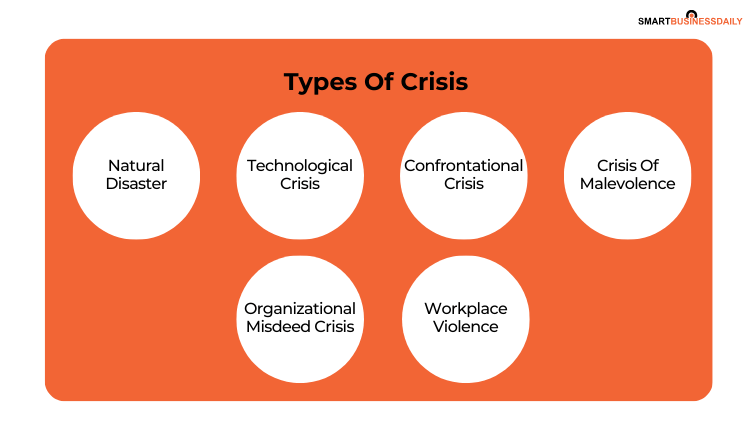
While training or learning crisis communication strategies, you will encounter different crises a business might experience. Therefore, it is essential to understand these crises from within.
This section will look at different forms of crises that you or your organization might face while operating. Here are eight of the most common business crisis management situations you must prepare for to keep your business safe.
Let us dive right in and look at some of the most common crises you might face.
1. Natural Disasters:
The most common and obvious crisis that one might experience is a natural disaster. These calamities or freaks of nature are impossible to predict.
Therefore, you will not get any hard-and-fast crisis management plan when dealing with these variants.
Natural disasters usually refer to calamities such as storms, volcanic eruptions, landslides, earthquakes, and tsunamis. Technology adoption can give you some ideas. However, nothing stands in the way of scorned Mother Nature.
All you can do is hope and pick up the pieces when Mother Nature is done with you.
2. Cybersecurity And Technological Crisis:
Technology adoption is evident, and the most logical step companies need to take to grow. However, this comes with its challenges. The first and foremost challenge is the technological breach, crisis, etc.
In today’s business landscape, technological crises are more common than before. As a result, more and more experts are prioritizing this while formulating their crisis management strategies.
Given the data-driven nature of the world, technological crises are devastating and can bring an organization down to its knees.
Take the Facebook case as an example. The breach hampered the brand’s reputation beyond fixing. As a result, the brand is slowly dwindling.
3. Confrontational Crisis:
Confrontations are important and natural in workplaces. Regardless of the quality of the work environment, confrontations are bound to arise.
However, when things get out of hand and employees start demanding things from the company, there is a need for dedicated confrontational crisis management.
Confrontational crises are those that arise purely from resentment towards the company. This form of resentment can be harbored by employees, interest groups, and other stakeholders.
Confrontational crises usually manifest in picketing, sit-ins, issuing ultimatums, etc.
4. Crisis Of Malevolence:
Even if your business is big and has been operating for a while, it is not immune to miscreants.
This is where the crisis of malevolence comes into play. Crisis of Malevolence is an umbrella term denoting crises arising from criminal activity.
Crisis of Malevolence refers to problems usually caused by criminal vendettas against companies. These include holding the company hostage, stealing data, tampering with evidence, extortion, phishing, etc.
The crisis of Malevolence can not only hamper business operations but also leave deep scars on individuals’ psyches. Therefore, this form of crisis is considered the most disruptive.
5. Organizational Misdeed Crisis:
Sometimes, a disruptive element comes from within. In other words, we are talking about disruptions caused by organizational misdeeds. This is also a prevalent form of crisis that organizations face.
Organizational misdeeds consist of three distinct types. The first deals with deception, the second deals with misconduct, and the third deals with skewed management values. This form of crisis is destructive to an organization’s reputation.
The worst part about this crisis is that it is usually noticed from a mile away. However, if senior management is involved, the situation usually needs to be controlled, and it becomes significant.
6. Workplace Violence:
Workplace violence has been one of the major organizational crises for the longest time. There have been countless cases where employees have demonstrated sudden bursts of anger toward their colleagues.
Workplace violence might not be disruptive to an organization on that level.
However, it can be pretty traumatizing to all the individuals involved. Therefore, it should be considered a crisis as it hampers business operations.
7. Public Relations and Communication Crises
Not every crisis begins with a physical event. Sometimes, a poorly handled announcement, a misleading marketing campaign, an executive interview, or a viral social media post can trigger widespread public criticism.
In today’s always-connected world, news spreads within minutes. Businesses that delay responding or provide inconsistent messaging often lose control of the narrative, allowing misinformation to spread quickly.
An effective crisis communication plan should identify authorized spokespersons, establish internal approval processes, prepare holding statements, and define communication channels before a crisis occurs.
Organizations that communicate honestly, consistently, and promptly are generally more successful at preserving public trust during challenging situations.
Why Understanding Crisis Types Matters?
Recognizing the different forms a crisis can take allows businesses to prepare more effectively.
While every emergency requires a unique response, organizations that understand their vulnerabilities are better positioned to respond quickly, protect stakeholders, and minimize long-term damage.
Rather than creating a single generic crisis plan, businesses should develop response strategies tailored to the risks they are most likely to face.
For example, a technology company may prioritize cybersecurity preparedness, while a manufacturing business may focus on operational continuity and supply chain resilience.
Also, the goal is not to predict every possible crisis but to build an organization that can adapt quickly, make informed decisions, and continue operating under pressure.
Role Of Leadership During Crisis:

Crisis management usually starts at the macro level. The usual process is to identify, assess, and fix.
However, all these things start at the top of the management. Therefore, if you are inexperienced in these matters and want to know your role, follow along.
This section will highlight some of the most critical and key roles leaders play during crisis management. So that you know what to do to avert crises.
Then again, this is a subjective section; therefore, you need to use your judgment to get the best result.
1. Signal Detection:
The foremost aspect of crisis management is understanding the signs. These signs usually manifest early. However, they are often overlooked.
As a crisis management leader, your foremost job is identifying the signs. So that you have clarity about the direction to pick.
2. Prep And Prevention:
The second part of the deal is the preparation and the prevention part of the conversation. As a business leader, you must stay prepared and prevent any crisis.
Therefore, preparation is an essential part of the whole deal. You must sit with the crisis management team and devise proper plans to counter the crisis.
3. Containment:
Crisis management is usually undertaken when a business encounters an obstacle. Therefore, even with crisis management techniques, you can only do so much to prevent a crisis.
However, as part of the management team, you must make active headway to contain the problem. Otherwise, the problem would get outta hand.
4. Recovery:
Once a business starts going under and the containment process is in full blast, the recovery process begins. The recovery process is essential and must be done carefully.
The recovery step is a multi-pronged approach where you incorporate different ideas under one roof. Therefore, it is a very complex process that must be done correctly.
5. Learning:
Every failure is an opportunity to learn. This is one of the most accurate statements in an entrepreneurial setting. A crisis cannot dishearten you.
Instead, you must be vigilant and adept enough to learn something new. Something that could help the organization avert such problems. Therefore, do not just try to contain the situation. Read the situation and find avenues to avoid them in the future.
6. Communication:
The final responsibility a crisis management leader has is to communicate and maintain transparency. This helps create a sense of reliability and credibility across departments.
A true leader leads in transparency. Not only that, but this practice would also enable you to handle the problem with a much more pre-emptive stance.
7. Review, Learn, And Improve
The work doesn’t end when the immediate crisis has passed. Every significant disruption presents an opportunity to evaluate what worked, what didn’t, and how future responses can be improved.
As a result, conducting a post-crisis review helps organizations identify gaps in planning, communication, technology, and decision-making.
Leadership Sets The Tone During A Crisis:
Employees closely observe leadership behavior during uncertain times.
Calm, transparent, and decisive leadership can strengthen confidence, while inconsistent messaging or delayed action often creates confusion and undermines trust.
Moreover, organizations cannot eliminate every crisis, but they can influence how effectively they respond.
Leaders who prepare in advance, communicate openly, support their teams, and commit to continuous improvement are far better positioned to navigate uncertainty than those who react only after problems escalate.
Ultimately, effective crisis management is less about avoiding disruption altogether and more about building an organization capable of responding with confidence, protecting its stakeholders, and emerging stronger from adversity.
Read More…




Related Articles



Comments Are Closed For This Article