








The Ultimate Beginner’s Guide To Master Your Bank Reconciliation Statement (And Finally Stop Losing Sleep Over Missing Cash!)
20 August 2026
8 Mins Read
- What Is A Bank Reconciliation Statement?
- Why It Really Matters!
- Key Benefits For Your Business
- How Does A Bank Reconciliation Statement Work?
- Timing Differences And Common Causes
- Bank Reconciliation Statement: The Formats And Examples
- A Real-World Example
- How Can You Prepare A Bank Reconciliation Statement?
- Step 1: Gather The Records For The Same Period
- Step 2: Compare And Cross-Out Corresponding Entries
- Step 3: List All Discrepancies On Either Side
- Step 4: Prepare Your Bank Reconciliation Statement
- Step 5: Double Check Everything Before Finalizing
- What Are The Errors You Must Avoid?
- 1. Double-Check Your Balances
- 2. Use A Separate Worksheet
- 3. Work From Both Ends
- 4. Focus On Numbers, Not Names
- 5. Connect It To The Rest Of Your Accounting
Maintaining updated business account records can be extremely satisfying. You feel like you’re on top of things.
Your books are in order. But wait, when you look at your bank statement, it all goes out the window!
Discrepancies can be small or large, and sometimes it’s even hard to tell where the difference is coming from.
Either way, these differences are not pleasant to deal with. In fact, according to a survey by the Bankers Association, almost 30% of small business owners suffer losses due to differences between their records and the bank’s.
The good news is that there’s an easy way to fix this problem called a Bank Reconciliation Statement.
In this article, we’ll discuss what a bank reconciliation statement is, why businesses need it, and how to prepare one with ease!
What Is A Bank Reconciliation Statement?
Think of a Bank Reconciliation Statement as a friendly bridge between your business records and your bank account. In simple terms, your books might say one thing, while the bank says another.
This document compares both balances and explains exactly why they don’t match.
Why It Really Matters!
Money can easily slip through the cracks when your numbers do not match.
However, a mismatch does not always mean someone made a mistake or did something wrong.
In most of the cases, it’s a simple timing delay, a hidden bank fee, or an overlooked transaction.
However, if you leave these gaps alone for too long, finding the root cause becomes a massive headache.
Key Benefits For Your Business
Regularly checking your numbers keeps your business safe and healthy. Here is how it helps you:
- Catch Missed Entries: Spot automatic bank charges, interest earned, or direct debits that you forgot to write down.
- Stop Cash Flow Surprises: Avoid overestimating your cash so you never deal with bounced payments or upset suppliers.
- Stay Ready for Audits: Keep your financial history organized and accurate, making tax time a total breeze.
- Spot Red Flags Early: Catch weird duplicate payments or unauthorized withdrawals before they hurt your wallet.
Also Check: What Happens If You File GST Late In Canada? Penalties, Interest And CRA Consequences.
How Does A Bank Reconciliation Statement Work?
Reconciling your balances is like playing detective. You should be able to identify which amounts have cleared, which have not, and which need immediate attention.
In the end, all your efforts should be geared toward the final closing balance that shows the exact amount of money you have at your disposal.
For this reason, the following is a brief highlight of the differences between what one’s books and the bank statement records:
- Cheques issued but not cleared: These are amounts that one has reduced in their books but that have not yet cleared or been processed.
- Direct debits: These are amounts the bank deducted, so they are not found in one’s books unless manually added.
- Deposits in transit: These are cash deposits added to one’s books but not yet processed by the bank.
- Interest: This is almost always missing from one’s books but appears on the bank statement.
- Duplicates and errors: These are almost always in one’s books and virtually absent from the bank statement, especially since most transactions are automated.
Timing Differences And Common Causes
There are some common causes of discrepancies between one’s bank records and books. They include:
- Outstanding cheques: Cheques that have been issued and recorded in one’s books but have not yet cleared the bank.
- Deposits in transit: Deposits recorded by an individual but not yet credited by the bank.
- Bank-specific transactions: These are transactions that occur on the bank’s end, for instance, direct debiting of fees by the bank or the crediting of interest by the bank.
One should always have a bank reconciliation statement to hand. One good way to do this is to reconcile your accounts frequently, since it is the most suitable tool for tracking finances.
This is because discrepancies can occur when transactions are recorded in one record but not the other.
Bank Reconciliation Statement: The Formats And Examples
When you are trying to put together a Bank Reconciliation Statement, it feels just like working through a simple and logical checklist!
When you’re putting together a statement like this, it might feel like you are working through a simple, logical checklist!
The basic structure stays the same, whether you do it manually on paper or let smart automated software handle the heavy lifting.
You start with one balance, add or subtract the missing items, and cross your fingers until the numbers finally shake hands!
A Real-World Example
Imagine your internal company books show a cash balance of $12,000, but your bank statement tells a completely different story.
Ultimately, you need to find out why. After digging into your transactions, you uncover three simple timing differences:
- You wrote a cheque for $4,000 that the recipient hasn’t cashed yet.
- A client directly transferred $3,000 into your account without telling you.
- The bank deducted a $500 processing fee that you missed.
Here is how you can easily arrange these numbers to find your true balance:
| Transaction Details | Amount ($) |
| Balance as per Cash Book | 12,000 |
| Add: Cheque written but not yet cashed | 4,000 |
| Add: Direct deposit from your customer | 3,000 |
| Less: Hidden bank fees | (500) |
| Balance as per Bank Statement | $18,500 |
How Can You Prepare A Bank Reconciliation Statement?
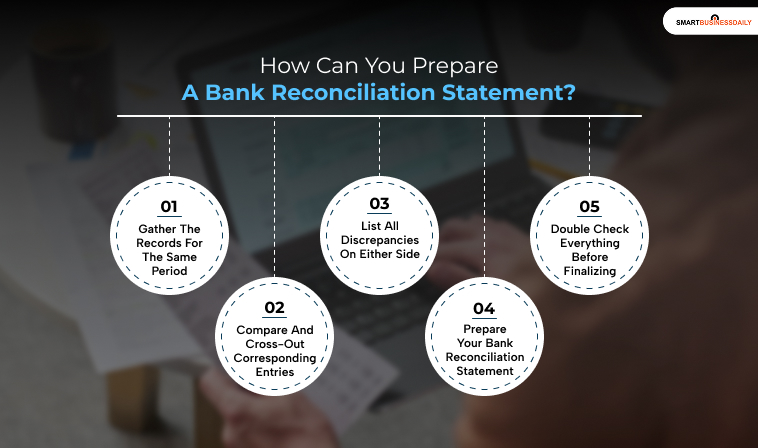
Creating a Bank Reconciliation Statement begins with the two sets of information that have slight discrepancies – the company’s internal books and the bank’s ledger.
When you get started, you may use either accounting software or Excel – the process remains similar.
It always boils down to one simple thing – organisation. In the end, all mismatches stem from deposits or payments that haven’t been processed yet or simply don’t match.
Let’s review the five simple steps for preparing a bank reconciliation statement.
Step 1: Gather The Records For The Same Period
Before you start, collect the relevant information.
For this step, you will need the cash book/general ledger and the bank statement for the same period (usually a month).
Pro tip: You can sync accounting software with your bank to simplify the process.
Always double-check that you are using the same period for both sets of data. If you miss this step, you will waste a lot of time trying to reconcile differences that should not be there.
The cash book needs to have all the latest transactions recorded before you proceed.
Step 2: Compare And Cross-Out Corresponding Entries
Now, go through the entries in your cash book. For each one, try to find a matching entry in the bank statement. If you find one, cross out the corresponding entry in the bank ledger️.
These entries do not require any action since both sets of books recognise them.
Some of the things you would typically find on your cash book that should match the bank statement include:
- Payments from customers
- Payments to suppliers
- Deposits that you have made to the bank
- The bank’s fees or interest
Step 3: List All Discrepancies On Either Side
For this step, you need to focus on entries that you could not cross out.
Discrepancies fall into two categories: the ones in your cash book and the ones on your bank statement. To keep track of them, you can make two separate lists.
The items that only appear on your cash book (and not the bank statement) usually include:
- Cheques that you have written, but the payees have not cashed.
- Deposits that you have made at the end of the month that the bank has yet to process.
The items that only appear on your bank statement (and not your cash book) include:
- Bank fees that you were not aware of
- Direct deposits from your customers
- Any type of automatic loan or EMI payments
Make sure you sort out items that legitimately appear in only one set of books from processing errors.
Step 4: Prepare Your Bank Reconciliation Statement
Now prepare the bank reconciliation statement. You can use either the adjusted cash book balance or the adjusted bank statement balance.
Start with the cash book balance. Then add any items the bank has received, but you have not recorded.
Subtract any payments that you have recorded, but the bank has not processed.
Once you have found this number, it should equal the adjusted bank statement balance.
Alternatively, you can start with the bank balance and then add/subtract the same numbers to get the adjusted cash book balance.
Step 5: Double Check Everything Before Finalizing
Finalise your reconciliation statement only when the adjusted balances match. Save the document as it will be part of your audit trail.
If your final balances do not match, you may have missed an entry or accidentally recorded something twice.
If the sheet shows equal balances, always double-check any additional entries you might have missed.
Even if you get equal balances, always review outstanding items to ensure that none of them should be on either book’s ledger.
You May Also Love To Read: How Is Gusto Payroll As A Service? – Let’s Find Out | Review, Pros & Cons, And Pricing
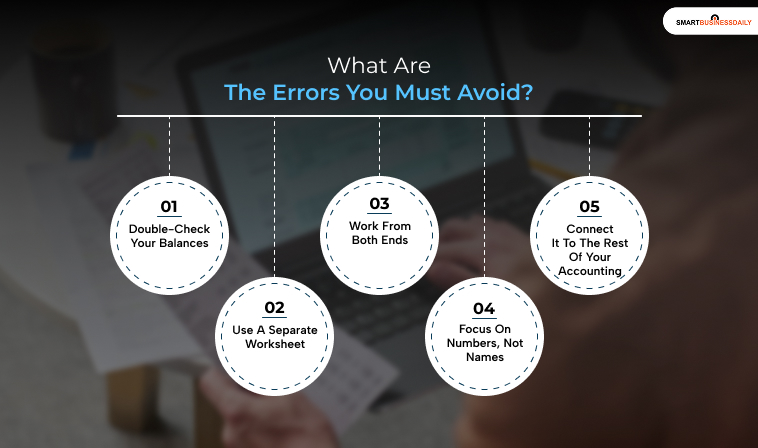
What Are The Errors You Must Avoid?
Think about how easy it seems to match your records. Now imagine that you are digging through 90 items to find a lost $1000 mistake.
Use the following helpful reconciliation tips to make it less likely that you will make a mistake when creating your Bank Reconciliation Statement or to recover your sanity if you already did.
The following time-saving advice should resolve the most common issues and get you back in the game faster:
1. Double-Check Your Balances
Make sure that the beginning balances are correct for both your records and the bank’s. A wrong number will trickle down and waste your time if last month’s ending balance was incorrectly saved.
2. Use A Separate Worksheet
To track your findings, use a separate tab or sheet for items that haven’t been matched.
It also keeps you from accidentally deleting or changing an important number in your accounting software
3. Work From Both Ends
Instead of only using your own books for reference, try working backwards from the bank’s numbers as well.
It is much easier to find a missing bank charge or extra deposit that way
4. Focus On Numbers, Not Names
Bank descriptions are notoriously unhelpful. For instance, a cheque may say “Vendor Payment” in your software, but it may be labelled simply “CHQ-8475” in the bank.
Always focus on numbers, dates, and reference codes instead of names when matching items.
5. Connect It To The Rest Of Your Accounting
Now that your Bank Reconciliation Statement is done correctly, make sure to connect it to the rest of your accounting software if you have not already. A good program will let you sync your reconciled data to your cash flow reports so your next audit is much easier.




Related Articles