






Stop Wasting Money On The Wrong Stock: The 3-Step VED Analysis Trick That Saves Crashing Businesses!
22 August 2026
7 Mins Read
- What Is VED Analysis?
- The Three Categories
- Why Should You Care?
- VED Classification Of Inventory
- Four Easy Steps To Grade Your Stock
- · Its Real Job (Function)
- · How Easy It Is To Buy (Availability)
- · The Wait Time (Lead Time)
- · Backup Options (Substitutability)
- The Quick VED Cheat Sheet
- The Combination Of VED Analysis And ABC Analysis
- The Top Benefits Of Using The ABC-VED Matrix
- · Flawless Resource Prioritization
- · Perfected Stock Levels
- · Total Cost Control
- · Zero-Risk Operations
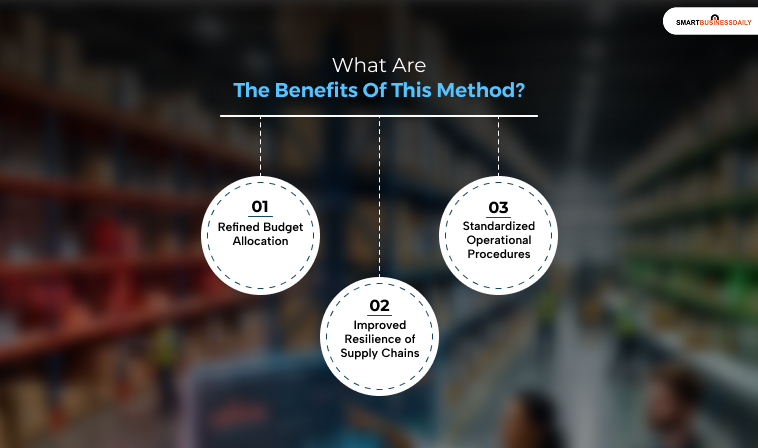
- What Are The Benefits Of This Method?
- Refined Budget Allocation
- Improved Resilience Of Supply Chains
- Standardized Operational Procedures
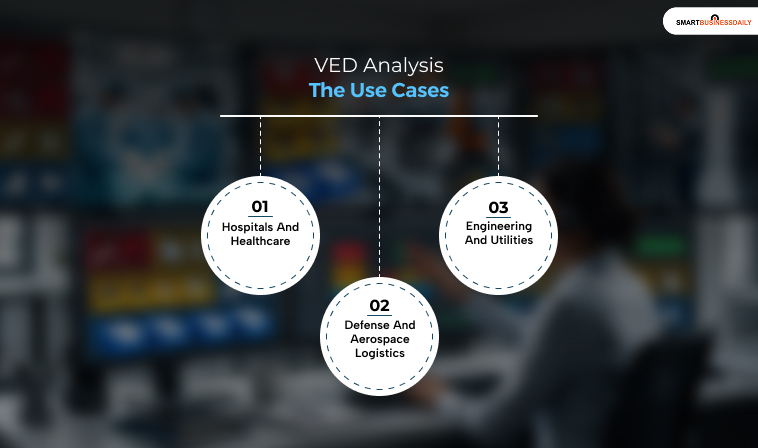
- VED Analysis: The Use Cases
- Hospitals And Healthcare
- Defense And Aerospace Logistics
- Engineering And Utilities
You always have to manage your inventory properly if you are trying to run a successful business. And there is one tool that can help you with that! The VED analysis.
This clever method helps you prioritise items based on their daily importance to your operations, not just their cost or how much you use them!
In this blog, we will explain exactly what VED Analysis is, why it is so important, and how you can use it right away to improve your inventory management.
Whether you run a busy warehouse or a small retail store, this guide will give you clear, practical steps to protect your production and keep your business running smoothly without any sudden breakdowns. Let’s dive in!
What Is VED Analysis?
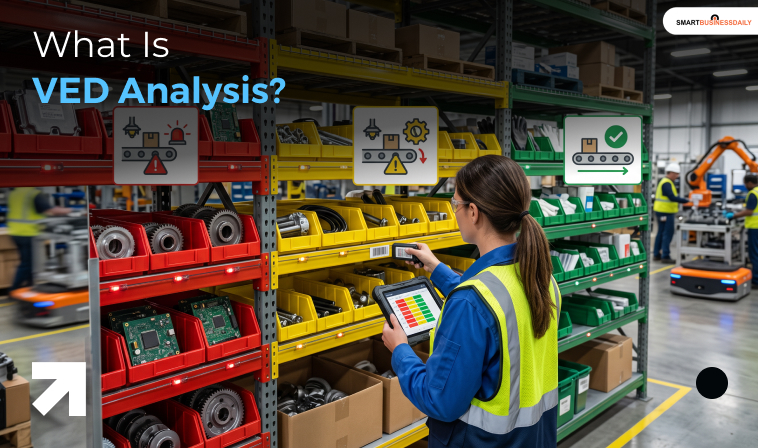
VED Analysis is an inventory management technique. It classifies items into three categories based on their operational importance and the critical nature of their availability.
Unlike ABC analysis, which ranks items by monetary value, VED focuses strictly on the impact that a stockout would have on production or services.
The Three Categories
VED Analysis divides your inventory into three easy groups, to make things simple:
- Vital (V): These are your absolute must-haves. For instance, if you run out of raw materials or motors, your whole business grinds to a sudden halt.
- Essential (E): These items are very important, but you can survive without them for a tiny bit. However, if you don’t restock items like safety gear or spare parts soon, you will definitely face trouble.
- Desirable (D): These are just nice to have around. For example, missing an office coffee machine or promotional items won’t hurt your daily work at all.
Why Should You Care?
Ultimately, VED analysis gives you total control over your stock! Firstly, it helps you to avoid terrifying stockouts of your critical items.
Not only that! It also saves you money because you won’t overspend on less important goods.
You can keep your business running smoothly every single day by knowing exactly where to focus your energy.
VED Classification Of Inventory
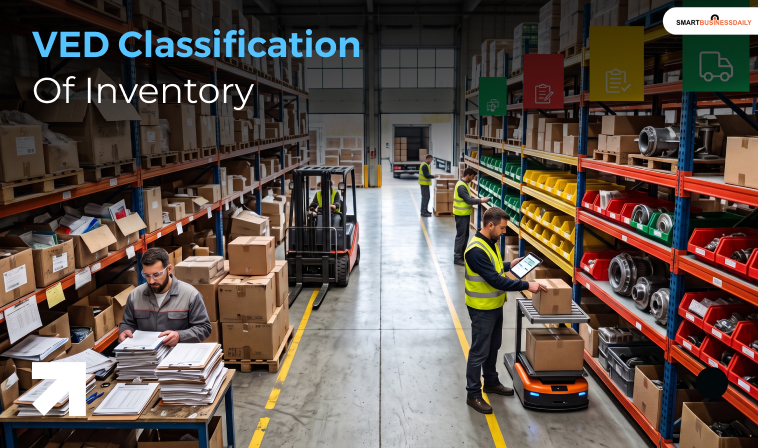
You need a smart system to manage piled-up inventory reports. If you don’t use VED analysis, it can be hard to avoid wasting a huge chunk of your budget on non-critical items.
Meanwhile, your truly vital stock runs dangerously low!
By grouping items by how much they matter to daily operations, your team can make sharper decisions.
Moreover, you will know exactly what must always be on the shelves, what can wait for a few days, and what should never clutter your valuable warehouse space.
Four Easy Steps To Grade Your Stock
Now, you just need to look at four simple factors for every item to set up your VED analysis like a pro:
· Its Real Job (Function)
Ask yourself, what happens if this item disappears? For example, an anesthesia machine in a hospital is vital to save lives, but an office printer is not.
· How Easy It Is To Buy (Availability)
Can you grab this item from a local shop down the road, or do you have to wait for a special delivery from overseas?
· The Wait Time (Lead Time)
You need to consider how long it takes for a new order to arrive at your door. Items that take months to ship need a lot more care and caution.
· Backup Options (Substitutability)
Can you easily swap the item for a different brand if you run out? If a quick substitute is available, your risk is much lower.
The Quick VED Cheat Sheet
To help your team visualise this, you can map your items using a simple guide. Here is how a basic VED Analysis matrix looks in action:
| Group | What Happens if It Runs Out? | Is It Easy to Find? | How Long to Arrive? | Can You Swap It? |
| Vital | Everything stops completely | Very Hard | Long wait time | No way |
| Essential | Efficiency drops badly | Medium | Moderate wait time | Maybe |
| Desirable | Minor, tiny impact | Very Easy | Short wait time | Super easy |
Ultimately, keeping this simple matrix handy will save your team hours of stressful guessing when ordering new stock!
Related Article For You: Last Mile Delivery: The Final 50 Feet That Make or Break Your Business.
The Combination Of VED Analysis And ABC Analysis
What happens when you mix financial smarts with operational survival? You get an absolute superpower for your warehouse!
You create a master strategy known as the ABC-VED Matrix by combining ABC analysis with VED Analysis.
The ABC analysis looks at how much items cost, and the VED analysis looks at how urgently you need them.
This combined approach gives you a complete, three-dimensional view of your stock, instead of looking at your inventory from just one angle.
It ensures you manage your business using both your wallet and your operational logic at the exact same time.
You May Also Love To Read: The Real Advantages And Disadvantages Of E-Commerce
The Top Benefits Of Using The ABC-VED Matrix
When you bring these two systems together, your business unlocks some massive advantages:
· Flawless Resource Prioritization
You can easily spot your “A” and “V” items. These are the high-value, highly critical items that deserve your absolute maximum attention and tightest budget focus.
· Perfected Stock Levels
This mix beautifully balances your bank account with your daily operational needs.
As a result, it stops you from overstocking useless items or running dangerously low on crucial components.
· Total Cost Control
There are businesses that spend too much money tracking expensive items that your business does not actually need to survive.
This matrix prevents you from over-prioritizing high-cost but non-essential goods.
· Zero-Risk Operations
You can safeguard your supply chain by highlighting the items that are both highly expensive and operationally vital.
This also keeps your production line safe from sudden, unpredictable shutdowns.
What Are The Benefits Of This Method?
When aligned with the criticality of day-to-day operations, inventory classifications help managers make fewer mistakes when deciding in real time.
In turn, businesses benefit from improved bottom-line performance while remaining prepared for supply chain disruptions and operational downtime.
Refined Budget Allocation
To begin with, this classification method ensures that the purchasing department spends the money wisely, basing all expenditures on objective criteria.
This way, the firm avoids wasteful spending on non-critical inventory that does not serve essential functions.
The purchasing budget is prioritized according to actual risk levels.
This achieves an overall balance between customer-centric spending and cost-efficient approaches.
Improved Resilience Of Supply Chains
Furthermore, prioritizing inventory items by importance helps build more resilient supply chains.
Thus, critical and very important items are safeguarded by maintaining sufficient safety stock in the warehouse.
Combined with inventory management software, VED analysis ensures that the most critical supplies are closely monitored.
It also supports more flexible purchasing cycles for essential items, helping the firm prepare for disruptions at any level of the supply chain.
Standardized Operational Procedures
Lastly, this three-tier inventory classification model promotes standardized policies regarding reordering intervals and regular stock checks.
For instance, you can set the interval between consecutive warehouse visits for each inventory category.
Also Check: Stop Overpaying Suppliers: The Power Of The GRN Full Form And 3-Way Matching
VED Analysis: The Use Cases
The main advantage of VED analysis is its flexibility, which allows it to be applied to almost all industries.
It is especially useful in fields where a stock-out of a particular item reported as vital may cause severe disruptions to work.
Grouping items as described in the VED analysis helps ensure the uninterrupted function of the most critical processes.
Below are some examples of different industries using the principles of the VED analysis for effective inventory management and avoiding shortfalls of essential supplies.
Hospitals And Healthcare
In healthcare institutions, inventory management is an essential part of the work since the inability to provide the necessary medical treatment may result in the death of a patient.
As a result, healthcare facilities use the VED analysis to ensure that they are not lacking in any of the vital medical supplies
Vital: Life-supporting machines, medicines that cannot be dispensed with, and other critical supplies should always be available.
Essential: Medical equipment and various consumables that are of extreme importance but have a lower probability of failure.
Desirable: Non-critical medical supplies that may be purchased only when there is an opportunity.
Defense And Aerospace Logistics
In aerospace and defense, equipment must be constantly available for use.
Consequently, VED analysis is vital to ensure a stock of supplies that allows minimal disruption to the work process.
Vital: Aircraft spares and other equipment, for which it is impossible to stop using in case of failure and continue working on other means in the meantime.
Such items are kept in high stock to ensure that, no matter what disruptions to the supply chain occur, supplies will still be available.
Essential: Tools and equipment necessary for the functioning of aircraft and other defense equipment. If they are completely depleted, the work process will be interrupted, but it will still be possible to continue performing some tasks.
Desirable: Comfortable clothing, field equipment, and other supplies that can be dispensed with in case of an immediate need for other materials
Engineering And Utilities
In large-scale engineering and utility companies, the continuous functioning of generators and other heavy equipment is vital.
As a consequence, the inventory management system in such companies utilizes the VED analysis to ensure that, in case of a malfunction of a particular machine, there will still be other units available for use
Vital: Large-scale equipment, for which there is no alternative, requires careful planning, as its failure will bring all operations to a halt.
For this reason, such equipment is controlled more closely than other assets. Its malfunction should be impossible to occur, and in case it happens, there must still be spares available
Essential: Various mechanical spares and tools essential to maintaining the continuous functioning of the equipment, ensuring the uninterrupted workflow of the facility.
If their stocks are depleted, it will only result in delays, but the work will still be possible to continue
Desirable: Tools necessary for light maintenance and cleaning of equipment are kept in low stock, which reduces total inventory and frees up space and money for more valuable supplies.




Related Articles