








How To Apply For A Small Business Loan
7 Mins Read
Published on: 04 November 2022
Last Updated on: 02 September 2026

- What To Consider Before Applying For A Small Business Loan
- 1. Understand How Much You Can Afford To Borrow:
- 2. Choose The Right Type Of Financing:
- 3. Review Your Credit And Financial Position:
- 4. Compare The Total Cost Of Borrowing:
- 5. Check The Lender's Requirements:
- How To Apply For A Small Business Loan?
- 1. Determine Why You Need The Loan And How Much You Need:
- 2. Compare Small Business Lenders And Loan Options:
- About Eligibility Requirements:
- 3. Check The Lender's Eligibility Requirements:
- 4. Prepare Your Documents:
- 5. Review The Application Before Submitting It
- 6. Submit Your Application:
- What Happens If Your Loan Application Is Rejected?
Running a small business often requires spending money before you can see the return. You may need financing to purchase equipment, hire employees, manage cash flow, expand your operations, or cover other business expenses.
A small business loan can provide the funds you need, but getting approved isn’t automatic. Why? Because lenders evaluate your business finances, credit history, revenue, time in business, and ability to repay the debt.
Also, the application process varies depending on the lender and type of financing you choose. Plus, understanding what lenders look for can help you prepare a stronger application and avoid unnecessary delays.
On that note, today we will breakdown how to apply for a small business loan, and touch upon what happens in case your loan is rejected.
Stay tuned.
What To Consider Before Applying For A Small Business Loan
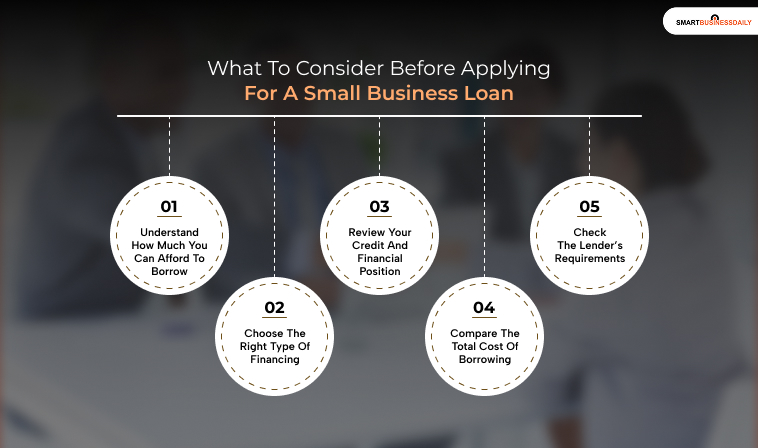
Before submitting a loan application, take some time to assess whether the financing is right for your business. A lender will typically look at factors such as your ability to repay, credit history, financial position, and the loan’s purpose.
Also, note that requirements vary by lender and type of financing.
As a result, here are five essential factors that you need to consider before finding out how to apply for a small business loan in 2026.
1. Understand How Much You Can Afford To Borrow:
Start by reviewing your business’s revenue, expenses, existing debt, and cash flow. Your goal should be to borrow an amount that supports your business without creating repayment obligations that strain your finances.
Consider how the expected loan payments will fit into your regular operating expenses and whether your business can continue making those payments if revenue temporarily falls.
2. Choose The Right Type Of Financing:
The best financing option depends on what you intend to do with the money.
A term loan may work for a major investment or expansion, while a business line of credit may be more appropriate for ongoing or short-term working-capital needs. Equipment financing can be useful when the funds are specifically needed to purchase equipment.
Don’t choose a loan simply because it offers the largest amount of funding. Choose financing that matches your business need and repayment capacity.
3. Review Your Credit And Financial Position:
Before applying, review your personal and business credit where applicable. Also look at your recent financial statements, bank activity, existing debts, and cash flow.
Identifying weaknesses before applying gives you an opportunity to address errors or prepare an explanation for anything a lender may question.
Lenders can also use financial information and credit history to assess whether your business is likely to repay the financing.
4. Compare The Total Cost Of Borrowing:
Don’t compare loans based only on the advertised interest rate. Look at the APR, fees, repayment period, payment amount, collateral requirements, personal guarantees, and other terms.
A loan with a lower advertised rate may not be the cheapest option once fees and other costs are included. Comparing several offers can help you understand the true cost of borrowing.
5. Check The Lender’s Requirements:
Every lender has its own eligibility criteria and documentation requirements. Some may require a minimum time in business or revenue level, while others may have different standards for credit history and collateral.
Review these requirements before applying. This can help you focus on lenders that are a realistic fit for your business and reduce unnecessary applications.
Once you’ve confirmed that the financing fits your needs and your business is prepared to apply, you can begin the application process.
How To Apply For A Small Business Loan?

In this section, we will jump straight to the loan application process. On that note, here’s how to apply for a small business loan in 2026.
1. Determine Why You Need The Loan And How Much You Need:
Before contacting a lender, determine exactly why your business needs financing.
Your reason for borrowing can help you identify the most suitable type of financing. For example, you might need a term loan for a major investment, equipment financing to purchase machinery, or a line of credit to manage short-term cash-flow needs.
You should also calculate how much you actually need to borrow.
In addition, avoid requesting significantly more money than necessary. Borrowing more increases your repayment obligations and the total cost of the loan.
At the same time, don’t underestimate your financing needs. If the money will be used for a specific project, prepare a realistic estimate of the associated costs.
You should also consider how the loan payments will fit into your business’s cash flow. A lender will want evidence that your business has sufficient financial capacity to meet its repayment obligations.
2. Compare Small Business Lenders And Loan Options:

Not every lender or loan product will be suitable for your business. Depending on your circumstances, you may be able to borrow from a traditional bank, credit union, online lender, or another financing provider.
Don’t choose a lender based solely on the advertised interest rate. Also, when comparing offers, look at:
- Total cost of borrowing
- Annual percentage rate (APR)
- Interest rate
- Origination and other fees
- Repayment period
- Monthly or other payment amounts
- Collateral requirements
- Personal guarantee requirements
- Prepayment penalties
- Funding time
About Eligibility Requirements:
Eligibility requirements can also vary considerably. Some lenders may place more weight on business credit, while others may review the owner’s personal credit history as well.
Moreover, traditional lenders may have stricter requirements regarding creditworthiness, time in business, revenue, and financial documentation. Some online lenders may have different eligibility criteria or faster application processes, but their financing can also cost more.
Don’t assume that a faster or easier application is a better deal. Compare the total cost and terms before making a decision.
Also, if you already have a relationship with a bank or credit union, you can also ask whether it offers financing for your business.
A previous relationship may make it easier for the lender to access certain information about your accounts, but it does not guarantee approval or better terms.
3. Check The Lender’s Eligibility Requirements:

Before completing a full application, review the lender’s basic requirements. These may include:
- Minimum time in business
- Minimum annual revenue
- Business and personal credit history
- Minimum credit score
- Industry or business-type restrictions
- Required financial documents
- Collateral requirements
- Personal guarantee requirements
Also, checking these requirements first can save time and help you avoid applying for financing you’re unlikely to qualify for.
As a result, if you’re comparing multiple lenders, create a shortlist based on your actual circumstances rather than applying indiscriminately.
4. Prepare Your Documents:
Once you’ve identified a suitable lender, gather the documents needed for the application. The exact requirements vary, but a lender may ask for information such as:
- Information about available collateral
- Legal business name and address
- Business licenses
- Tax identification information
- Business formation documents
- Business plan or loan proposal
- Recent business bank statements
- Income statements and balance sheets
- Business and personal tax returns
- Accounts receivable or other financial records
- Information about business owners
- Details of existing debts
A business plan may be particularly useful when you’re borrowing to launch, expand, or make a significant investment. Moreover, it should clearly explain how you intend to use the funds and how the investment could support the business.
Keep your financial information accurate and consistent across your documents. Why? Because discrepancies can lead to additional questions and delay the underwriting process.
5. Review The Application Before Submitting It
Once you’ve completed the application, review every detail carefully. Check your business name, address, tax information, revenue figures, outstanding debts, ownership information, and requested loan amount.
Moreover, you have to make sure your financial statements and supporting documents are complete and up to date.
An error doesn’t necessarily mean that a lender will reject your application, but incomplete or inconsistent information can lead to delays or additional documentation requests.
Taking a few extra minutes to review the application can prevent avoidable problems later.
6. Submit Your Application:
After reviewing your application and gathering the required documentation, submit it through the lender’s approved application process.
Also, depending on the lender, you may be able to apply online, in person, or through another application channel. After submission, the lender may:
- Approve, decline, or modify the financing offer.
- Verify the information you provided.
- Review your business and personal credit history where applicable.
- Analyse your financial statements and cash flow.
- Request additional documents.
- Evaluate collateral or guarantees if required.
- Underwrite the application.
The time required varies considerably. Some lenders can provide decisions quickly, while more complex applications may take longer.
If the lender approves your application, don’t stop at the approval notice. Instead, review the final loan agreement carefully before accepting it.
Also, make sure you understand the interest rate, fees, repayment schedule, collateral requirements, personal guarantees, and other obligations.
What Happens If Your Loan Application Is Rejected?
Knowing how to apply for a small business loan is great. But what if your loan is rejected? A rejected application doesn’t necessarily mean that your business cannot obtain financing.
First, find out whether the lender provides a reason for the decision. You may need to improve your credit profile, increase revenue, reduce existing debt, provide additional documentation, or wait until your business has a longer operating history.
You can also compare other financing options, but avoid accepting expensive financing simply because it is easier to obtain.
The goal isn’t just to get approved. Instead, it’s to find financing that your business can realistically afford to repay.
Additionals:




Related Articles



Comments Are Closed For This Article