







Safety Stock Formula For US Small Businesses: What It Is, How To Calculate It
27 May 2026
7 Mins Read
- What Is Safety Stock?
- Demand Uncertainty
- Lead Time Uncertainty
- How To Calculate The Safety Stock Formula?
- Example Calculation
- Factors That Affect How Much Buffer You Need?
- Demand Swings.
- Supplier Reliability.
- Product Shelf Life.
- How Much Does A Stockout Actually Cost You?
- The Service Level Method That Gives You More Precision
- A Real Small Business Story: Proper Preparation Pays Off
- What About Shipping Realities?
- Common Mistakes Small Businesses Make
- Setting It Once And Forgetting It.
- Using The Same Formula For Every Sku.
- Ignoring Outliers Without Thinking About Why They Happened.
- Carrying Too Much Buffer.
- How The Safety Stock Formula Works Best For Small Businesses.
On this website, I talk about multiple small-scale entrepreneurs to highlight niche problems that small business owners face. This is also a similar story.
It’s about a hardware store in Ohio, run by one of my friends from my grad school. Last winter, he ran out of pipe insulation right when a cold snap hit.
As a result, He had three customers walk out in one day. He knew demand could spike. But he just had no buffer. That empty shelf cost him more than a lost sale. It cost him his repeat customers.
That’s what happens without safety stock. So, it is obvious that you have to manage your inventory based on the safety stock formula.
What Is Safety Stock?

Safety stock, sometimes called buffer stock, is the extra inventory you keep on hand to protect your business against surprises.
We all know demand suddenly jumps. After all, small businesses don’t have the dedicated team or tools to predict demand. Not just demand; other contingencies can also hit you at any time.
For instance, a supplier ships late. Or a truck gets stuck at a distribution hub. These things happen constantly in real supply chains.
According to a 2026 study by Total Retail, stockouts cost US retailers an estimated $82 billion to $ 350 annually.
For small businesses, a single stockout can wipe out a week’s worth of customer trust. But beyond that, the business will also lose many repeat customers. To sum up, you need a buffer stock.
Buffer stock isn’t about hoarding inventory. Instead, it’s about covering the gap between what you expected and what actually happened.
Two things cause that gap: demand uncertainty and lead time uncertainty.
Demand Uncertainty
Demand uncertainty is when your customers buy more (or less) than you predicted. An umbrella seller has wild demand swings. A toilet paper seller, not so much.
Lead Time Uncertainty
Lead time uncertainty occurs when your supplier takes longer than expected.
Things like a shipment stuck at a last mile sorting and distribution center, a customs delay, or a port backup push your actual arrival date past your planned one.
How To Calculate The Safety Stock Formula?
The most widely used method to calculate the safety stock formula, and the best starting point for most small businesses, is the Average-Max method:
Safety Stock = (Max Daily Usage × Max Lead Time) − (Avg Daily Usage × Avg Lead Time)
Here’s what each number means:
- Max Daily Usage, the highest number of units you’ve sold in a single day
- Max Lead Time, the longest it’s ever taken your supplier to deliver
- Average Daily Usage, your typical daily sales, averaged over time
- Average Lead Time, how long deliveries normally take
This formula asks: what’s the worst-case scenario, and how far is that from normal? That gap is your buffer.
Example Calculation
Say you sell phone cases online. Here’s your data:
| Variable | Value |
| Max daily usage | 80 units |
| Max lead time | 18 days |
| Average daily usage | 50 units |
| Average lead time | 12 days |
Safety Stock = (80 × 18) − (50 × 12) = 1,440 − 600 = 840 units
You should keep 840 units as a buffer. That might sound like a lot. But if your supplier suddenly takes three extra weeks, you won’t face a backorder situation where customers are waiting on items that aren’t even in stock yet.
Speaking of which, you must know what is a backorder? It’s when a customer places an order for a product you don’t have available right now.
It’s better than losing the sale entirely, but it damages trust. Repeat customers notice it if you are constantly taking in backorders from your site. In other words, safety stock is how you avoid getting there.
Factors That Affect How Much Buffer You Need?
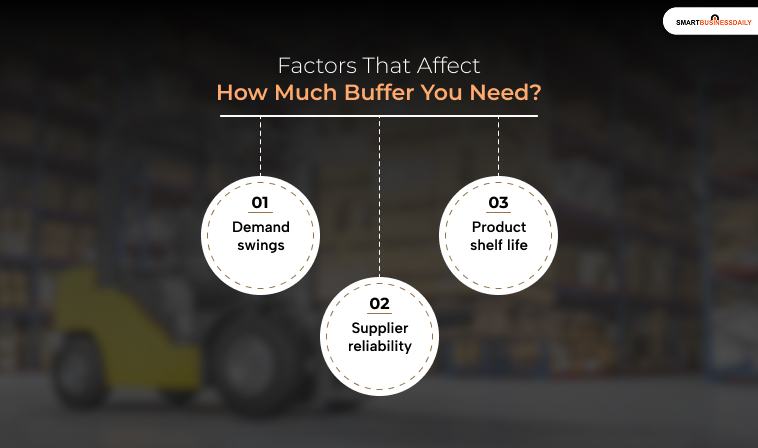
Not every product needs the same cushion. So, here are a few things to weigh:
Demand Swings.
A candle brand in Austin saw sales triple during the 2021 winter storm. They had no buffer. Within 48 hours, they were backordered on their top five SKUs.
Buffer stock, even in modest amounts, would have allowed them to meet the surge on time.
Supplier Reliability.
If your vendor ships from overseas, lead time can vary significantly. In the same vein, factors like shipping lanes, customs holds, and last mile delivery hiccups add variability you can’t always predict.
Product Shelf Life.
Perishable goods need tighter management. You can’t just pile up a buffer stock of fresh flowers or specialty food items.
For these, you calculate a smaller buffer and reorder more frequently.
How Much Does A Stockout Actually Cost You?
If you sell a commodity item that people can buy anywhere, losing a sale to a competitor is painful. If you sell something unique, customers might wait. But you must remember that they won’t wait long.
The Service Level Method That Gives You More Precision
Once your business grows past the guesswork stage, this safety stock formula gives you more control:
Safety Stock = Z × σ(demand) × √Lead Time
Where:
- Z is your service level factor (how often you want to avoid a stockout)
- σ(demand) is the standard deviation of your daily demand
- √Lead Time accounts for variability over the replenishment period
Here’s a quick reference table for the Z value based on how often you want to be in stock:
| Service Level Target | Z-Score |
| 90% | 1.28 |
| 95% | 1.65 |
| 98% | 2.05 |
| 99% | 2.33 |
A 95% service level means you’ll have the product available 95% of the time a customer wants it. Most small businesses in the US aim for 90–95%. Beyond that, the inventory costs start climbing fast. If you feel like, you can create a backorder contingency for the rest 5%.
A Real Small Business Story: Proper Preparation Pays Off
Thrive Market, which started as a small online health food retailer, built early systems around safety stock before they scaled. By calculating buffer levels per SKU based on supplier lead time variability, they reportedly cut stockout rates significantly in their growth phase.
Their founders have spoken publicly about how inventory discipline was core to customer retention early on. So, now you know that marketing is not everything.
You don’t need Thrive Market’s budget to think like this. A basic spreadsheet with your daily sales history and supplier lead times is enough to run the formula above. Comment below if you still have any doubts.
What About Shipping Realities?
Here’s something the textbook formulas don’t fully address: your lead time isn’t just your supplier’s production time. It includes every step from the product’s creation to its delivery to your hands.
For online sellers, this includes last mile delivery. On that note, remember the last mile is the final leg from a regional hub to your door or your customer’s door. According to research, the last mile accounts for 53% of your entire logistics cycle cost.
As a result, last mile delivery optimization has become a major focus for logistics companies. Because it’s where most delays and costs pile up.
If your supplier uses a carrier with inconsistent last mile performance, that variability should be factored into your max lead time number.
Some small business owners use services like Sendle USA for domestic shipping, especially for smaller parcels. In the same vein, you must remember that consistent carrier performance directly affects the accuracy of your replenishment cycle forecasts.
Delivery speed also matters from the customer side. If you’re competing on fulfillment, you can compare your fulfillment speed with how long does Amazon take to deliver in your category. In other words, that tells you the benchmark customers are comparing you against. Moreover, it tells you how much of a stockout penalty you’ll pay if you fall short.
You May Also Check: Delivery Attempt Failed: What It Really Costs Small Businesses
Common Mistakes Small Businesses Make
Setting It Once And Forgetting It.
Small businesses face a whole range of contingencies. For example, demand patterns change. Often, suppliers change as well.
So, revisit your buffer numbers at least every quarter. Do that more often if you’re growing fast or in a seasonal business.
Using The Same Formula For Every Sku.
Your bestseller and your slowest mover don’t need the same treatment. High-velocity products with unpredictable demand need more buffer. On the other hand, the slow movers with stable demand need less.
Ignoring Outliers Without Thinking About Why They Happened.
If a supplier was delayed once due to a hurricane, that’s not a reason to permanently inflate your max lead time. But if they’re consistently late, you must consider that max number as constant.
Carrying Too Much Buffer.
Safety stock is not free. Holding costs like storage, insurance, and tied-up cash keep adding up.
In the same vein, you must remember that the goal isn’t maximum safety; it’s the right level of safety for your service targets and your margins.
How The Safety Stock Formula Works Best For Small Businesses.
The safety stock formula isn’t complicated. It’s simple math applied to real data you probably already have.
What makes it powerful is the discipline to actually use it. Simply put, you have to pull your sales history, track your supplier lead times, and set buffer levels before you run out.
My grad friend with the hardware store now keeps a rolling 90-day sales average in a spreadsheet and tracks every supplier delivery date. In addition, he recalculates his buffer stock at the start of each season.
Most importantly, he hasn’t had a critical stockout since.
That’s not an example of sophisticated inventory software. He was just paying proper attention to every aspect of his business.
Start with the basic formula. Use your actual data. Adjust as you learn.




Related Articles

Comments Are Closed For This Article