








Why AI Route Optimization Is No Longer Just For The Big Guys?
19 May 2026
8 Mins Read
- What Does AI Route Optimization Actually Do?
- Where Should I Include AI Route Optimization First?
- The Real Problem Nobody Talks About
- My Real Life Experience
- How Big Players Manage Deliveries Seamlessly?
- What Smaller Operations Actually Need To Know?
- Start With Your Inventory Posture
- On The Shipping Side
- Is AI Route Optimization Actually Helping Small Businesses?
- AI Route Optimization Challenges For Small Businesses
- A Quick Solve Guide For Small Businesses
- AI Route Optimization And The Broader Delivery Ecosystem
- Why AI Route Optimization Isn’t Optional Anymore
My neighbor runs a small flower delivery business out of Queens. So her setup just has three drivers, a beat-up cargo van, and a spreadsheet she inherited from the previous owner.
Last Valentine’s Day, she had 140 deliveries to make across four boroughs. She planned the routes herself the night before. But it took her almost two hours.
So, what was the result? Three stops had the wrong address sequence. One driver crossed the same bridge twice. To sum up, she lost around $200 in fuel and overtime.
But there were no dramatic disasters. So, what made her lose? Just the quiet, grinding cost of poor routing that small businesses bear every single day.
That’s what AI route optimization is actually about. It is not some futuristic logistics platform. In simpler words, it’s the difference between your driver crossing a bridge twice or not.
What Does AI Route Optimization Actually Do?
| · Finds the most efficient delivery route for you in real time
· Seamlessly adjusts route based on traffic, blockages, and priority · Learns from previous deliveries to manage orders faster and more safely |
At its core, it’s software that figures out the most efficient path for multiple deliveries. But it can address several factors simultaneously to ensure the mapping is error-free.
For example, AI route optimization considers traffic, time windows, driver hours, package priority, and real-time road conditions. Older routing tools did this, too. But they were static. In other words, you’d input the stops, get a fixed route, and hope for the best.
However, AI-based systems adjust on the fly. A road closure at 11 AM automatically reshuffles the entire afternoon schedule. In the same vein, a driver running late triggers a reassignment to the closest available vehicle.
So, that creates a pattern. Again, the AI system learns from patterns. For instance, patterns like which zones are slow on Fridays. Or which customers tend to be home in the mornings.
Where Should I Include AI Route Optimization First?
For businesses dealing with last mile delivery, this matters enormously. The last mile accounts for over 53% of total shipping costs, according to a Business Insider Intelligence report.
It is that final stretch from a distribution hub to the customer’s door. Simply put, it’s where the money bleeds out, slowly, stop by stop.
The Real Problem Nobody Talks About
Here’s what I’ve seen happen repeatedly. A small ecommerce seller starts shipping maybe 30 orders a day. Simply put, the seller’s manual routing works fine.
Then they hit 80, 100, and then 150 orders. Suddenly, the spreadsheet does not work anymore.
As a result, deliveries pile up at the last mile sorting and distribution center. Consequently, customers start complaining, and the seller scrambles for a quick fix.
My Real Life Experience
I know one such seller, Carol, firsthand. She sells handmade ceramics. Fathoming a higher demand, Carol switched to a local courier that used AI routing.
Her experience with the earlier delivery was not good. During two back-to-back weeks, customers reported “delivery attempt failed” notices on packages.
But she found out that the packages were never actually delivered. The driver had simply run out of time. Inefficient routing meant 12 stops got skipped on a Tuesday.
So, what actually changed after the switch?
After switching, her on-time rate jumped from around 84% to 97% within six weeks. Most importantly, the driver made no such errors this time. You can call this a successful story of last mile delivery optimization.
When you link AI to ecommerce tracking, it simply results in happier customers. Are you also planning to make a switch?
How Big Players Manage Deliveries Seamlessly?
A lot of micro-e-commerce companies don’t realize how the big players manage their delivery so flawlessly. Or how does same day delivery work for them?
Let me tell you, it is just a case of better routing intelligence. Amazon, for example, uses AI to pre-position inventory at micro fulfillment centers that are close to dense zip codes.
After that, Amazon routes same-day drivers based on live order data. So, How long does Amazon take to deliver on same-day orders?
In eligible zones, it is often under 4 hours. And that’s routing AI doing the job for you. It is no longer just warehousing.
Related Resource: When Does Amazon Stop Delivering? A Complete Guide To Amazon Delivery Hours
What Smaller Operations Actually Need To Know?
You don’t need to be Amazon. But you do need to think like a logistics operation, even if you’re small.
Start With Your Inventory Posture
AI routing only helps if your fulfillment side isn’t creating delays upstream. If you’re someone who doesn’t know what is a backorder, no routing system can fix that gap.
Well, backorders are items customers ordered that aren’t yet in stock. Meanwhile, the FIFO method (first in, first out) is still one of the most practical ways to manage perishable or time-sensitive stock.
Both are equally important to ensure your inventory is timely restocked and old stocks do not last long.
So, what is the best inventory posture? Pair the FIFO method with a basic safety stock formula to buffer against demand spikes. In other words, your AI route optimization will now work better with improved inventory support.
The other thing is a good ecommerce fulfillment structure. If you’re shipping from a single warehouse to customers across the country, AI routing helps, but only marginally.
For seamless delivery, consider distributing your inventory closer to demand clusters. Again, that is exactly what a micro fulfillment center model enables.
On The Shipping Side
If you’re a small operation that ships low volumes, you don’t necessarily need enterprise software.
Platforms like Sendle USA offer route-optimized, carbon-neutral delivery for small businesses with no minimum volumes. But before choosing a service, check whether it is still in operation. After all, it’s worth knowing your options before locking into a carrier contract.
For quick errands like mailing documents or sending small packages, people often wonder: can you buy stamps at UPS?
The answer is yes at most locations. Though if you’re shipping regularly, building a carrier relationship or using a multi-carrier platform makes more sense in the long term.
Is AI Route Optimization Actually Helping Small Businesses?
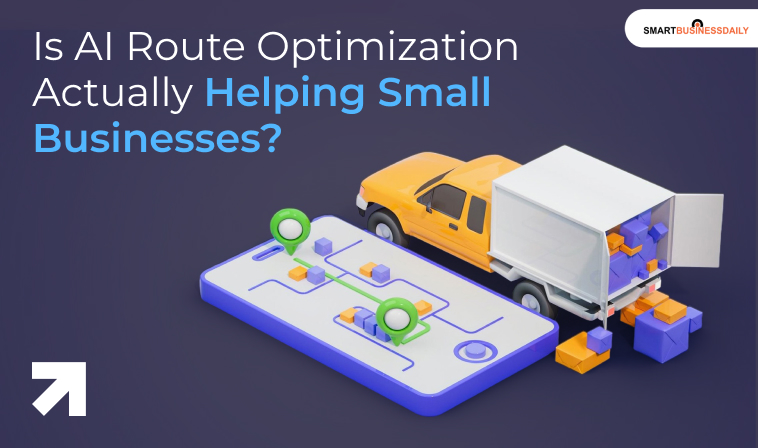
According to McKinsey, companies that have implemented AI in supply chain operations have seen logistics costs drop by 15% on average. A 2026 report from the American Transportation Research Institute found something interesting.
Routing inefficiencies cost the U.S. trucking industry 10-20% of fuel. The main problems remain idling, driver behavior, and suboptimal routes.
As a small business, every wasted mile your delivery driver runs costs real dollars.
AI Route Optimization Challenges For Small Businesses
AI route optimization is a simple technology. Atleast, it is user-friendly. However, small businesses need to tackle some customary challenges before they can switch to AI route optimization.
Cost is the first one. Most capable AI routing platforms charge in packages. That’s why only businesses with a moderate to big fleet can benefit from them. But what about businesses that conduct deliveries with only 3 drivers?
In the same vein, the cost of an AI route optimization package can range between $200 to $800. However when your revenue margin is already low, it is difficult to manage a fixed cost of that margin.
Then there’s data. AI routing gets smarter over time. But only if you feed it clean, consistent delivery data. Many small operations don’t have that.
But why can’t they store data clinically? They don’t maintain a static address record for at least 1 year. Then, they don’t maintain delivery time records.
However, the worst is that there are no historical traffic patterns. The system has nothing to learn from.
Integration is another headache. If your order management, inventory, and dispatch systems don’t sync, the routing tool keeps working in a silo. As a result, the AI cannot trace patterns and improve the optimization rate.
The good news: entry-level tools like Circuit, Routific, and OnFleet offer small-business tiers under $50/month. Start there, focus on data hygiene first, and scale up once the basics are working.
A Quick Solve Guide For Small Businesses
| What’s Happening | Practical Solution | |
| High Cost for Small Fleets | Most AI tools are priced for larger operations, making $200–$800/month hard to justify for businesses with only a few drivers. | Start with entry-level platforms like Circuit, Routific, or OnFleet under $50/month. Upgrade only when delivery volume grows. |
| Low Profit Margins | Fixed software costs become difficult to absorb when margins are already tight. | Treat it as a cost-saving tool, not an expense. Track fuel savings, faster deliveries, and fewer failed attempts to justify ROI. |
| Poor Data Quality | Irregular address records, missing delivery times, and no structured data reduce AI accuracy. | Standardize address formats, track delivery times consistently, and maintain records for at least 6–12 months. |
| No Historical Patterns | Without past traffic or delivery data, the AI system has nothing to learn from. | Start collecting even basic data now. For instance, traffic delays, peak hours, and customer availability patterns. |
| System Integration Issues | Order, inventory, and dispatch systems don’t sync, leaving routing tools isolated. | Use tools with built-in integrations or connect systems gradually to create a unified workflow. |
AI Route Optimization And The Broader Delivery Ecosystem
AI route optimization is actually a part of the delivery ecosystem. It’s one piece of a larger shift in how ecommerce fulfillment and last mile delivery optimization are being handled.
Better ecommerce tracking, for instance, feeds directly into routing efficiency. When customers get live updates and can redirect deliveries drivers spend less time on redelivery attempts.
You can simply leave updates like leave at the door, or change the time window. In the same vein, failed deliveries are one of the highest silent costs in last mile logistics.
Every returned package and every reroute adds costs that customers eventually feel as higher prices. Or you get slower shipping options.
Expedited shipping has also pushed businesses toward smarter routing by default. When a customer pays for two-day or next-day delivery, you can’t afford to make a mistake.
One wrong turn, or one missed time window, and you’ve violated a service promise. AI routing essentially removes the human error element from sequencing.
Why AI Route Optimization Isn’t Optional Anymore
My neighbor in Queens eventually tried a basic route optimization app. It was nothing fancy. And the cost was just under $50 a month.
This past Valentine’s Day, her business completed 160 deliveries with the same three drivers. She was done by 6 PM. The best part: no bridge was crossed twice.
AI route optimization isn’t about replacing human judgment. It’s about giving that judgment better inputs.
For small and mid-size businesses trying to compete in a delivery landscape shaped by the giants, it’s become less of a luxury and more of a survival tool.
The technology is accessible now. The real question isn’t whether you can afford it. It’s whether you can afford not to use it.




Related Articles



Comments Are Closed For This Article