








Exploring Pulsamento: What It Is And Why It’s Showing Up Everywhere
18 May 2026
6 Mins Read
Today I want to talk about my neighbor Kevin. What he’s recently done is build a production studio out of his garage. He’s from Austin. It’s his story.
His setup is not remarkable. I mean, he has a basic setup. Meanwhile, there are only 3 to 4 clients. But there are also some independent artists trying to make their own demo files on a low budget. No wonder they’re searching for someone like Kevin.
But then he brought a twist. He once or twice discussed something called pulsamento. At first, I thought it was a pure gimmick. But turns out it wasn’t.
Pulsamento is a word from music theory that has existed for a long time. In addition, it was spreading into conversations about health tech, branding, and even signal engineering.
Kevin kept using it when describing the feel of a track. In simpler words, it is the thing underneath the melody that makes you nod your head without realizing you’re doing it.
But there’s more to it. In fact, there are some specific reasons why the word is quietly gaining ground.
What Is Pulsamento?
At its simplest, pulsamento means the act or quality of pulsating. It’s something that makes the track rhythmic, repetitive, and alive with movement.
The word comes from the Latin pulsare, meaning to beat or strike. It’s the same root that gives us “pulse.”
But pulsamento carries a little more texture than pulse does. It’s not just a beat. On the contrary, it’s the feeling of a beat. The way something rhythmic moves through you.
Kevin described it like this:
“Pulse is the metronome. Pulsamento is what makes someone feel it in their chest.”
Different Meanings Of Pulsamento
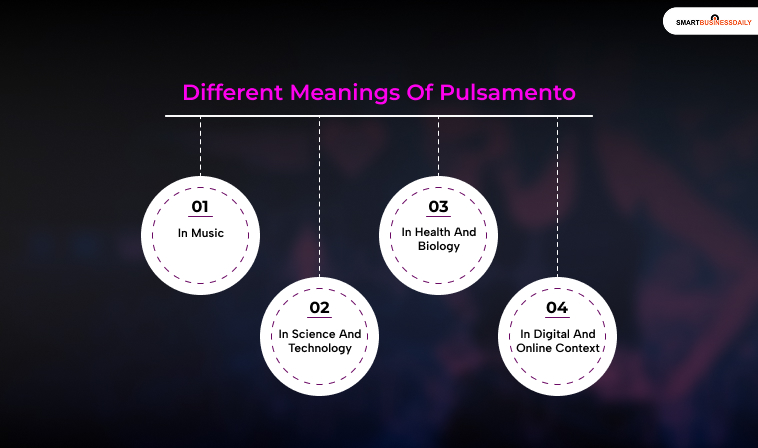
Do you know what makes the term Pulsamento so special? Firstly, it’s not popular. Yet it is specifically used in so many different fields. That’s its beauty.
To clarify, you can see it across different domains. Moreover, there are very specific user cases in every domain where you can use it.
In Music
Everything has a first appearance. For pulsamento, it is music. That’s why its use in music is so deeply rooted.
The most obvious mentions are in classic and flamenco guitar. When someone says “pulsmento,” they are referring to a specific guitar string-plucking technique. But what kind of sound does this pull generate?
In simpler words, it generates a warm and full tone. But people may ask, “How do you pull the pulsamento string?”
In simple words, you exert that much pressure, which makes your finger rest on the immediate next string. So there is a harmonic calculation behind it. In addition, it is certainly not how strumming works. Musicians must note that.
Kevin says he uses it when a track has the right feel. But he can’t point to exactly what’s making it work. “It’s got pulsamento,” he’ll say. Everyone in the room knows what he means.
In Science And Technology
Here it gets more technical. But it still makes sense. In signal processing and electronics, pulses are everything. Data moves through systems as timed bursts of energy.
The precision of those bursts determines whether information arrives clean or corrupted. The parameters that must be controlled here are their frequency, their rhythm, and their regularity.
Pulsamento, in this context, is really just a more expressive way of describing that rhythmic regularity. To specify, the radar systems work on it.
At the same time, the optical fibre networks depend on it. Even the Wi-Fi signal bouncing around your house right now is, at some level, pulsating.
In Health And Biology
That is where Pulsamento is used most profoundly. For instance, your heart beats roughly 100,000 times a day. That rhythm or that pulsamento is the most fundamental signal your body produces.
Doctors monitor it constantly. In the same vein, Irregular pulsation is one of the first signs that something is wrong.
The rise of wearable health tech has made all of this personal in a new way. My friend Dara started using a continuous glucose monitor last year for her pre-diabetes.
She told me that watching her glucose levels rise and fall in real time changed how she thought about her body entirely. She called it “learning my own rhythm.”
That’s pulsamento, even if she never used the word.
Heart rate variability (HRV) is a huge area of consumer health right now. Devices like Whoop and Oura track it obsessively.
All of it is built on the same idea. In simpler words, the rhythm of your body tells a story if you know how to read it.
In Digital And Online Context
This is where it gets a little different. Online, pulsamento has started appearing as a niche keyword and a potential brand term. Startups and content creators are drawn to it for obvious reasons. It sounds distinctive. Easy to say. Crosses language barriers naturally. And it implies energy, movement, life.
That’s genuinely valuable when you’re trying to name something that needs to feel dynamic. For instance, it can be a music app. Or a fitness platform.
Even a health monitoring tool. You can use the term anywhere. But it will always mean something significant.
Also Check: What’s In Wurduxalgoilds Product: Decoding Innovation Behind This Mysterious Blend
Why Pulsamento Is Gaining Attention?
I asked Kevin why he thought the word was spreading beyond music circles. He thought about it for a second and said, “Because everything is rhythm now.”
He’s not wrong. Think about how we talk about work using jargon like workflows, cycles, sprints, and cadence. Again, think about health. We use terms like sleep cycles, heart rate patterns, and circadian rhythms.
In the market, we do the same. I mean, we have all heard the terms like volatility, pulses of activity, and momentum. We’ve started seeing patterns everywhere. Pulsamento gives us a word for what we’re looking at.
Above all, I cannot ignore the branding angle of the term. As anyone trying to build an online presence knows, finding a word that isn’t already buried under ten years of competitor content is genuinely hard.
However, Pulsamento is distinctive. It has a genuine and versatile meaning. Meanwhile, it’s not made up. Plus, it has its roots. But what makes it distinct is that it’s not overused either. That’s a rare combination.
Potential Applications
This term and its concept can be applied in many areas. For instance, think of a music platform that makes the tracks feel better. Meanwhile, you can also consider a health coaching service that specializes in helping people understand their bodies’ daily rhythms. For instance, sleep, energy, and stress.
In the same vein, you can use pulsamento in connection with a creative agency. For instance, the agency puts rhythm and timing at the center of its brand strategy work.
Kevin is already thinking about using it as a name for a new production collective he’s putting together. To clarify, he wants something that communicates feel, not just function. That’s exactly what pulsamento does.
Is Pulsamento A Brand, A Tool, Or A Concept?
Honestly, it is all three, depending on who’s using it and why. As a concept, it’s real and has a genuine history in music and science.
At the same time, as a potential brand, it’s attractive in ways that most words aren’t. For example, it is memorable, meaningful, and also cross-cultural.
As a keyword, it occupies a niche that isn’t yet saturated, which makes it interesting for content strategy. The answer to “what is pulsamento” is really: it depends on the context you bring to it.
Final Verdict
Words that travel across disciplines are rare. To clarify, most language is domain-specific. In other words, it means one thing to one group and nothing to everyone else.
Pulsamento is different. A guitarist, a cardiologist, an electrical engineer, and a startup founder can all use it and be pointing at something real. Kevin put it better than I could. I asked him what he’d say to someone who’d never heard the word. He said, “Tell them it’s the difference between a heartbeat and proof that someone’s alive.” That’s pulsamento.
Additional Resource: Is Xevotellos Model Good For You Or Is It Just A Big Tech Bluff? Read The Entire Article To Know!




Related Articles



Comments Are Closed For This Article