








Different Marketing Approaches For Corporations and Startups: A Comprehensive Overview
5 Mins Read
Published on: 02 December 2022
Last Updated on: 03 September 2026

- Marketing Approaches for Corporations:
- 1. Maintain A Consistent Brand:
- 2. Build A Brand Around Customer Needs And Values:
- 3. Turn Expertise Into Useful Content:
- Marketing Approaches For Startups
- 1. Focus On The Right KPIs:
- 2. Establish Authority In A Focused Niche:
- 3. Build A Community Around The Product:
- 4. Experiment Before Scaling:
- Corporation vs. Startup Marketing: What's The Difference?
- Which Marketing Approach Should You Choose?
Corporations and startups operate under very different conditions.
A large corporation may have an established brand, a broad customer base, dedicated marketing teams, and substantial resources. But a startup might have a smaller team, a limited budget, and little brand recognition to build on.
These differences affect how each business approaches marketing.
A corporation can often focus on strengthening an existing brand, expanding into new markets, and retaining customers at scale.
In contrast, a startup may need to prioritize finding product-market fit, reaching a specific audience, testing acquisition channels, and generating awareness with limited resources.
Neither approach is inherently better.
TBH, the right strategy depends on the company’s size, resources, goals, and stage of growth. And that is precisely what we will examine today – to breakdown the different marketing approaches that corporations and startups use in their daily business operations.
Stay tuned.
Marketing Approaches for Corporations:
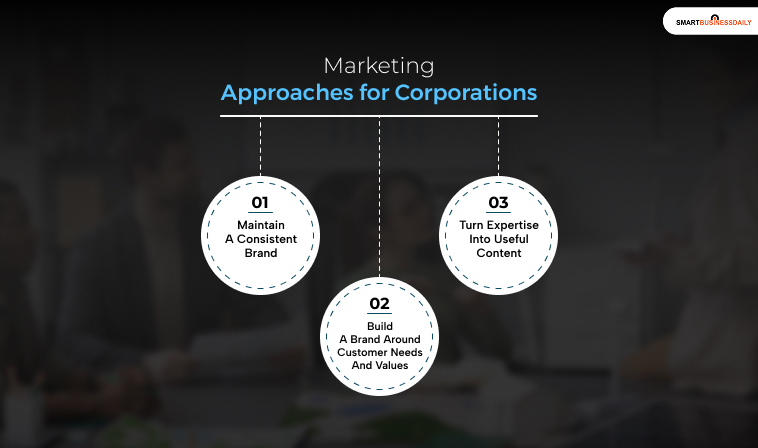
Large corporations typically have more established brands and larger marketing budgets. Their challenge is often maintaining consistency while adapting to changing customer expectations and market conditions.
1. Maintain A Consistent Brand:
Brand consistency becomes increasingly important as a company grows.
Large organizations may operate across multiple products, regions, departments, and marketing channels. Without clear brand guidelines, customers can receive very different messages depending on where they interact with the company.
Corporations should establish clear standards for their:
- Product communications
- Brand voice
- Visual identity
- Messaging
- Customer experience
- Advertising
- Social media presence
Consistency doesn’t mean every campaign has to look or sound identical. Instead, the core brand identity should remain recognizable while campaigns adapt to different audiences and platforms.
A consistent brand can make it easier for customers to recognize the company and understand what it represents.
2. Build A Brand Around Customer Needs And Values:
Large companies often have enough resources to compete on more than product features or price. They can build broader brand associations around the problems their products solve and the values their customers care about.
Lifestyle marketing can be part of this approach, but it should be based on a genuine understanding of the target audience.
Rather than trying to appeal to everyone, corporations can segment their audiences according to factors such as needs, preferences, behaviors, and purchasing patterns.
Also, the resulting campaigns can then connect the product with a broader customer need or aspiration without losing sight of the actual value being offered.
3. Turn Expertise Into Useful Content:
Corporations often have access to specialists, researchers, executives, customer data, and industry experience that can be turned into useful marketing content.
This creates opportunities for:
- Research reports
- Industry studies
- Expert commentary
- Educational guides
- Webinars
- Case studies
- Product resources
- Customer education
The goal shouldn’t be to produce content simply because the company has something to publish. Instead, your content should answer customer questions, demonstrate expertise, or help prospects make better decisions.
Large organizations can also create centralized knowledge resources, such as customer education centers and self-service content, to support customers throughout the buying journey.
Marketing Approaches For Startups
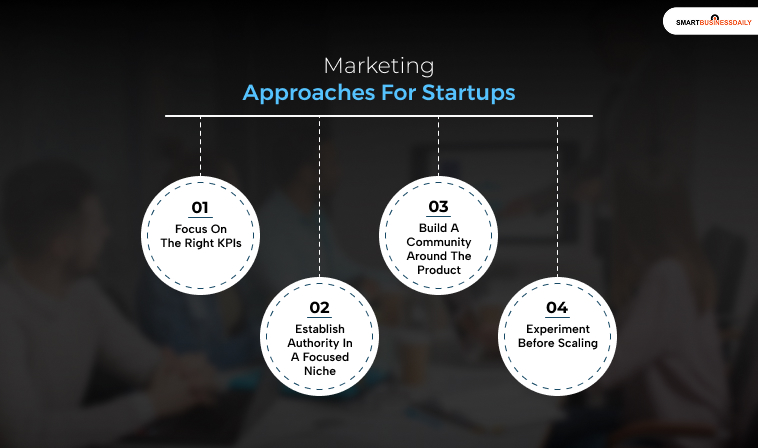
While developing corporate strategies requires setting well-defined goals for the marketing team to achieve, startups, especially those in their early stages, focus on inventing novel ideas. Therefore, their strategy includes setting and following KPIs, becoming an authority, and concentrating on the community.
1. Focus On The Right KPIs:
Startups can’t afford to measure everything.
The most useful marketing KPIs should connect directly to the company’s current business objective. A startup trying to validate product-market fit may care more about qualified signups, activation, retention, and customer feedback than raw website traffic.
Other useful metrics can include:
- Cost per acquisition
- Conversion rate
- Customer acquisition cost
- Customer lifetime value
- Qualified leads
- Retention rate
- Revenue from marketing channels

The right metrics will change as the company grows. A startup should regularly review its KPIs and stop investing heavily in channels that aren’t producing meaningful results.
2. Establish Authority In A Focused Niche:
A startup rarely has the resources to compete with established companies across an entire industry. A more practical approach is to identify a specific audience and become highly relevant to its needs.
For example, instead of creating generic content for every small-business owner, a startup could focus on a specific group and develop content around its most important problems.
This focused approach can help a startup build credibility while making its marketing more relevant.
Startups can also demonstrate expertise through:
- Original research
- Expert-led content
- Case studies
- Industry publications
- Podcasts
- Partnerships
- Social media
- Educational resources
3. Build A Community Around The Product:
Startups can use community-building to create stronger relationships with early customers and potential users.
The community doesn’t have to be a formal forum. Instead, it could develop through a newsletter, social media group, events, webinars, user groups, or regular conversations with customers.
The important part is creating opportunities for people to share experiences, ask questions, provide feedback, and interact with the brand.
This can also give startups valuable information about what customers actually need. Those insights can influence product development as well as marketing.
4. Experiment Before Scaling:
One advantage startups often have is the ability to move quickly. Instead of committing a large budget to one marketing channel, a startup can test several approaches with smaller investments.
For example, a company might experiment with:
- Search engine optimization
- Paid search
- Social media
- Email marketing
- Partnerships
- Referral programs
- Influencer campaigns
- Industry communities
The goal is not to be everywhere. Instead, it is to identify which channels consistently reach the right audience and produce valuable customers.
Once a channel proves effective, the startup can invest more resources into it.
Corporation vs. Startup Marketing: What’s The Difference?
The biggest difference isn’t that corporations should use one set of marketing tactics while startups use another. Many of the same channels can work for both.
The difference is usually how those channels are used and what the business needs from them.
| Marketing Consideration | Corporation | Startup |
| Primary Challenge | Maintaining and expanding market position | Building awareness and finding customers |
| Brand | Established | Still developing |
| Audience | Often broad and segmented | Often narrower and more focused |
| Budget | Usually larger | Usually more limited |
| Marketing Approach | Structured and scalable | Experimental and agile |
| Content | Broad authority and customer education | Focused expertise and problem-solving |
| Measurement | Multiple business and marketing KPIs | Strong focus on efficient growth and learning |
| Community | Often supports an existing customer base | Can help build an early customer base |
| Decision-making | May involve multiple teams | Often faster and more centralized |
These aren’t strict rules. A corporation may use startup-style experimentation, while a growing startup may eventually need more structured processes.
Which Marketing Approach Should You Choose?
The best marketing strategy depends less on whether your company is technically a corporation or startup and more on its current situation.
A corporation with a strong brand may benefit from investing in customer retention, brand expansion, content authority, and market segmentation.
A startup may get better results by narrowing its audience, testing acquisition channels, building credibility, and measuring which activities produce real customers.
Both businesses should remain willing to adapt. Market conditions, customer behavior, and available channels change over time.
The most effective approach is therefore not to copy the marketing strategy of another company. Instead, build a strategy around your resources, audience, competitive position, and current stage of growth.
Additional:




Related Articles



Comments Are Closed For This Article