








A Good E-Commerce Marketing Strategy Is Possible, What What Are The Ways To Build One? Read This Guide And Find Out!
8 Mins Read
Published on: 03 February 2026
Last Updated on: 04 May 2026
- What Is Ecommerce Marketing?
- What Are The Important Factors For A Good E Commerce Marketing Strategy?
- 1. Set Clear Goals And Measurements
- 2. Use Your Budget Wisely
- 3. Identify Your Target Audience
- 4. Conduct A Thorough Market Research
- Competitive Inspection:
- Customer Surveys:
- Industry Trends:
- Swot Analysis:
- 5. Choose The Right Marketing Channels
- 6. Analyze Data For Insights
- 7. Review, Adjust, And Optimize
- 8. Experiment With A/B Testing
- Landing Pages:
- Product Descriptions:
- Pricing And Promotions:
- Digital Ads:
- Product Visuals:
- What Are The Common Challenges That Delays A Good E Commerce Marketing Strategy?
- Disorganized Data
- Low Conversion Rates
- One-Time Buyers
- What Are The Future Additions In E Commerce Marketing Strategy?
- Ai-Powered Personalization:
- Voice Search Optimization:
- Social Commerce:
- Sustainability Initiatives:
- Subscription-Based Models:
- Chatbots And Conversational Commerce:
- What Makes A Good E Commerce Marketing Strategy? Now You Know!!!
A long time ago, I just had a website for my business. And guess what? It was enough to get customers.
Now, we have over 1.2 billion websites online. I suggest that now, you need more than a nice homepage to stand out.
The E-commerce marketing strategy is key. It’s the way to bring in visitors. Then, you can turn them into buyers. After this, they just keep them coming back.
The digital marketplace is crowded. But it also offers chances for brands that know how to reach the right audience effectively.
Investments show this trend. In 2025, global spending on advertising and marketing is expected to hit $1.87 trillion.
In 2024, U.S. ecommerce stores will spend $3.5 billion on ads alone.
However, successful e-commerce marketing isn’t just about spending money on ads.
It’s about creating a complete strategy. This strategy should combine SEO, content creation, email, social media, and data insights to build strong customer relationships.
What Is Ecommerce Marketing?

E-commerce marketing includes all efforts to promote your online store. This ranges from SEO and ads to email campaigns and social media posts. At its core, it answers three questions:
- Firstly, you must ask, how do you attract the right visitors?
- Secondly, you must be concerned about how to turn them into buyers.
- Finally, ask yourself, how do you encourage them to return?
The advantages are clear. A good e commerce marketing strategy will lower costs to
- Acquire Customers
- Increases Average Spend
- Boosts Customer Lifetime Value
As tools improve, the field keeps changing. For example, we have instant SMS offers now.
To succeed, you must mix established marketing methods with new ideas, always focusing on the customer experience.
What Are The Important Factors For A Good E Commerce Marketing Strategy?
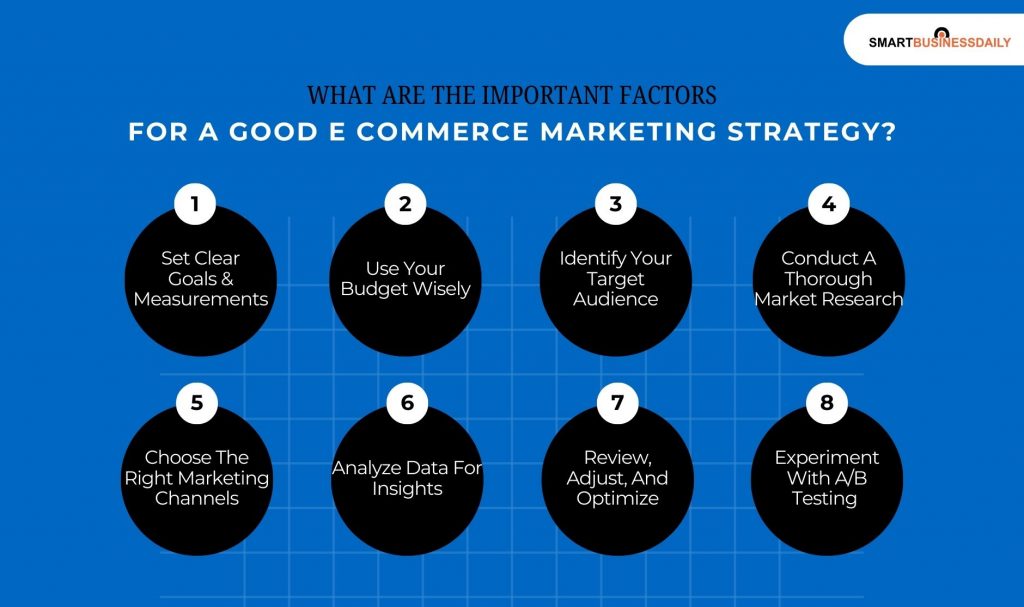
A clear plan connects every action to your online business goals. Follow this simple framework to create one that grows with you.
1. Set Clear Goals And Measurements
You have to start by deciding what success means for you. Do you want to boost sales? Or, do you want to reach more people?
Or maybe launch a new product?
I always aim to have clear goals. I believe these guide your marketing choices.
2. Use Your Budget Wisely
In addition to the former point, you must decide how much to spend based on your sales.
Additionally, you also have to fix a budget for the growth stage and goals. New brands usually spend 1220% of revenue.
On the other hand, the established brands focus on organic growth. In fact, they also prioritize customer retention.
Break it down:
- 40% for awareness
- 30% for consideration
- 20% for conversion
- 10% for testing
Include costs for tools, ads, and content creation. BigCommerce users can adjust their budget during a campaign, like moving money from low-performing Facebook ads to Google Shopping.
3. Identify Your Target Audience
Not every online shopper is your customer, and that’s fine. The key is to know exactly who you want to reach and what makes them buy.
Start by looking at your current customer data. Identify patterns among your existing buyers, like:
- Age
- Location
- Online Shopping Habits
- Favorite Products
Create buyer personas to represent your ideal customers and their buying journeys.
Now, there’s a question I want you to ask yourself: Why do they choose you instead of others? What problems are they solving?
Additionally, you need to use insights from your website. Also, refer to your CRM and social media to complete the picture.
In fact, you need to have an understanding of your audience. It makes your marketing more personal and effective.
4. Conduct A Thorough Market Research
Look beyond your store’s data to understand your industry and competitors. Gather insights from:
Competitive Inspection:
What keywords or channels are they winning in?
Customer Surveys:
What do shoppers value most? Price, speed, quality, or shared values?
Industry Trends:
What platforms are growing, and what are customers expecting?
Swot Analysis:
Identify strengths, weaknesses, opportunities, and threats.
5. Choose The Right Marketing Channels
You just want to know where your customers are. So, you need to focus on channels that suit your audience and product.
If your brand is visually appealing, you might do well on Instagram or Pinterest.
Others may succeed with content marketing or email. Take THE UPSIDE, an activewear brand that uses BigCommerce.
They personalize every customer interaction with tools like Klaviyo and Searchspring.
They are using real-time data for product recommendations and emails.
On social media, they engage shoppers through Facebook and Instagram Shopping. So, this allows browsing and buying without leaving the app.
The key takeaway? Select channels that match your customers’ habits, making every interaction smooth from scrolling to checkout.
6. Analyze Data For Insights
Data tells you how well your e-commerce marketing is performing. Tracking the right metrics helps you:
- See What Works
- Identify New Trends
- Make Better Decisions
Focus on key performance indicators (KPIs) like:
- Conversion Rate
- Revenue
- Customer Acquisition Cost (Cac)
- Average Order Value (Aov)
Additionally, I suggest that you gather data from your e-commerce platform and website analytics.
Also, you can refer to the CRM, email, or ad tools to get a complete view.
For example, UK apparel brand White Stuff tracked mobile load times and conversion rates during its BigCommerce site launch.
So, this data showed that their new setup was 100% faster on mobile. Additionally, this setup increased conversions by 37%.
When you measure the right things, you can link data directly to business growth.
7. Review, Adjust, And Optimize
Keep an eye on your KPIs. Also, be ready to change your strategy if something isn’t working.
Additionally, if a product launch isn’t successful or a campaign doesn’t perform well, adjust quickly.
Focus on core KPIs like:
- Conversion rate (CR)
- Customer acquisition cost (CAC)
- Average order value (AOV)
- Customer lifetime value (CLV)
But remember, numbers are just part of the picture. Pay attention to your customers through reviews, social media, and feedback.
Analyze your website’s conversion funnel to identify drop-offs and recurring issues.
Act on this information. By combining data with customer insights, you can keep your marketing plan flexible and your customers satisfied.
8. Experiment With A/B Testing
A/B testing helps you make data-driven decisions. By comparing two versions of a webpage, email, or ad, you can find out which one works better.
Track success using metrics like conversion rates, clicks, or revenue per visitor.
Here are common areas for testing:
Landing Pages:
Change images, product descriptions, calls to action (CTAs), and layouts to see which drives more conversions. Remember to optimize for mobile devices.
Product Descriptions:
Test headlines, copy, and messaging to highlight benefits that matter to customers.
Pricing And Promotions:
Experiment with discounts, bundles, or tiered pricing to maximize revenue.
Digital Ads:
Try different ad creatives, copy, headlines, and formats on platforms like Google and Facebook.
Product Visuals:
Test different angles, zoom options, and lifestyle images to boost clicks and sales.
As an example, Brondell used BigCommerce’sbuilt-inn tools and selective integrations to improve ite-commercece site while A/B testing.
They added an AI-powered red tool to enhance onsite search, leading to a
- 173% increase in search revenue
- 94% boost in search conversion rate
- 63% rise in revenue per visitor
By combining native tools with smart integrations, Brondell improved both backend efficiency and the customer experience.
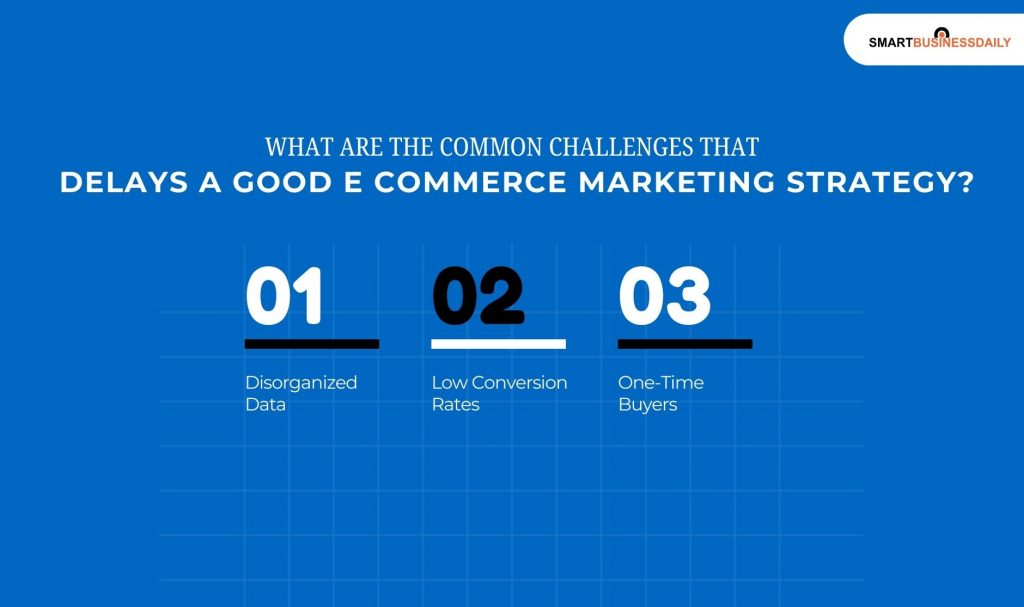
What Are The Common Challenges That Delays A Good E Commerce Marketing Strategy?
In today’s world, convenience is key, and customers have high expectations. E-commerce shoppers want a personalized experience that goes beyond what they expect in regular stores.
With so many options available, online businesses face tough competition.
So, what can online marketers do? Here are some ways to tackle common e-commerce challenges:
Disorganized Data
Marketers have access to lots of data, but it can be overwhelming. Using various tools can lead to data being separated and difficult to manage.
To succeed, marketing teams need a single solution that combines all customer data and technology.
This unified approach gives a complete view of customer information and allows marketers to focus on strategy and creativity.
Low Conversion Rates
Many online shoppers browse without buying, which is like window shopping in stores.
Here, I want to say something I see often. E-Commerce companies often spend a lot on attracting visitors to their websites.
But they sometimes overlook the goal. They are also supposed to convert visitors into buyers.
The average conversion rate for e-commerce sites is only 2.86%. So, this shows there is room for improvement.
Also, I would suggest that you focus on personalizing the shopping experience. This will boost sales.
Additionally, you can also run campaigns across different channels. In fact, you must also start providing incentives.
One-Time Buyers
It costs five times more to get a new customer than to keep an existing one. Therefore, one-time buyers can lead to lost profits.
E-commerce marketers should work on transforming first-time buyers into loyal repeat customers.
To improve retention, marketers can run campaigns to win back customers who left without purchasing.
Additionally, they can also offer loyalty programs with rewards for repeat purchases.
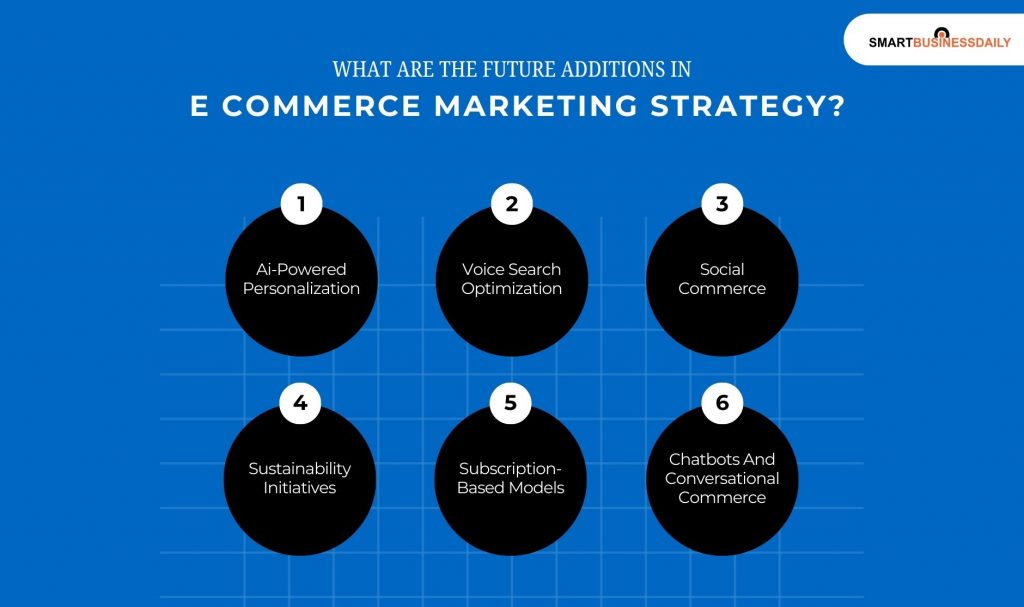
What Are The Future Additions In E Commerce Marketing Strategy?
E-commerce marketing is changing quickly with new technologies and strategies. Here are some important trends to watch:
Ai-Powered Personalization:
I think many businesses will start using tools that provide this feature. I have used AI a few times for my business.
And with that, I have created highly personalized shopping experiences.
Now, here, I am including tailored product recommendations. Additionally, I am also referring to pricing that changes based on customer behavior.
Voice Search Optimization:
In recent times, I hope you can see the surge in voice assistants like Alexa and Google Assistant.
They are becoming insanely popular. So, I think it’s important for online stores to make sure they work well with voice searches.
This way, you will be able to attract more customers.
Social Commerce:
Social media platforms like Instagram and TikTok now allow people to shop directly through their apps.
So, this turns them into important sales channels.
Sustainability Initiatives:
Many brands are focusing on eco-friendly practices in their marketing. I think it’s an amazing move!
This way, they will meet the growing demand for sustainable products and packaging.
Subscription-Based Models:
More online businesses are offering subscription services. These provide convenience and ongoing value.
Additionally, it improves customer satisfaction and loyalty.
Chatbots And Conversational Commerce:
Automated chatbots now offer 24/7 customer support. They help users navigate shopping and provide personalized assistance.
Watch for these trends and the new technologies that support them to stay ahead of what customers expect.
What Makes A Good E Commerce Marketing Strategy? Now You Know!!!
Well, I have given you all the necessary information that you need for a good marketing strategy.
Now, before I leave, I want to say something from my personal experience. I would always advise you to remember that these are just metrics.
Yes, if you meticulously follow these, you have a good chance of getting it right. But I also want you to be creative with it.
As strategists or planners, we cannot let mere rules and guidelines run our businesses solely.
We have used them like weapons, where the real warrior is your observation and creating the outcome.
Keep planning!




Related Articles



Comments Are Closed For This Article